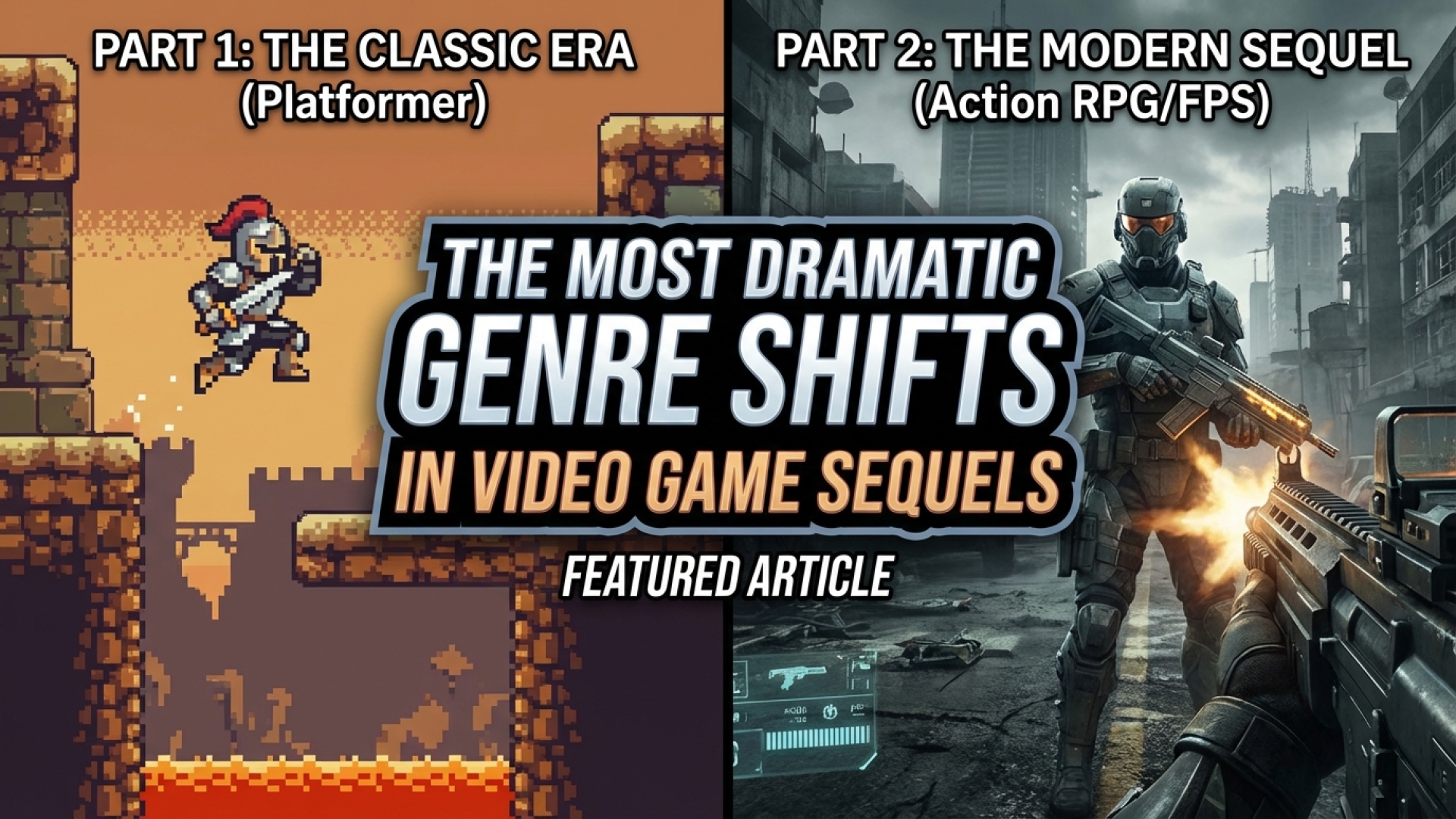
In the fast-paced world of digital innovation, game spin-offs often jump genres to test new waters. However, it is far more rare—and far more daring—for a direct sequel to completely reinvent its core mechanics. At
Digital Tech Explorer, we are fascinated by these pivots in software evolution. Whether driven by hardware limitations or a desire to stay ahead of industry trends, these shifts represent the boldest risks in development history.
As your resident storyteller,
TechTalesLeo, I’ve delved into the archives to find the most dramatic genre shifts in
gaming history. These titles didn’t just iterate; they transformed, proving that sometimes you have to break the mold to build a legend.
Fallout 3: From Isometric to Immersive
When Bethesda acquired the rights to the Fallout franchise, they didn’t just update the graphics; they changed the perspective of the wasteland entirely. Moving from Interplay’s top-down, isometric turn-based roots into a first-person action RPG was a massive technical gamble. While some purists still debate the shift, it’s undeniable that this move propelled the series into the mainstream, making it a staple of modern
PC games.
Helldivers 2: The Third-Person Evolution
The original Helldivers was a masterclass in twin-stick shooter design, viewed from a MOBA-style top-down perspective. Fast forward to the sequel, and Arrowhead Game Studios pivoted to a chaotic, cinematic third-person shooter. It’s a perfect example of how changing the camera angle can completely redefine the scale and intensity of a digital experience without losing the soul of the original IP.
Police Quest & SWAT: A Systematic Shift
The evolution here is fascinating from a software design standpoint. Beginning in the ’80s as point-and-click adventure games focused on police procedure, the series eventually morphed into
Police Quest: SWAT 2—an isometric tactical game—before finally settling into the iconic
SWAT first-person shooters. This journey mirrors the rapid advancements in
hardware during that era, where 2D limitations gave way to 3D tactical possibilities.
Duke Nukem 3D: Abandoning the Platform
Many fans forget that Duke Nukem began his career as a 2D platformer hero. If Apogee hadn’t pivoted to the first-person perspective, Duke might have been lost to history like so many other ’90s mascots. The shift to a 3D FPS was so transformative that the original two platforming games are now mere footnotes. Today,
Duke 3D remains a hallmark of level design, showing that a complete genre overhaul can lead to a lasting legacy.
Yakuza: Like A Dragon – Changing the Combat Logic
After six mainline entries defined by real-time street brawling, Ryu Ga Gotoku Studio took a massive risk by turning
Yakuza: Like A Dragon into a turn-based RPG. By introducing a protagonist obsessed with Dragon Quest, the developers cleverly justified the genre shift through narrative storytelling. It turned out that executing perfect guards and strategic moves was just as satisfying as the old-school fisticuffs.
Syndicate: The Cyberpunk Transformation
The original
Syndicate (1993) was a brutal real-time strategy (RTS) game where players managed squads of augmented agents. When the series returned in 2012 via Starbreeze, it was reborn as a high-octane FPS. While the shift was polarizing and the sales didn’t meet corporate expectations, the 2012 version remains a cult classic for its smooth shooting mechanics and innovative “breaching” gameplay.
Half-Life: Alyx – The Hardware Pivot
While still technically a shooter,
Half-Life: Alyx represents a pivot in accessibility and delivery. Valve decided to take one of the most anticipated sequels in history and lock it behind a VR requirement. This move wasn’t just about gameplay; it was about pushing the boundaries of
hardware and defining what high-fidelity VR could actually achieve.
Red Dead Redemption: From Arcade to Open World
Red Dead didn’t start with the sweeping vistas of the American West we know today.
Red Dead Revolver (2004) was a level-based, arcade-style shoot ’em up with a campy tone. When Rockstar took over for the sequel,
Red Dead Redemption, they pivoted to a grounded, serious open-world epic. The shift was so successful that
Revolver is now considered the “black sheep” of a prestige franchise.
Dune 2: Defining a New Genre
In one of the most significant pivots in tech history,
Dune 2 served as a sequel to a point-and-click adventure game. Westwood Studios shifted the focus to unit control and base building, essentially creating the blueprint for the entire RTS genre. Without this “happy accident” in development, the landscape of PC gaming—and titles like
Warcraft—would look vastly different today.
Grand Theft Auto 3: The 3D Revolution
No list of genre shifts is complete without
Grand Theft Auto 3. Moving from the top-down perspective of the first two games into a fully realized 3D open world wasn’t just a sequel update—it was a paradigm shift for the entire software industry. It set the standard for modern
4K resolution gaming environments we enjoy today.
To summarize these massive shifts, here is a quick look at how these iconic series evolved:
| Game Series |
Original Genre |
Sequel Genre Shift |
| Fallout |
Isometric RPG |
First-Person Action RPG |
| Helldivers |
Twin-Stick Shooter |
Third-Person Shooter |
| Duke Nukem |
2D Platformer |
First-Person Shooter |
| Yakuza |
Beat ’em Up / Brawler |
Turn-Based RPG |
| Dune |
Adventure/Strategy |
Real-Time Strategy (RTS) |
| GTA |
Top-Down Action |
3D Open World |
At
Digital Tech Explorer, we believe these pivots show that innovation often requires leaving the past behind. Whether it’s a leap in
AI or a shift in camera perspective, these bold moves are what keep the tech world moving forward.
For more deep dives into software trends and hardware analysis, stay tuned to TechTalesLeo.