
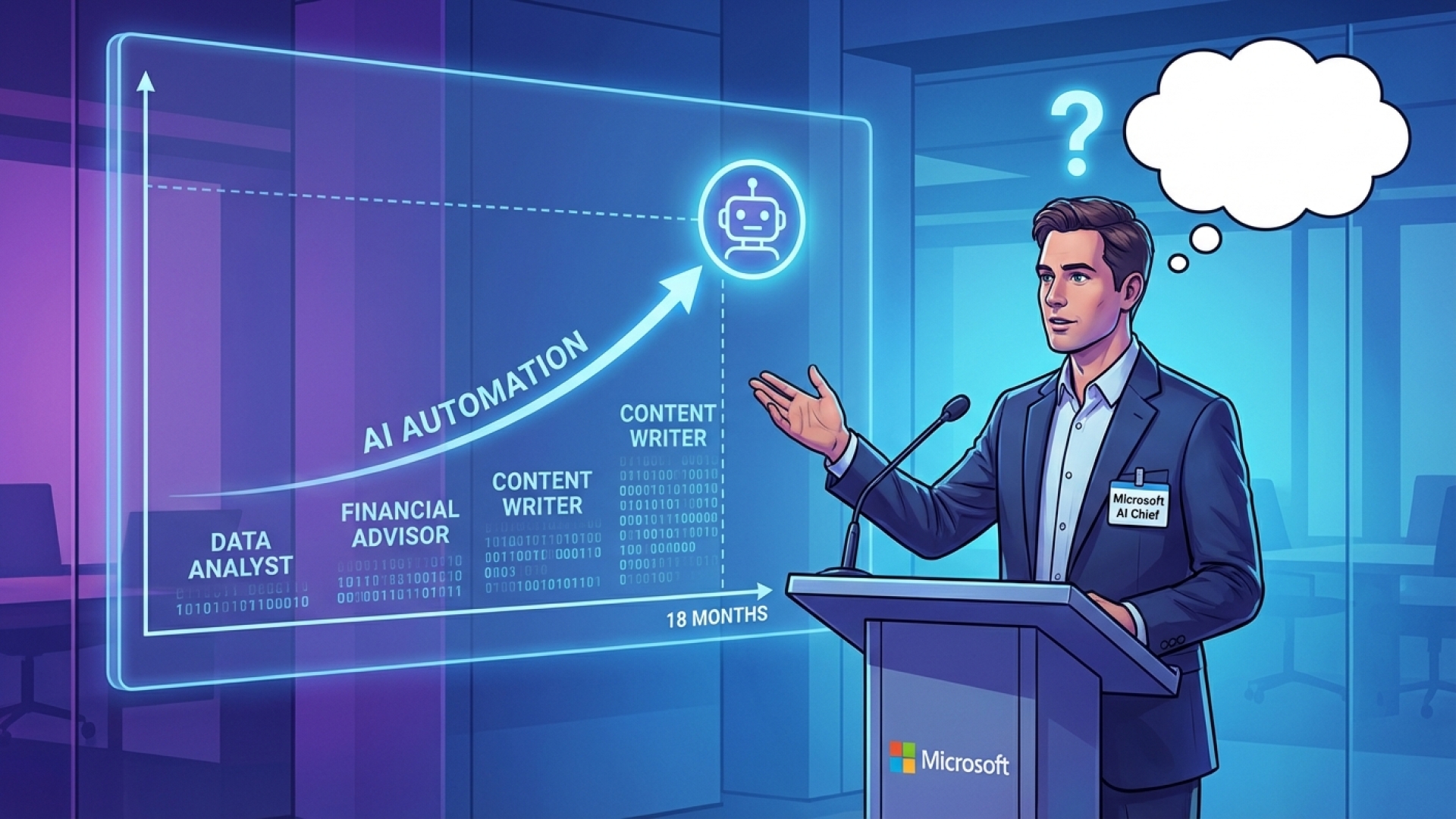
It seems like only yesterday we were discussing the theoretical limits of Artificial Intelligence. Now, Microsoft AI CEO Mustafa Suleyman has delivered a striking prediction that has the professional world buzzing. In a recent interview with the Financial Times, Suleyman stated that AI will achieve “human-level performance on most, if not all, professional tasks” within the next 12 to 18 months.
The Bold Prediction: AI and White-Collar Automation
For those of us at Digital Tech Explorer following the rapid evolution of AI and machine learning, Suleyman’s timeline is aggressive. He suggests a significant shift for white-collar roles, particularly those centered around computer-based workflows. He explicitly identified professions such as lawyers, accountants, project managers, and marketing specialists as roles where the majority of tasks could be fully automated within this short window.
This prediction points toward a profound transformation in how we view “professional” work. If AI can indeed replicate the output of a seasoned project manager or a legal researcher in less than two years, the economic and structural landscape of the corporate world will undergo a seismic shift.
A Curious Omission in the Automation List
As a storyteller in the tech space, I find the gaps in these narratives often as interesting as the claims themselves. While Suleyman’s list of automatable roles is extensive, one title was conspicuously absent: “Microsoft AI CEO.”
One might wonder if leadership roles—which often involve high-level strategy, attending meetings, and making market-moving predictions—are also on the chopping block. It raises an essential question for tech enthusiasts and professionals alike: Is any role truly “safe,” or is the perceived vulnerability of a job simply a matter of perspective?
The Reality Gap: AI Aptitude vs. Professional Complexity
Suleyman cited recent AI acceleration in software engineering as evidence for his claims. However, there is a growing sentiment among developers and specialists that designing a tool for programmers is not the same as replacing a lawyer. The nuance, ethics, and specialized knowledge required in highly regulated fields are often underestimated by those focused solely on the technical script.
The following table illustrates the current tension between AI automation and the “human element” in the professions Suleyman mentioned:
| Profession | Automated Task (AI Strength) | The Human Moat (Current AI Gap) |
|---|---|---|
| Lawyer | Case law research and document discovery. | Courtroom advocacy and ethical counseling. |
| Accountant | Data entry and tax calculation. | Strategic financial planning and nuanced auditing. |
| Project Manager | Scheduling and status reporting. | Conflict resolution and team motivation. |
| Software Engineer | Code generation and boilerplate. | System architecture and creative problem solving. |
Navigating the Future with Digital Tech Explorer
While it is easy to predict the automation of roles one is unfamiliar with, a deeper look at specific tasks reveals complexities that current AI systems still struggle to replicate. Critical thinking, emotional intelligence, and intricate problem-solving remain significant barriers to full replacement.
As we navigate these 2024 tech trends, the blanket assertion that most professional tasks will be handled by AI by 2025 invites healthy skepticism. While hardware and GPU advancements continue to push the boundaries of what is possible, the value of human expertise remains the cornerstone of innovation.
About the Publisher: Digital Tech Explorer is your trusted source for the latest in technology, software, and coding. Founded by a seasoned software engineer, we focus on transparency, thorough research, and real-world testing to help developers and tech enthusiasts stay ahead of trends.
Disclaimer: All content on Digital Tech Explorer is for informational and entertainment purposes only. We do not provide financial or legal advice. Some of the links on Digital Tech Explorer are affiliate links; we may earn a commission if you click through and make a purchase, at no additional cost to you.