

Dave Plummer, the legendary software engineer behind iconic Windows utilities like the original Task Manager and Space Cadet Pinball, has recently unveiled a striking vision for a modern management interface. However, this isn’t a sneak peek at a future Windows update; it is the vibrant, neon-soaked dashboard for his latest venture: the Tempest AI project.
In a characteristic blend of humor and humility, Plummer shared the creation on social media, noting that the design reflects what Task Manager might look like if he were still steering the ship at Microsoft. “This is probably what Task Manager would look like (and sound like) if I were still around. Which is why it’s a good thing I knew to stay in my lane, design-wise,” he remarked. You can view the initial reveal and the community’s enthusiastic reaction on his X feed.
A Deep Dive into the Tempest AI Dashboard
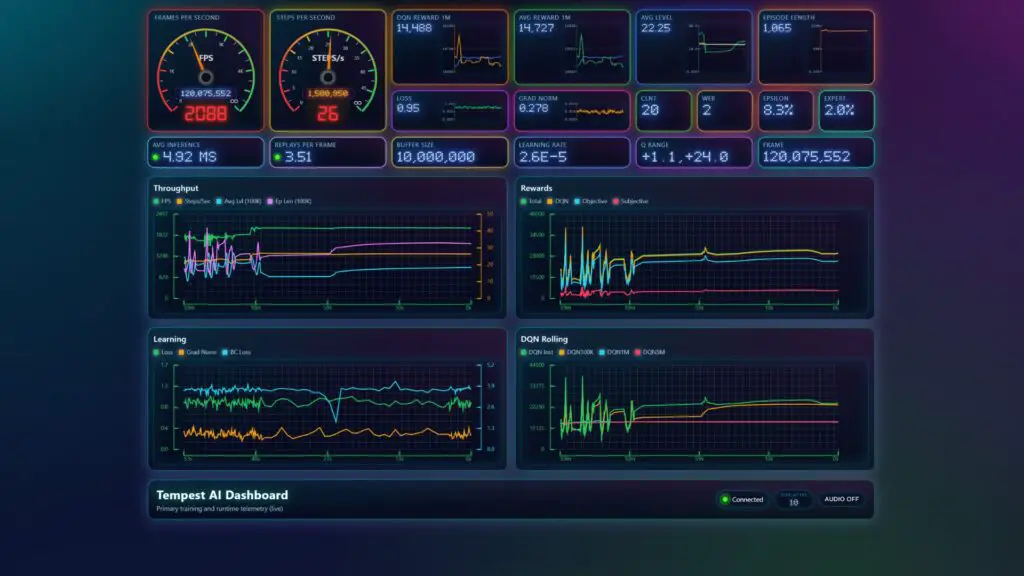
The dashboard for Plummer’s Tempest AI is a far cry from the utilitarian grey boxes we are used to in standard operating systems. It features a chaotic yet mesmerizing blend of real-time graphs and two prominent speedometer-style gauges, all wrapped in a Cyberpunk-inspired visual wrapper. This sensory experience is heightened by an optional, high-energy synthwave and glitch-track soundtrack that pulses alongside the data.
While Plummer acknowledges this “over the top” design would likely overwhelm a standard office user, it serves as a perfect window into the complex computations occurring under the hood of his AI-driven experiments. For those brave enough to experience the sensory overload firsthand, a live web version of the Tempest AI Dashboard is available, complete with a toggle to mute the music for a more focused analysis.
Decoding the Tempest AI Project
At the center of this flashy interface is a serious pursuit of machine learning. The Tempest AI is designed to master the 1981 Atari classic, Tempest. This was a groundbreaking title in the gaming industry, being one of the first to utilize QuadraScan vector technology to simulate 3d movement. Its unique perspective and relentless pace make it a notoriously difficult game for both humans and algorithms to conquer.
Plummer explained his fascination with the title, stating, “Tempest is a beast to master with fast-paced action and complex patterns. Its spinning 3D playfield and relentless enemies make every second a test of skill and reflexes.” Having been personally “hooked” on the game for over four decades, Plummer’s project bridges the gap between retro nostalgia and modern hardware capabilities. You can explore his full breakdown of the project in this detailed video.
The Challenge of Retro AI Mastery
Plummer’s connection to the game is more than just academic; he is a world-record holder in Tempest. This personal mastery allows him to understand the nuances required for the AI to succeed. He notes that most humans struggle with the game’s depth, making it the perfect stress test for an AI. By training a model to navigate the 3D-vector space of an 80s arcade cabinet, Plummer is showcasing how far gaming logic and artificial intelligence have evolved.
At Digital Tech Explorer, we appreciate this blend of legacy software expertise and future-facing innovation. While we might not want our system GPU monitors to blast synthwave every time we open a file, Plummer’s dashboard is a brilliant reminder that tech can be both powerful and playful. It is a fitting tribute to a classic era of gaming, reimagined through the lens of modern digital innovation.
For more stories on digital innovation and the stories behind your favorite software, follow TechTalesLeo and stay tuned to Digital Tech Explorer.