
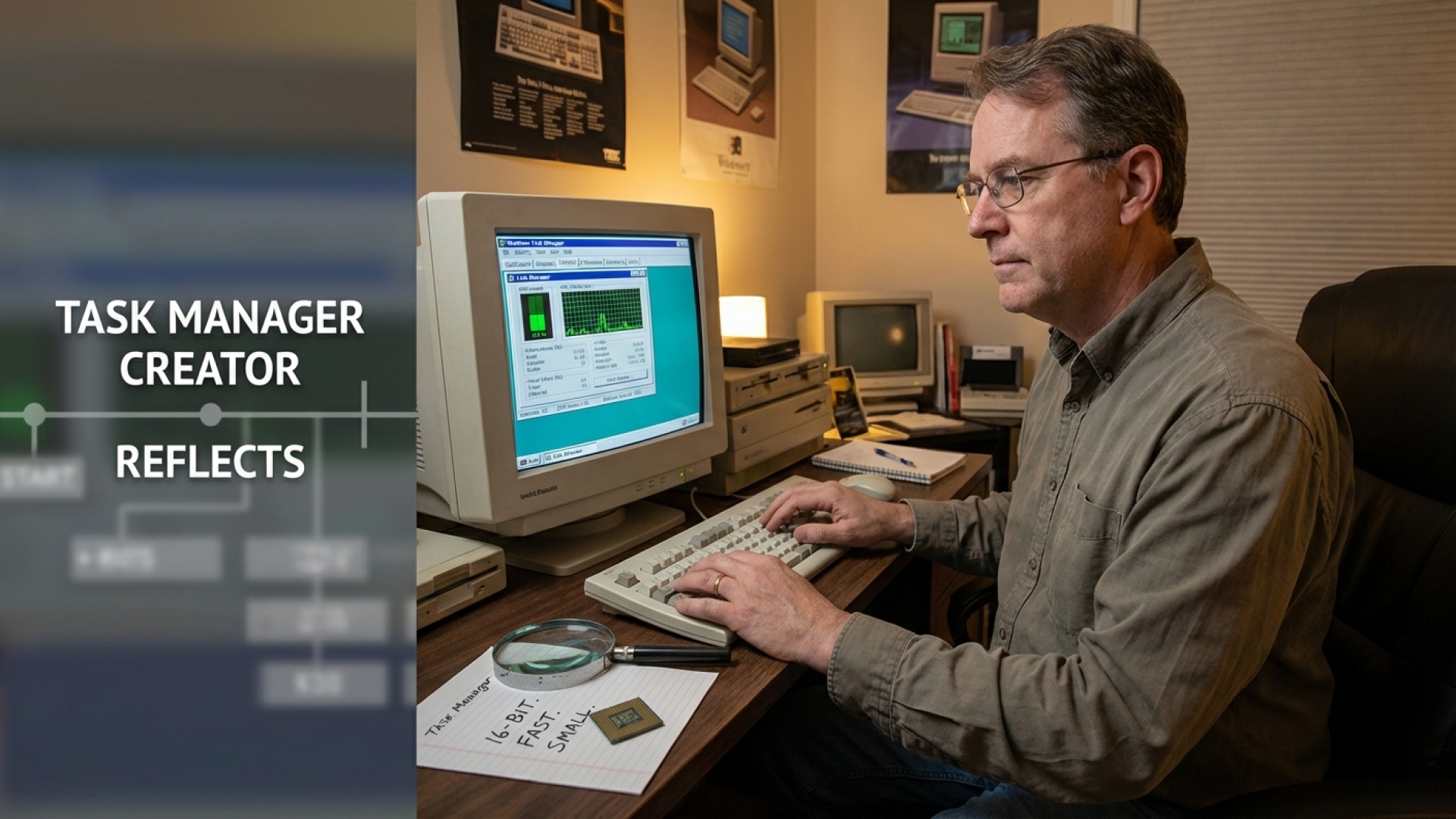
In the world of software engineering, there are few utilities as iconic—and as vital—as the Windows Task Manager. Most users only summon it when their system is buckling under pressure, but for the software’s creator, Dave Plummer, the utility was designed with a philosophy of lean, mean efficiency that seems almost alien in today’s world of multi-gigabyte applications. In a recent deep dive on his YouTube channel, the former Microsoft engineer shared the fascinating story of why the original version was 50 times smaller than its modern counterpart.
At Digital Tech Explorer, we often explore the intersection of legacy coding and modern digital innovation. Plummer’s insights offer a masterclass in how hardware constraints once forced developers to write some of the most resilient code in history. When he first penned Task Manager, the entire program came in at under 80 kB—a footprint so small it could launch instantly even when a CPU was pegged at 100%.
The Genesis of a Lightweight Utility
Plummer’s obsession with speed didn’t happen by accident. His formative years were spent coding for the Commodore 64, a machine with a 1 MHz processor where every byte was precious. “Once you spend your formative years on a machine where every instruction has to justify its existence like it’s applying for a loan, you never fully recover from that,” Plummer explains. “Every line has a cost. Every allocation leaves footprints.”
This rigorous mindset was the foundation of the original hardware interactions within Windows. Task Manager wasn’t just a program; it was a lifeboat. It had to be “insanely fast” because its primary job was to rescue a dying system. If the rescue tool itself was bloated, it would simply contribute to the crash.
Evolution: From 80 kB to 4 Megabytes
Today, Task Manager has grown to approximately 4 megabytes. While that is still tiny by modern gaming or software standards, it represents a 5,000% increase in size. To help visualize this evolution, let’s look at the technical shifts between the eras:
| Feature/Metric | Original Task Manager | Modern Task Manager |
|---|---|---|
| Approximate Size | ~80 kB | ~4 MB |
| Design Priority | Absolute Minimum Footprint | Feature Richness & Accessibility |
| Coding Style | Bespoke Runtime Startup | Standard Frameworks/Dependencies |
| User Interface | Basic GDI Drawing | Rich Data Visualizations & Dark Mode |
Plummer is quick to defend modern engineers, noting that today’s environment is vastly more complex. “I’m not here to say that modern engineers are just dumb because they’re not,” he states. However, he highlights a shift in “the instinct for refusal.” While old code asked if a feature was worth the cost, modern software often asks if the hardware can simply handle it.
A Bespoke Approach to Stability
One of the most unique technical aspects of the original Task Manager was how it bypassed standard procedures. Plummer reflects on how he replaced the standard runtime startup code with a bespoke version just to avoid the “baggage” of standard software operations. This allowed the tool to communicate with other instances of itself and force-close unresponsive processes without needing to rely on the very system components that might be failing.
He characterizes this level of optimization as the work of a young, ambitious developer. “It’s the sort of thing you do when you’re young enough to think that manually replacing the runtime startup code is a reasonable afternoon activity,” he jokes. Yet, it is this “strutting” confidence that created a utility so stable it has remained a core part of the OS for three decades.
Legacy and the Future of Windows
Since leaving Microsoft in 2003, Plummer has remained a vocal figure in the tech community, sharing stories about coding Space Cadet Pinball and providing critiques on the current state of AI and OS development. Earlier this year, he even showcased a “synthwave” inspired AI dashboard, hinting at what a modern Task Manager might look like if he were still at the helm.
At Digital Tech Explorer, we believe Plummer’s story is a reminder that while hardware continues to scale, the principles of efficient coding and digital storytelling remain timeless. Whether you are building a simple script or a complex blockchain application, there is always something to be learned from a developer who treated every byte like a precious resource.
“Task Manager officially turns 30 years old today! Press CTRL-SHIFT-ESC and say Happy Birthday!” — Dave Plummer
For more deep dives into software history and the latest in 2024 releases, stay tuned to Digital Tech Explorer.