
Motorola’s Bold Experiments: The Ingestible Password Pill and Authentication Tattoos
In the rapidly evolving landscape of digital innovation, some ideas are so ahead of their time they border on science fiction. During the brief period between 2012 and 2014 when Motorola Mobility was under the stewardship of Google, the company explored radical solutions to a problem we still struggle with today: the friction of password authentication. In 2013, Motorola unveiled concepts that would turn the human body itself into a security key.
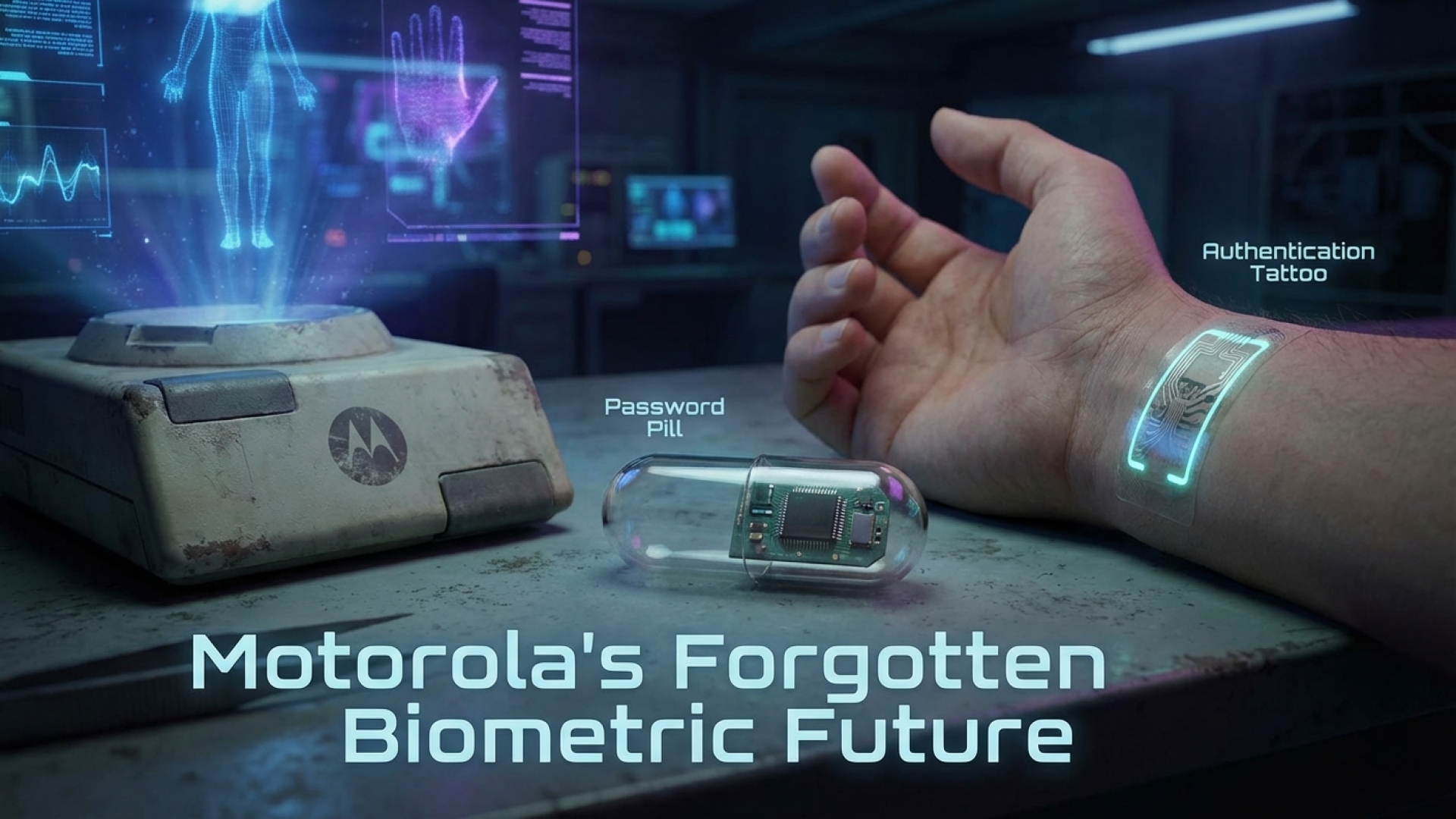
One of the most provocative ideas was the password pill. As highlighted by Hackaday, this ingestible device contained a small chip designed to dissolve in the stomach. Once activated by stomach acid, it would emit an 18-bit ECG-style signal, effectively broadcasting an authentication code from inside the user. Regina Dugan, then-head of advanced research at Motorola, described the vision clearly: “Essentially, your entire body becomes your authentication token.”
Safety was a primary focus for the research team. These pills, developed in partnership with Proteus Digital Health, were non-toxic and designed for daily use. While the idea of swallowing hardware might sound extreme, Proteus had already secured FDA approval for similar ingestible sensors used in medical monitoring. During demonstrations, Dugan confirmed the technology was functional, successfully authenticating a smartphone through the user’s body signal.
Comparison of Motorola’s Experimental Authentication Methods
| Technology | Partner Company | Primary Mechanism | Status (2013) |
|---|---|---|---|
| Password Pill | Proteus Digital Health | Ingestible sensor emitting ECG-style signals | Functional Prototype |
| Digital Tattoo | MC10 | Stretchable circuits applied to the skin | In Development |
Beyond ingestibles, Motorola sought to bridge the “mechanical mismatch between humans and electronics” through digital tattoos. Partnering with MC10, a firm specializing in stretchable circuits, Motorola aimed to create authentication wear that moved with the user. Dugan noted that while electronics are typically “boxy and rigid,” humans are “curvy and soft,” making flexible, skin-applied tech a more natural fit.
The goal was to grant users what Dugan playfully called a “superpower.” By wearing the circuit, a user’s touch could unlock doors, start cars, or log into computers instantly. It was a move toward a world where technology is integrated so seamlessly that the hardware becomes invisible.
Ultimately, Motorola Mobility was sold to Lenovo for $2.91 billion in 2014. While Google retained the majority of the patent portfolio, many of these wild R&D projects shifted focus or transitioned into the broader wearables market. Dennis Woodside, the head of Motorola at the time, acknowledged that these products weren’t ready for immediate retail, but emphasized that “having the boldness to think differently” was essential for solving everyday tech frustrations.
Today, while we may not be swallowing chips for lunch, the spirit of these innovations lives on in biometric security and the Internet of Things (IoT). Until the day our bodies become our primary login, a reliable password manager remains the best way to keep your digital life secure without the need for medical-grade hardware.