

Heat has long been the silent killer of hardware. For those of us in the gaming community, we spend hundreds of dollars on liquid cooling and massive heat sinks just to keep our rigs from throttling. But as we push the boundaries of digital innovation into the furthest reaches of our solar system, standard cooling isn’t an option. At Digital Tech Explorer, we often see how hardware limitations dictate the pace of exploration—until now.
A research team at the USC Viterbi School of Engineering has engineered a breakthrough that makes even the most rugged industrial SSDs look fragile. They have developed a graphene tungsten memristor capable of maintaining data integrity at temperatures reaching a staggering 700 °C. To put that in perspective, the surface of Venus—a planet notorious for crushing and melting most human-made probes—clocks in at a “mere” 460 °C.
As TechTalesLeo, I find the most compelling tech stories are the ones where necessity meets unexpected discovery. This isn’t just a minor upgrade; it’s a fundamental shift in how we approach data retention in extreme environments.

Thermal Endurance: A Comparison
To understand why this USC research is a game-changer, we have to look at the current ceiling for storage technology. Most consumer-grade and even specialized silicon-based hardware begins to fail long before it reaches the boiling point of water.
| Technology Type | Max Operating Temp | Primary Use Case |
|---|---|---|
| Silicon-based SSDs | ~200 °C (Failure point) | Consumer PCs & Servers |
| AlScN Flash (2024 Research) | 600 °C | High-temp Industrial |
| USC Graphene Memristor | 700 °C | Deep Space & AI Edge Computing |
The “Happy Accident” of Discovery
In the world of engineering, some of our greatest leaps forward happen when we aren’t looking for them. Joshua Yang, one of the paper’s authors, noted that the discovery was largely accidental. While the team was experimenting with the properties of graphene, they realized they had stumbled upon a configuration that solved a decade-old problem in material science.
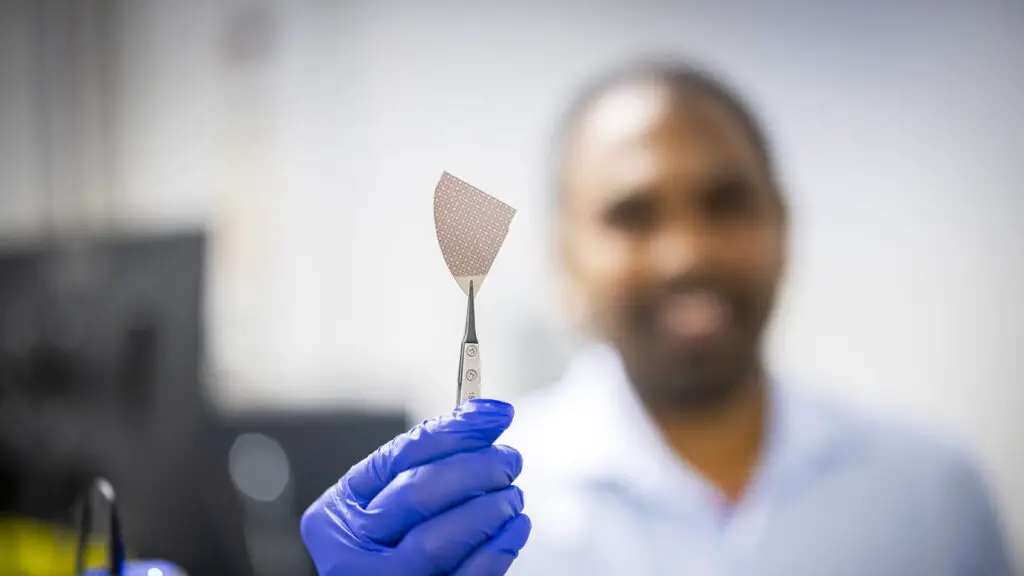
The device is built using a “sandwich” of materials: a tungsten-hafnium oxide-graphene stack. Tungsten and graphene are both known for their incredible heat resistance, while the hafnium oxide acts as the crucial switching layer between the two electrodes.
This builds upon earlier 2024 milestones where researchers used aluminum scandium nitride to hit the 600 °C mark. However, the USC team’s use of graphene has allowed them to push the thermal envelope even further, ensuring the device remains stable where others would literally melt into uselessness.
Why Graphene Changes Everything
The technical hurdle with previous memristors was “atom migration.” When using platinum as a bottom layer, high temperatures cause tungsten atoms to migrate and pool together. This prevents the device from switching between resistive states—rendering the memory unreadable.
By substituting platinum for graphene, the team discovered that the tungsten atoms remain stable. During rigorous testing, these graphene-based memristors maintained their ON/OFF states for over 145 hours at extreme heat. Even more impressive, the chips survived 1 billion switching cycles at 700 °C, pulsing at incredible speeds of 30 nanoseconds. This level of endurance is exactly what is needed for the next generation of AI acceleration in harsh environments.
From Venus to AI Data Centers
While space exploration is the most obvious beneficiary, the implications for Artificial Intelligence are just as profound. Memristors are uniquely suited for machine learning because they can perform matrix multiplication—the heavy lifting of AI—directly through the flow of current.
“Over 92 percent of the computing in AI systems like ChatGPT is nothing but matrix multiplication,” Yang explains. By using these memristors, we can perform these calculations orders of magnitude faster and with significantly less energy than traditional GPU-based architectures.
At Digital Tech Explorer, we believe this synergy between material science and computer architecture is the key to the next decade of innovation. Whether it’s a probe descending into the Venusian atmosphere or an AI cluster running at maximum efficiency, the future of tech is looking increasingly heat-resistant.