
At Digital Tech Explorer, we often focus on the cutting edge of hardware and the latest 2024 releases. However, sometimes a piece of software comes along that reminds us why we fell in love with technology in the first place. I am writing this at 3 am, fueled by the kind of excitement only a true digital discovery can provide. In just a few hours of play, Project: Gorgon has done something I previously thought impossible: it has convinced a habitual cynic like me that the indie MMORPG can not only survive but thrive with a dedicated, niche community.
Last year, I found myself lamenting the perceived death of the old-school MMO. I argued that the landscape of PC games and player expectations had changed too much to ever return to the “golden age.” Project: Gorgon has proven me completely wrong. It provided a full-blown “Ratatouille moment,” transporting me back to an era of innocence and discovery where every digital corner felt new, mysterious, and slightly dangerous.

Wonderfully Wild Mechanics
Project: Gorgon isn’t interested in modern conveniences or the hand-holding tutorials that dominate current software design. Instead, it offers a “controlled madness” maintained by a house of dopamine-sparking systems that reward curiosity over efficiency. This is a game that respects your intelligence by allowing you to fail.
Take the tutorial island as a case study. If you wander into a dungeon unprepared, a blaring alarm warns you of a potential curse. These aren’t just minor stat debuffs; these curses can cause zone bosses to spawn and hunt you down relentlessly across the map. The game even features a teleportation system where entering the wrong coordinates can send you to a random, potentially lethal location. It lets you make bad decisions and forces you to live with the consequences—a refreshing change in a world of “undo” buttons.
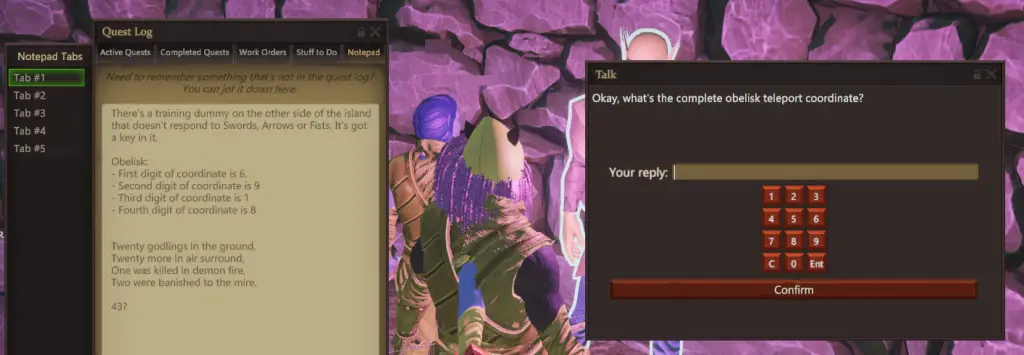
In this world, death is frequent and often unavoidable. You might be ganked by walking brains or hunted by a slime that is immune to your current damage type. But remarkably, dying is actually a skill you can level up. Progression is tied to an unconventional skill system that includes standard fare like Swords and Fire Magic alongside bizarre entries like Psychology, Mycology, and “Pig.”
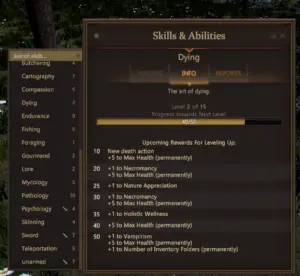
The “Psychology” skill, for instance, allows you to ask a pig about its relationship with its mother so intensely that the creature dies from the emotional weight. Unlocking these skills is rarely straightforward; to learn Fire Magic, I had to find a shirtless dancing man and perform a specific ritual in a fireplace. As a storyteller, these are the moments I live for—where the mechanics tell a story of their own.
Simply the Quest: A Breakdown of the Experience
The skills in Project: Gorgon are ultimately an excuse to engage in strange, baffling nonsense. In my first five hours, the sheer variety of interactions was staggering. To give you an idea of the depth, here is a breakdown of my initial experience:
| Activity Type | Interaction Summary | Outcome |
|---|---|---|
| Intellectual | Solved a math equation from a golem | Earned a lollipop |
| Exploration | Hurled spore bombs at dummies | Found secret keys |
| Social | Matchmaker for two psychic mantises in hats | Heartbreaking failure |
| Survival | Accidentally drank a bottle of ink | Immediate regret |
| Hygiene | Told I was too stinky to talk to an NPC | Had to find a bath |
| Logistics | High-stakes cheese delivery in a storm | Successful delivery |
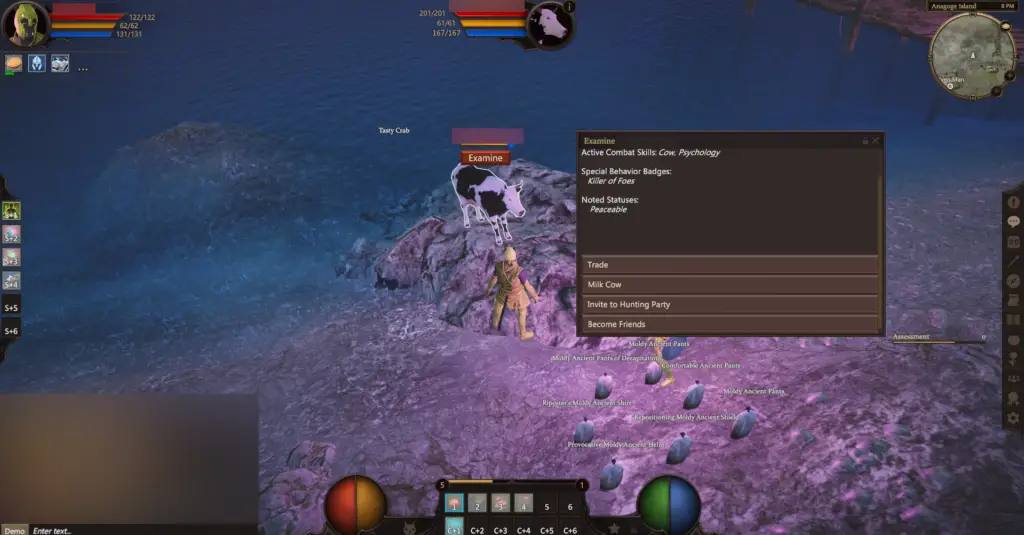
The game’s greatest strength is social interaction. In most modern PC games, you would simply consult a wiki the moment you get stuck. In Project: Gorgon, the lack of linearity and the sheer complexity of the world encourage you to actually talk to people. Whether it’s asking a player who has permanently transformed into a “dog” for directions or pointing a stranger toward a hidden warehouse, the game fosters a living, breathing community where knowledge is a currency shared between friends.
The Verdict
Project: Gorgon is a chaotic, messy, and irreverent experience. It is unapologetically “grindy,” but those grinds collapse into each other in a way that feels meaningful rather than tedious. It bridges the gap between complex old-school systems and modern usability by focusing on the joy of the journey rather than the efficiency of the endgame.
If you have ever yearned for the “good old days” of the genre, I highly recommend downloading the demo. Give yourself over to the chaos and see where it takes you. It is well worth the trip for any tech enthusiast looking for something genuinely different.
About the Author: TechTalesLeo is a dynamic storyteller and tech enthusiast who brings technology to life through captivating narratives. With a background in digital media, Leo focuses on bridging the gap between complex tech and everyday usability.
Disclaimer: All content on Digital Tech Explorer is for informational and entertainment purposes only. We do not provide financial or legal advice.
Affiliate Disclaimer: Some of the links on Digital Tech Explorer are affiliate links. This means we may earn a commission if you click through and make a purchase, at no additional cost to you. Our recommendations are based on thorough research and personal experience.