
Virtual reality technology continues to evolve at a breakneck pace, pushing the boundaries of immersion with every new iteration. At Digital Tech Explorer, we’ve tracked the progression of display tech from the early days of “screen door” grids to the high-fidelity experiences of today. Central to this evolution is the display technology housed within the headset. Today, we’re looking at the transformative impact of Micro-OLED displays, specifically as showcased in the high-end Pimax Crystal Super VR headset.
Introduction to Micro-OLED VR
Imagine two virtually identical VR headsets, both belonging to the high-end, tethered Pimax Crystal Super lineup. Externally, they look exactly the same. However, the moment you put them on, the difference becomes undeniable. One is equipped with traditional QLED displays, while the other features cutting-edge Micro-OLED technology. After extensive testing at the Digital Tech Explorer lab, switching between the Pimax Crystal Super QLED and the Pimax Crystal Super Micro-OLED, the conclusion is clear: Micro-OLED delivers an exceptional visual experience, though it comes with specific trade-offs that enthusiasts should consider.
Understanding Pimax Crystal Super Optical Engines
The Pimax Crystal Super utilizes a modular “optical engine.” This component is the heart of the headset, integrating the lenses, screens, cooling system, and eye-tracking sensors. For developers and hardware enthusiasts, this modularity is a game-changer, allowing users to swap engines to suit their specific needs. Pimax offers several options for the Crystal Super:
- QLED 35 PPD
- QLED 42 PPD
- QLED 57 PPD
- QLED Ultrawide FoV
- Micro-OLED 53 PPD
All QLED versions utilize an LCD panel enhanced with Quantum Dot technology and a Mini LED backlight. This setup enables local dimming, where small zones of the backlight can be individually switched on or off to boost contrast. While these provide impressive picture quality, the Micro-OLED 53 PPD option stands in a league of its own.
The Micro-OLED optical engine integrates a Sony panel (likely the ECX344A), featuring a remarkable 53 pixels-per-degree (PPD) rating. This high PPD is achieved by meticulously balancing clarity with a slightly reduced field of view (FoV) to maximize pixel density.
Micro-OLED vs. QLED: At a Glance
To help you decide which engine fits your setup, we’ve broken down the key specifications between the flagship QLED and Micro-OLED options.
| Feature | Crystal Super QLED | Crystal Super Micro-OLED |
|---|---|---|
| Display Technology | LCD w/ Quantum Dot & Mini LED | Sony Micro-OLED (ECX344A) |
| Pixels Per Degree (PPD) | Variable (up to 57) | 53 PPD |
| Weight (Optical Engine) | 355 grams | 231 grams |
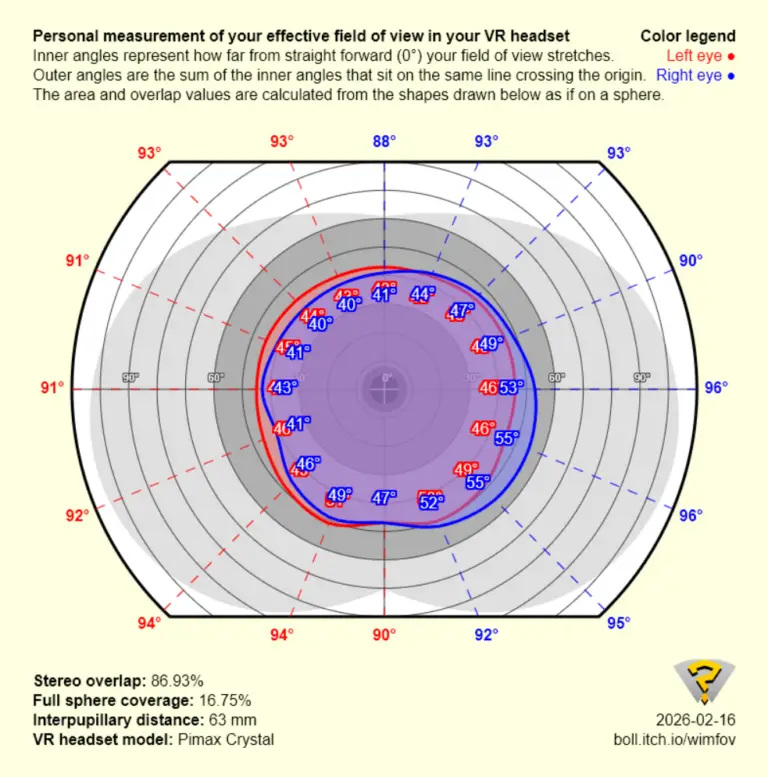
| Stereo Overlap | Approx. 77% (at 50 PPD) | Approx. 86% |
| Price (Complete Headset) | $1,799 | $2,199 |
Micro-OLED Technology Deep Dive
The Power of Pancake Lenses
For the Micro-OLED engine, Pimax employs specially designed pancake lenses. These lenses are notorious for demanding high brightness to compensate for light loss within the optics. Fortunately, the Sony panel is rated at 1,000 cd/m², ensuring the image remains vibrant even after passing through the complex lens system. Unlike the convex lenses found in the latest AI-integrated mobile headsets, these are concave, which is necessary to magnify the minuscule Micro-OLED screens to a usable scale.
Glare and Ergonomics
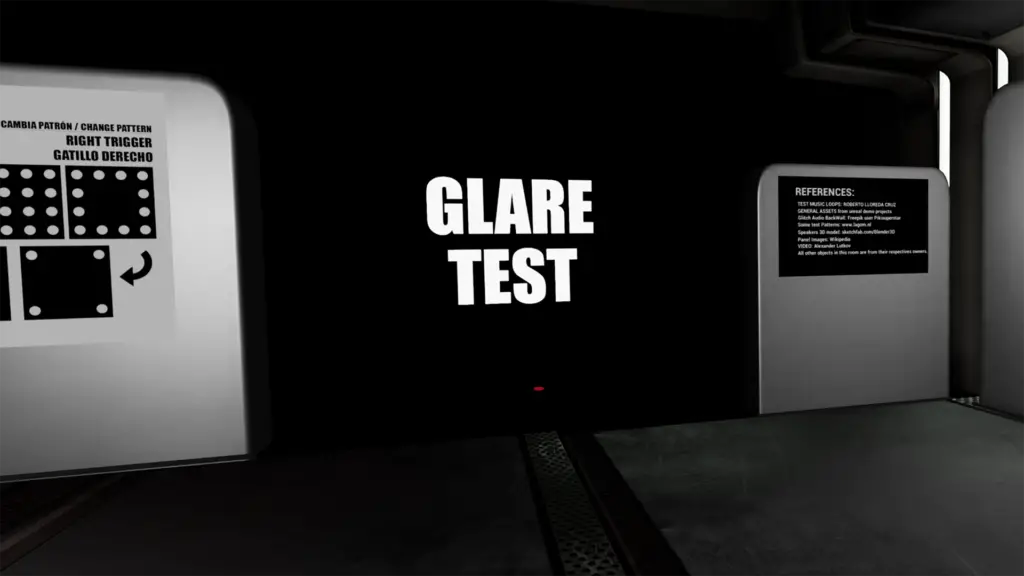
In our stress tests, the Micro-OLED exhibited slightly more glare than the QLED model, though it remained unobtrusive during standard gameplay. One of the most immediate benefits, however, is the weight. The Micro-OLED engine is significantly lighter at 231 grams compared to the QLED’s 355 grams. This reduction improves the overall balance of the headset, making long coding or gaming sessions much more comfortable.
Stereo Overlap and Immersion
Stereo overlap—the portion of the visual field seen by both eyes simultaneously—is critical for depth perception. The Micro-OLED variant boasts an 86% stereo overlap. Compared to the 77% found in the 50 PPD QLED model, the Micro-OLED provides a much more cohesive and comfortable visual experience, reducing eye strain during extended use.
Eliminating the Screen Door Effect
One of the most compelling reasons to upgrade is the total elimination of the screen door effect (SDE). This grid-like pattern has been the bane of VR since its inception. Thanks to a pixel density of 3,389 PPI (pixels per inch), the gaps between subpixels on the Sony Micro-OLED panel are invisible to the human eye.
When testing titles like Arizona Sunshine Remake, the difference is night and day. While the QLED version shows a faint grid against bright skies, the Micro-OLED version is perfectly smooth. There are no traceable lines, allowing for a level of immersion that truly bridges the gap between digital and reality.
Vibrancy and Color Fidelity
Beyond resolution, Micro-OLED excels in color fidelity. While QLED uses local dimming to simulate blacks, OLED pixels can turn off completely, providing true infinite contrast. This prevents the “color washout” sometimes seen in bright scenes on LCD-based displays. Whether you are exploring dark corridors or vibrant alien landscapes, the Micro-OLED maintains impeccable saturation and depth.
Final Thoughts: The Value Proposition
The premium for this technology is noteworthy. The Micro-OLED optical engine is priced at $1,199 (£920) as a standalone upgrade, or $2,199 (£1,700) for the full Crystal Super kit. This is a $400 premium over the QLED model.
For the dedicated gaming enthusiast or professional developer who demands the absolute peak of visual fidelity, the investment is justified. The clarity, weight reduction, and color depth of the Micro-OLED engine set a new benchmark for high-end PCVR hardware in 2024 and beyond.
Disclaimer: All content on Digital Tech Explorer is for informational and entertainment purposes only. Some links may be affiliate links, meaning we may earn a commission at no additional cost to you.