
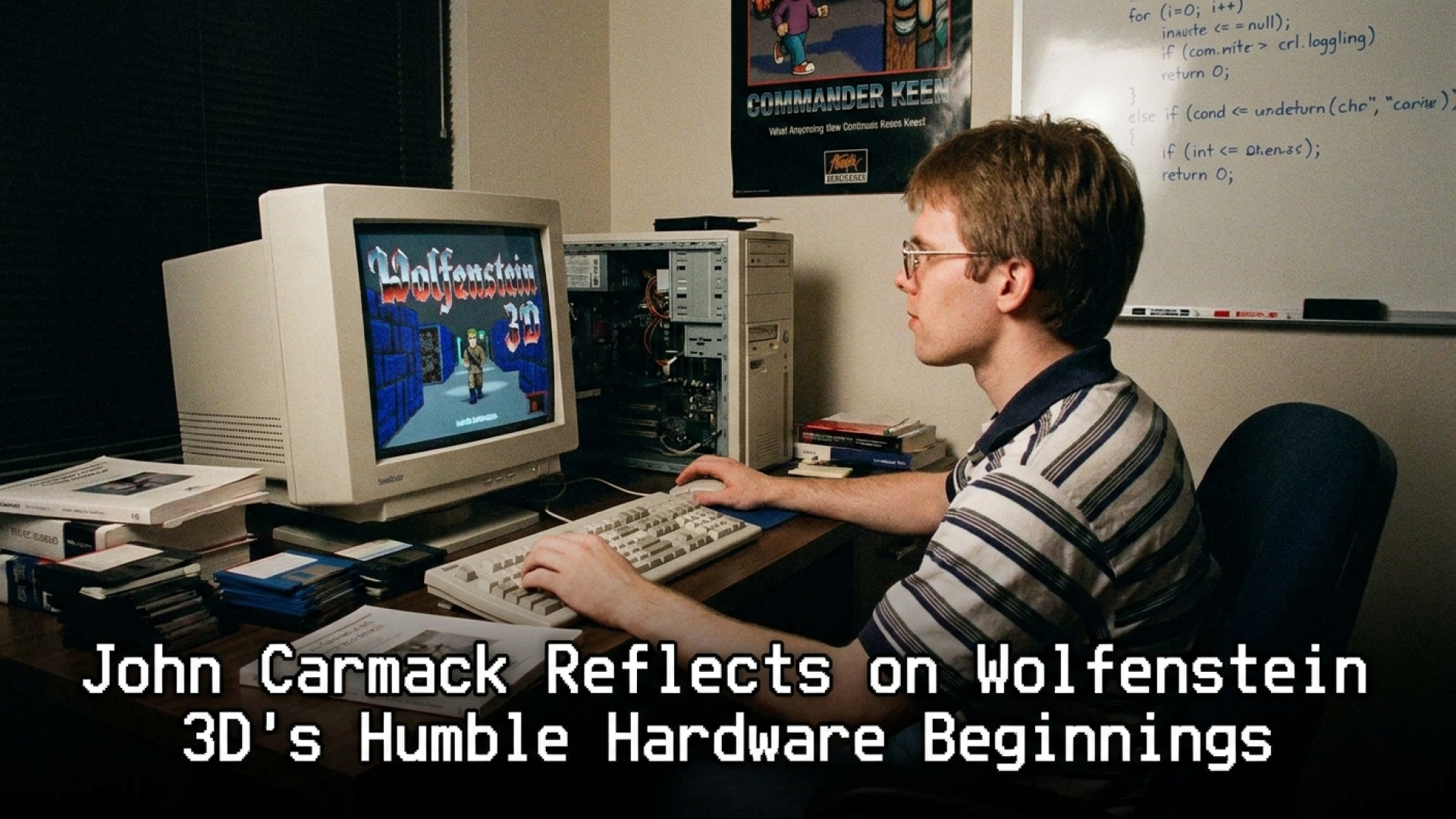
At Digital Tech Explorer, we are constantly tracking the evolution of hardware and artificial intelligence. Few figures embody this transition better than John Carmack. Founded on February 1, 1991, id Software redefined the landscape of PC gaming with titles like Doom, Quake, and the groundbreaking Wolfenstein 3D. To mark the company’s 35-year legacy, Carmack recently shared a reflective video on X, offering a rare look at the artifacts that inspired a generation of software engineers.
“Every day that I sit down to my AI research work, doing petaflops of tensor calculations, I’ve got above me a reminder of the old days at the dawn of id Software,” Carmack noted. Behind his workstation sits a triptych of posters from Nick Derington’s “Ode to id” series, capturing iconic moments from the 16-bit era that now overlook his modern multi-monitor setup.

The Dawn of Wolfenstein 3D: Innovation Through Constraint
As a storyteller in the tech space, I find the limitations of the early 90s fascinating. Carmack highlighted the extreme constraints his team faced while developing Wolfenstein 3D. The synergy between code, art, and design was not just a preference—it was a necessity for survival in a “tight little box” of resources.
| Feature | Early Development Specs (1991-1992) |
|---|---|
| CPU Speed | 16 Megahertz |
| Memory (RAM) | 640 KB |
| Storage Media | Floppy Disks |
| Graphics Resolution | 320 x 200 Pixels |
| Operating System | MS-DOS |
“I think we did a pretty good job back then, and I’m grateful that the legacy lives on to this day,” Carmack stated. These MS-DOS rigs were the forge for what would eventually become the modern first-person shooter genre.
Leveling Up: The NeXT Workstation Era
When the team moved into the development phase for Doom, the hardware requirements shifted. Carmack and his peers upgraded to NeXT workstations, the high-end machines developed by Steve Jobs’ secondary venture. This shift provided the computational headroom necessary to build the world’s most famous gaming engine of the time. Carmack previously noted that using the NeXT system was an “eye-opener” that offered tangible advantages in software architecture and productivity.
Doom’s Legacy: The Ultimate Hardware Benchmark
Decades later, Doom serves a unique purpose in the tech community: if a device has a screen and a processor, someone will try to run Doom on it. We’ve seen it ported to motherboard BIOS chips, pregnancy tests, and even nested within the game itself. This enduring relevance is a testament to the efficient coding and visionary design that emerged from those early hardware constraints.
A New Frontier: Keen Technologies and AGI
Today, Carmack has pivoted from rendering pixels to architecting intelligence. He currently leads Keen Technologies, an AI research firm that secured a $20 million investment in 2022. His current mission is as ambitious as his early days at id Software: achieving “AGI (Artificial General Intelligence) or bust.”
While he briefly served as a consultant for Meta’s VR division, his focus is now squarely on the future of machine learning. At Digital Tech Explorer, we believe Carmack’s journey from 16 MHz CPUs to petaflop-scale AI research serves as an inspiration for every software engineer looking to push the boundaries of what is possible. Whether it is a corridor in Doom or a neural network for AGI, the principle remains the same: finding the “very best corner” of the technology available to us.
For more deep dives into the history of hardware and the future of AI, stay tuned to Digital Tech Explorer.