
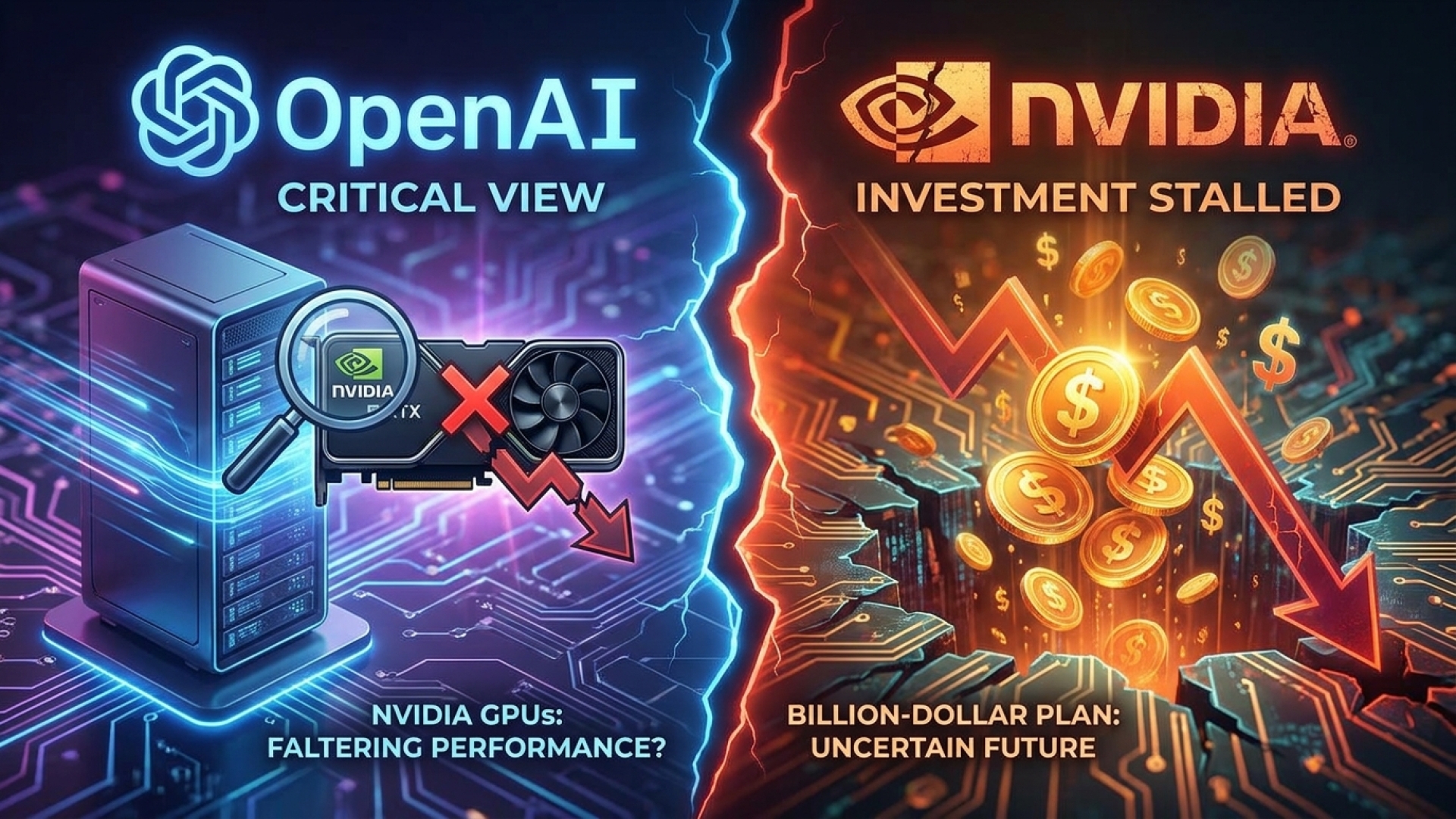
In the rapidly evolving landscape of digital innovation, even the most formidable alliances can face sudden turbulence. Here at Digital Tech Explorer, we’ve been closely tracking the relationship between AI powerhouses OpenAI and Nvidia. Recent developments suggest that the “honeymoon phase” of this era-defining alliance is beginning to fray, as strategic disagreements and technical roadblocks come to the surface.
Nvidia’s $100 Billion Investment Stalls
In a move that sent shockwaves through the tech world last September, Nvidia announced ambitious plans to invest upwards of $100 billion in OpenAI. However, new reports from the Wall Street Journal indicate that this massive deal has hit a significant snag. Nvidia CEO Jensen Huang has reportedly expressed private concerns regarding what he perceives as a “lack of discipline” in OpenAI’s business strategy.
As a platform founded by software engineers, we understand the importance of technical and fiscal discipline. Huang is reportedly wary of the mounting competition OpenAI faces from formidable rivals such as Google and Anthropic. While Huang maintains publicly that Nvidia will continue to provide substantial financial support, he has recently distanced himself from the $100 billion figure, suggesting the final commitment may be far more conservative than initially teased.

OpenAI Expresses Dissatisfaction with GPU Performance
While the financial side of the deal falters, the technical partnership is also showing signs of strain. According to reports from Reuters, OpenAI has expressed dissatisfaction with Nvidia’s latest GPU offerings, specifically regarding “inference”—the critical task of running AI models to generate real-time responses for users.
Our team at Digital Tech Explorer focuses on the practical application of hardware, and it appears OpenAI is finding Nvidia’s general-purpose architecture slightly lacking for their specialized needs. Sources suggest that OpenAI is frustrated with the latency and processing speeds during intensive tasks like software development and cross-platform communication. As ChatGPT scales to serve millions of users simultaneously, the sheer power of a GPU is often less important than the efficiency of the underlying architecture.

The Industry Shift Toward Specialized ASICs
This tension highlights a pivotal trend in the tech world: the migration toward Application Specific Integrated Circuits (ASICs). While Nvidia’s chips are incredibly powerful, they are designed as general-purpose accelerators. For highly specific and repetitive tasks like AI inference, ASICs—chips custom-built for one primary function—often offer better efficiency and lower power consumption.
We’ve seen this story play out before in the world of cryptocurrency, where mining hardware evolved from standard GPUs to highly optimized ASICs. With Microsoft recently unveiling its “Maia” AI chips tailored specifically for inference, it is highly likely that OpenAI will pursue a similar path to reduce its heavy reliance on Nvidia’s expensive and energy-intensive hardware.
Conclusion: An Uncertain Path Forward
Despite the current friction, these two giants remain fundamentally linked. OpenAI still requires massive quantities of Nvidia silicon to maintain its dominance in the AI acceleration space, and Nvidia benefits immensely from OpenAI’s role as the poster child for the current tech revolution. However, with multi-billion dollar investments paused and technical dissatisfaction rising, the once-unshakeable alliance is showing its first major cracks.
At Digital Tech Explorer, we will continue to monitor these shifts in the hardware landscape to bring you the insights you need to stay ahead of the curve. For more tech stories and deep dives into the future of coding and innovation, follow the latest updates from TechTalesLeo.
Disclaimer: All content on Digital Tech Explorer is for informational and entertainment purposes only. We do not provide financial or legal advice. Some links may be affiliate links, meaning we may earn a commission at no additional cost to you.