

Traveling across the globe to inspect what some might dismiss as “just a mouse” may seem excessive, especially when that device carries a $180 price tag. Yet, for those of us at Digital Tech Explorer, we know that peak performance is born from rigorous engineering and relentless hardware testing. I recently joined the team at Logitech’s headquarters in Lausanne, Switzerland, to pull back the curtain on the development of their premier gaming peripherals, including the highly anticipated Logitech G Pro X2 Superstrike.
While casual users might see a simple plastic shell, the reality is a complex symphony of design and mechanical endurance. From artisanal hand-carving to high-velocity “fling-a-tron” machines and electromagnetic isolation chambers, the process is as much an art as it is a science. As TechTalesLeo, I’ve seen many tech stories, but the human element behind Logitech’s innovation—the literal carving of shapes to fit the human palm—remains one of the most compelling narratives in modern peripheral development.
The Art of Ergonomic Design
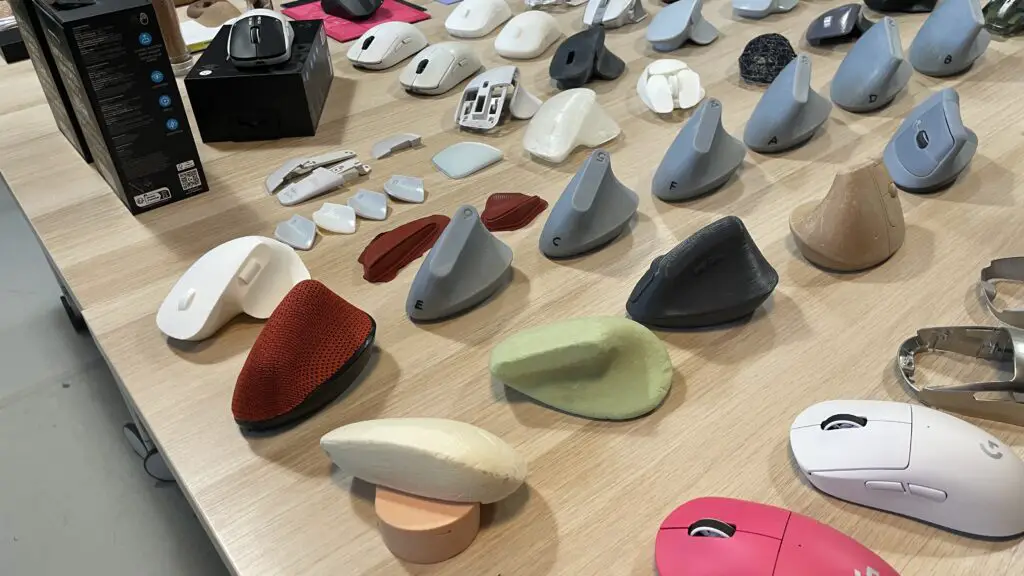
Innovation at Logitech doesn’t always start in a CAD program; it often begins at the office coffee machine. Regis Croissonnier, Logitech’s chief engineer, views these informal exchanges as the heartbeat of their innovation mindset. In a building full of engineers, a casual conversation can spark a breakthrough in sensor efficiency or weight reduction.
In the design studio led by Nick Jinkinson, the team pushes the boundaries of the “what if.” They experiment with radical concepts—mice made of plastic strands or devices with virtually no internals. To keep the designs grounded in usability, the team utilizes “old school” techniques. Designers frequently start with blocks of chemical wood, using band saws and hand-shaving tools to refine the ergonomics. This analog approach ensures the product feels natural in a human hand before a single line of code is written.
This physical testing is supplemented by medical-grade research. By using electrode pads to monitor muscle tension and wrist pressure, Logitech has confirmed that vertical designs can significantly reduce forearm strain. It is this marriage of digital innovation and biological study that defines their current design era.
Extreme Sensor Validation
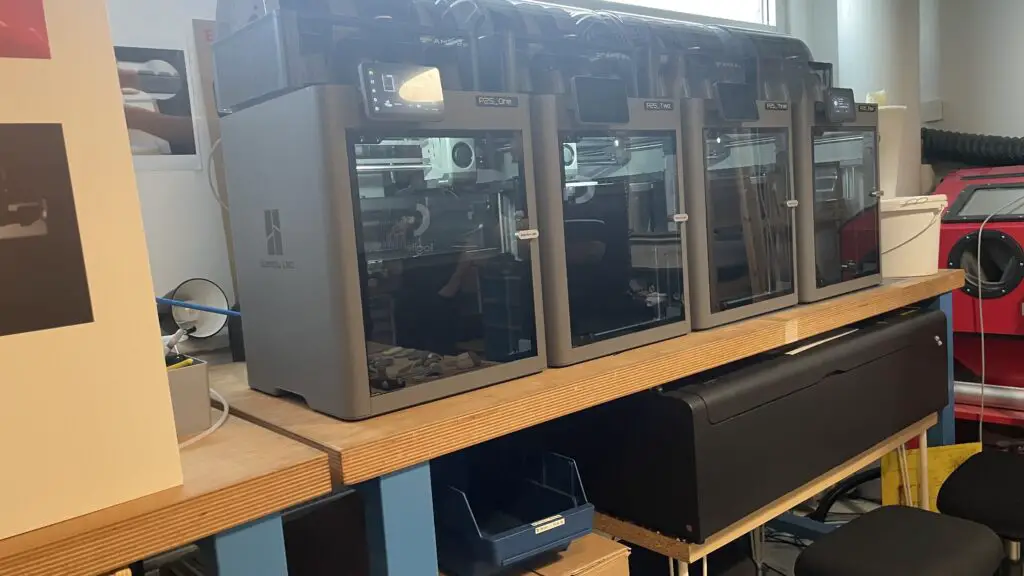
Beneath the design studios lie the basement labs, where the internal components undergo a mechanical gauntlet. Here, four primary machines evaluate every aspect of sensor performance. These automated systems test accuracy, acceleration, and lift-off distance with a level of consistency that no human pro-gamer could replicate.
| Testing Metric | Machine Function | Target Performance |
|---|---|---|
| Sensor Accuracy | Compares sensor data against a fixed “ground floor” motor movement via SPI. | Zero variance from baseline. |
| Max Acceleration | 4.5 kW motor spins disks to simulate extreme flick shots. | Up to 100 Gs of acceleration. |
| Max Speed (IPS) | High-speed spinning plate tests data integrity at velocity. | 1,000+ Inches Per Second (IPS). |
| Latency Analysis | Measures the distribution of results to account for sensor reporting intervals. | Minimal wireless “drift.” |
François Morier, principal engineer of optical sensing, highlighted the 4.5 kilowatt motor used to drive their speed-testing disks. To reach speeds of up to 25 meters per second without melting the hardware, mouse skates are actually removed during the test to eliminate friction-induced heat. This level of extreme testing ensures that when you’re playing high-stakes PC games, the hardware is never the bottleneck.
The “Red Apple” of Wireless Connectivity
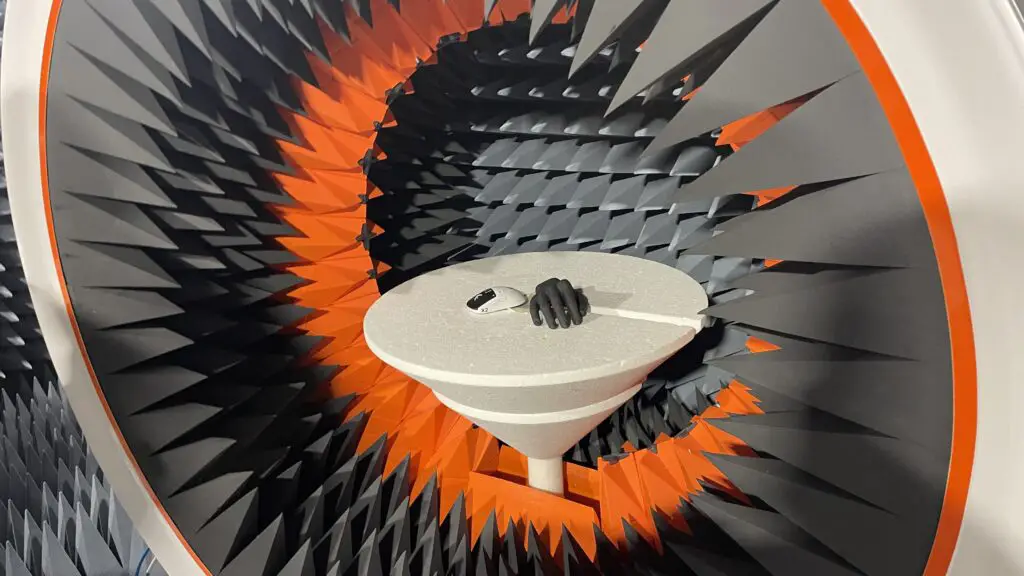
For a wireless device to succeed in a competitive environment, it must survive the “noise” of a thousand other signals. Logitech utilizes anechoic chambers—Faraday cages that block all external electromagnetic waves—to perfect their LightSpeed wireless technology.
The goal, as described by RF manager Frederic Fortin, is the “red apple.” This is a 3D visualization of a perfect radiation pattern where signal power is maximized in every direction. To ensure real-world reliability, they use a “plastic hand” to simulate how human grip might obstruct the antenna. They even simulate the chaotic RF environment of a LAN party, pumping in noise to see how their wireless receivers perform against competitors under stress.
Pushing Boundaries with the G Pro X2 Superstrike
The culmination of this research is evident in 2024 releases like the Logitech G Pro X2 Superstrike. This flagship model introduces inductive switches, which drastically reduce click latency by using electromagnetic induction rather than traditional mechanical contact.
To validate this leap, Logitech partnered with the EPFL university to conduct extensive human-centric studies. By measuring the minute differences in actuation times between professional gamers and casual users, they’ve tuned the Superstrike to offer a haptic experience that feels both rapid and reliable. An actuator machine provides the final empirical stamp, depressing buttons at precise speeds to confirm the reduction in latency that keeps developers and enthusiasts ahead of the curve.
At Digital Tech Explorer, we believe that understanding the “how” is just as important as the “what.” Seeing the meticulous craftsmanship in Lausanne confirms that while it might look like “just a mouse,” the engineering inside is a masterpiece of modern digital innovation.
Disclaimer: All content on Digital Tech Explorer is for informational and entertainment purposes only. We do not provide financial or legal advice.
Affiliate Disclaimer: Some of the links on Digital Tech Explorer are affiliate links. This means we may earn a commission if you click through and make a purchase, at no additional cost to you. Our recommendations are based on thorough research and personal experience.