
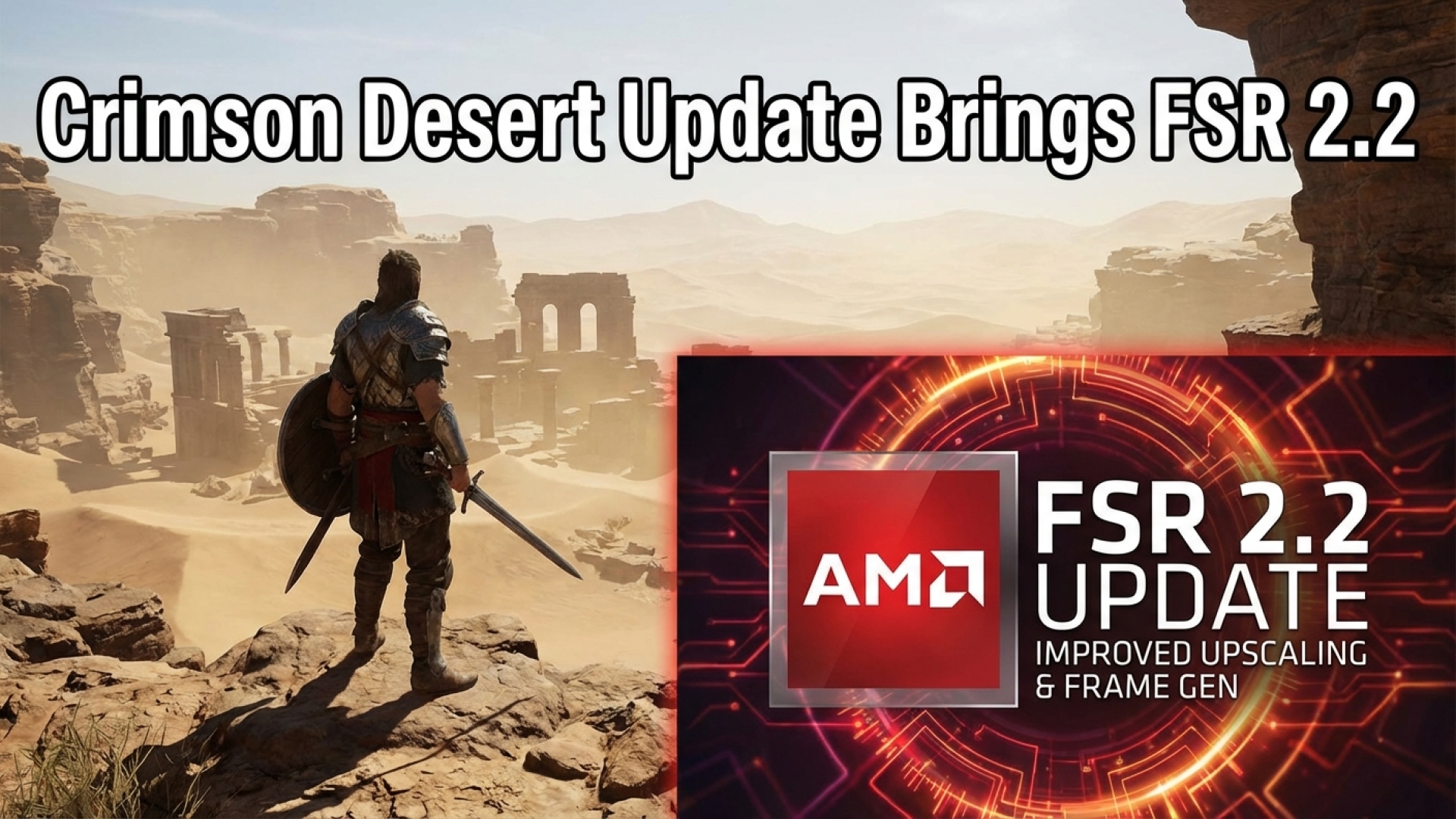
As a tech enthusiast constantly chasing the smoothest frame rates and the most immersive visuals, I know there is nothing quite as satisfying as a well-timed optimization patch. If you have been exploring the vast world of Crimson Desert on an AMD graphics card, your experience is about to get a significant boost. The latest update officially implements FSR SDK 2.2, delivering a more refined approach to upscaling and frame generation.
According to the official notes released by Pearl Abyss for update 1.02.00, the integration of FSR 2.2 focuses on consistency. While the most noticeable gains are for PC players utilizing GPU hardware from Team Red, the upscaling enhancements have also been rolled out for Xbox and PlayStation users, ensuring a smoother visual flow across all major platforms.
Refining the Visual Landscape
Beyond the FSR integration, this patch addresses several technical hurdles that previously hindered the gaming experience. One critical fix involves GPU memory management; previously, users reported that memory usage would spike excessively when DLSS was active. This has been stabilized, significantly reducing the “shimmering” effects and heavy loads that occurred when utilizing AI-accelerated upscaling features.
Shadow and reflection enthusiasts will also notice a difference. Pearl Abyss has corrected an issue where foliage failed to render in ray-traced reflections while using FSR or DLSS. Furthermore, flickering bugs associated with DLAA and HDR have been squashed, and a strange indoor rendering bug that affected character faces on lower graphics settings has been resolved.
Here is a quick breakdown of the primary graphical fixes included in this update:
| Feature | Enhancement Description |
|---|---|
| Upscaling | FSR SDK 2.2 implemented for better stability and frame generation. |
| DLSS Support | Resolved excessive GPU memory usage and shimmering issues. |
| Ray Tracing | Fixed foliage rendering in ray-traced reflections. |
| Lighting & HDR | Eliminated flickering when DLAA or HDR is enabled. |
The Road to Peak Performance
While these updates are a massive step forward, the journey of hardware optimization is rarely finished in one go. Some players have noted that while upscaling and frame generation feel more fluid, there are still minor visual artifacts—sometimes referred to as “boiling” textures—specifically when using AI Ray Reconstruction. It is a reminder that as games become more complex, the interplay between software and silicon becomes a delicate dance.
At Digital Tech Explorer, we value the transparency Pearl Abyss has shown. Since launch, the developers have been diligent in rolling out performance fixes and control tweaks. While the storytelling and world-building of Crimson Desert have sparked much debate among the community, the technical foundation is clearly being reinforced with every patch.
For those of us who have been playing on and off, these performance gains make a compelling case to jump back in. If you have been waiting for the game to reach its peak technical state, update 1.02.00 brings us much closer to that reality. For more insights on the latest 2024 releases and hardware optimization tips, stay tuned to our latest deep dives.
Check out more from TechTalesLeo for the latest in digital innovation and tech storytelling.