
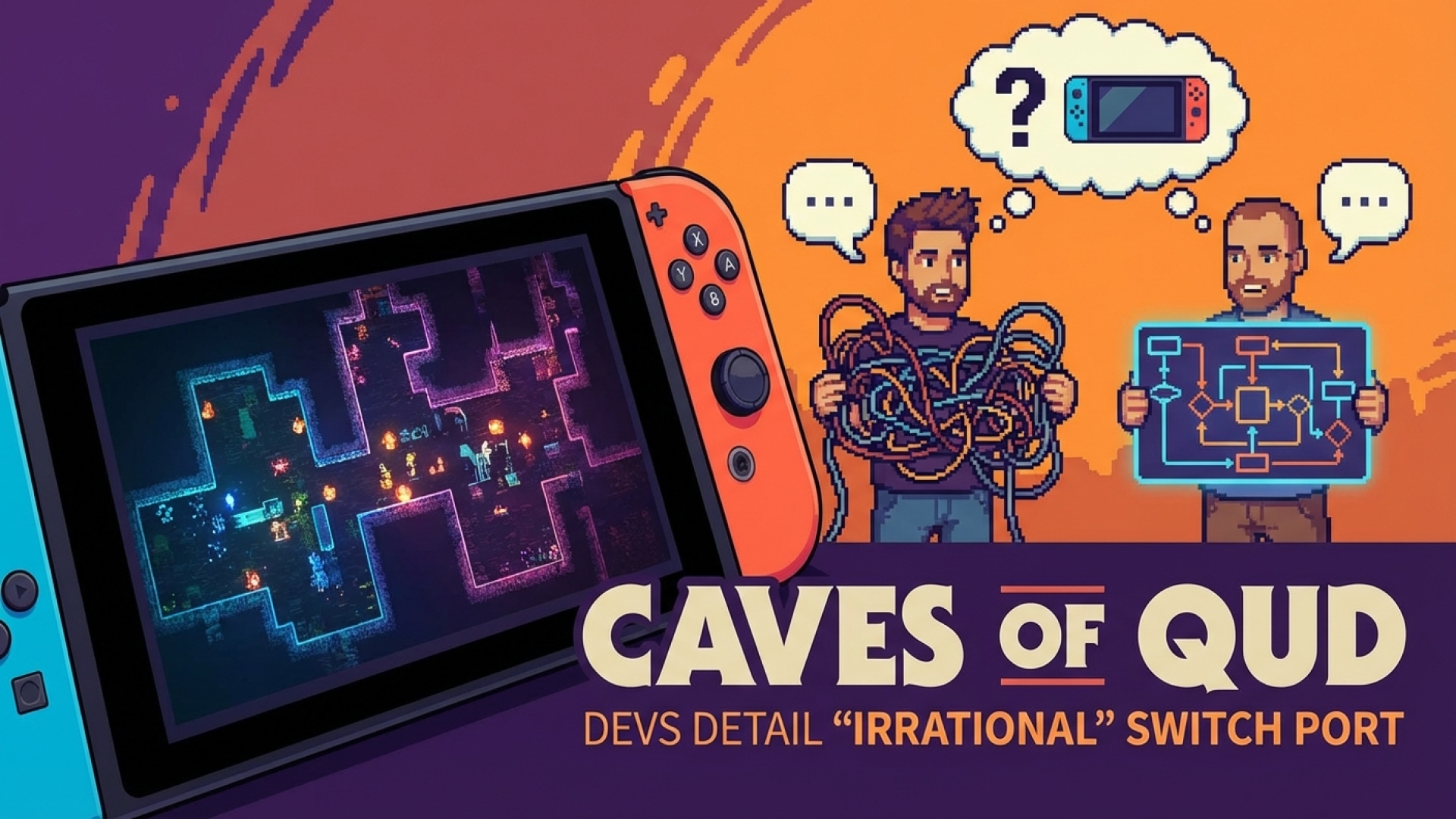
At Digital Tech Explorer, we are constantly fascinated by the intersection of complex software architecture and hardware limitations. Few titles embody this tension better than Caves of Qud, a deeply systemic, decades-in-the-making roguelike RPG. Often categorized alongside legends like Deus Ex and Dwarf Fortress, it is the quintessential “PC-centric” experience. Yet, in a move that has stunned both developers and enthusiasts, this intricate masterpiece has successfully migrated to the Nintendo Switch—a platform many assumed simply couldn’t handle its dense mechanics and keyboard-heavy interface.

Solving the ‘Impossible’ Porting Puzzle
From a software engineering perspective, porting Caves of Qud to a handheld console seemed bordering on irrational. The game’s default control scheme utilizes nearly every key on a standard keyboard, and its procedural world-generation engine can significantly tax even modern hardware. For co-creator Brian Bucklew, however, the “impossibility” was the primary draw.
“I’m not sure it’s a rational decision,” Bucklew admitted during a recent discussion on the game’s evolution. “I think we are interested in solving impossible problems in general. The idea of making the game work on a gamepad—something that shouldn’t logically happen—was a challenge that enticed us to see it through.”
UI Overhaul: The Gateway to Portability
The journey to the Switch was paved by critical updates released in 2024. Before exiting early access, the development team implemented a massive UI and control overhaul. This update was the “secret sauce” that first made the title playable on the Steam Deck, providing a blueprint for console success.
By introducing a sophisticated gamepad binding scheme, the team created intuitive shortcuts and button combinations. These changes allowed players to navigate complex tasks—such as analyzing the lethal geometry of a Chrome Pyramid—without needing a full QWERTY setup. This technical foundation proved essential for the transition to Nintendo’s gaming ecosystem.
| Feature | Legacy PC Setup | Switch / Gamepad Optimization |
|---|---|---|
| Control Input | Full Keyboard / Keybind intensive | Contextual radial menus & shortcuts |
| Interface | Text-heavy, classic terminal style | Modernized UI with scalable windows |
| Performance | High CPU load per turn | Optimized systemic generation for mobile chips |
Challenging the Market Status Quo
Bucklew’s motivation wasn’t purely technical; it was also about market disruption. He sought to disprove the industry myth that “systemic games” lack an audience on consoles. At Digital Tech Explorer, we’ve tracked how indie developers are increasingly finding success by bringing deep PC games to broader audiences.
The gamble paid off spectacularly. Upon its release, Caves of Qud climbed into the top five of the ‘Physical + Digital’ category on the eShop, outperforming 95% of the top 100 titles. This performance confirms that there is a hungry market for high-depth, intellectually stimulating experiences on portable hardware.
Design Serendipity: Accidental Foresight
Interestingly, some of the design choices that facilitated this port were made years ago without consoles in mind. Bucklew and co-founder Jason Grinblat previously pivoted away from the cryptic, dozen-key command structures seen in traditional roguelikes like NetHack. They opted instead for menu-driven interactions to improve player discovery.
“We barely fit onto a gamepad, but we do because of that decision,” Bucklew noted. This move toward accessibility, originally intended to help new players learn the game’s depth, inadvertently became the mechanical bridge that allowed the Switch port to exist.
The Next Frontier: Mobile Ambitions
With the Switch milestone reached, Freehold Games is now looking toward the Android and iOS markets. Adapting Caves of Qud for smartphone screens—specifically portrait mode—presents a new set of hurdles. While modern phone CPUs often outperform the aging Switch hardware, the UI design for a vertical, touch-only interface is a daunting task.
As we continue to follow this story at Digital Tech Explorer, it’s clear that the team’s commitment to innovation remains unshakable. If they can conquer the Switch, a high-quality mobile version of Qud seems less like a dream and more like an impending reality. For both veterans and newcomers, the world of Qud is becoming more accessible than ever, one “impossible” port at a time.
Stay tuned to Digital Tech Explorer for more in-depth analyses of how today’s most innovative developers are bridging the gap between complex software and everyday usability. For more from our lead storyteller, visit TechTalesLeo’s author page.