
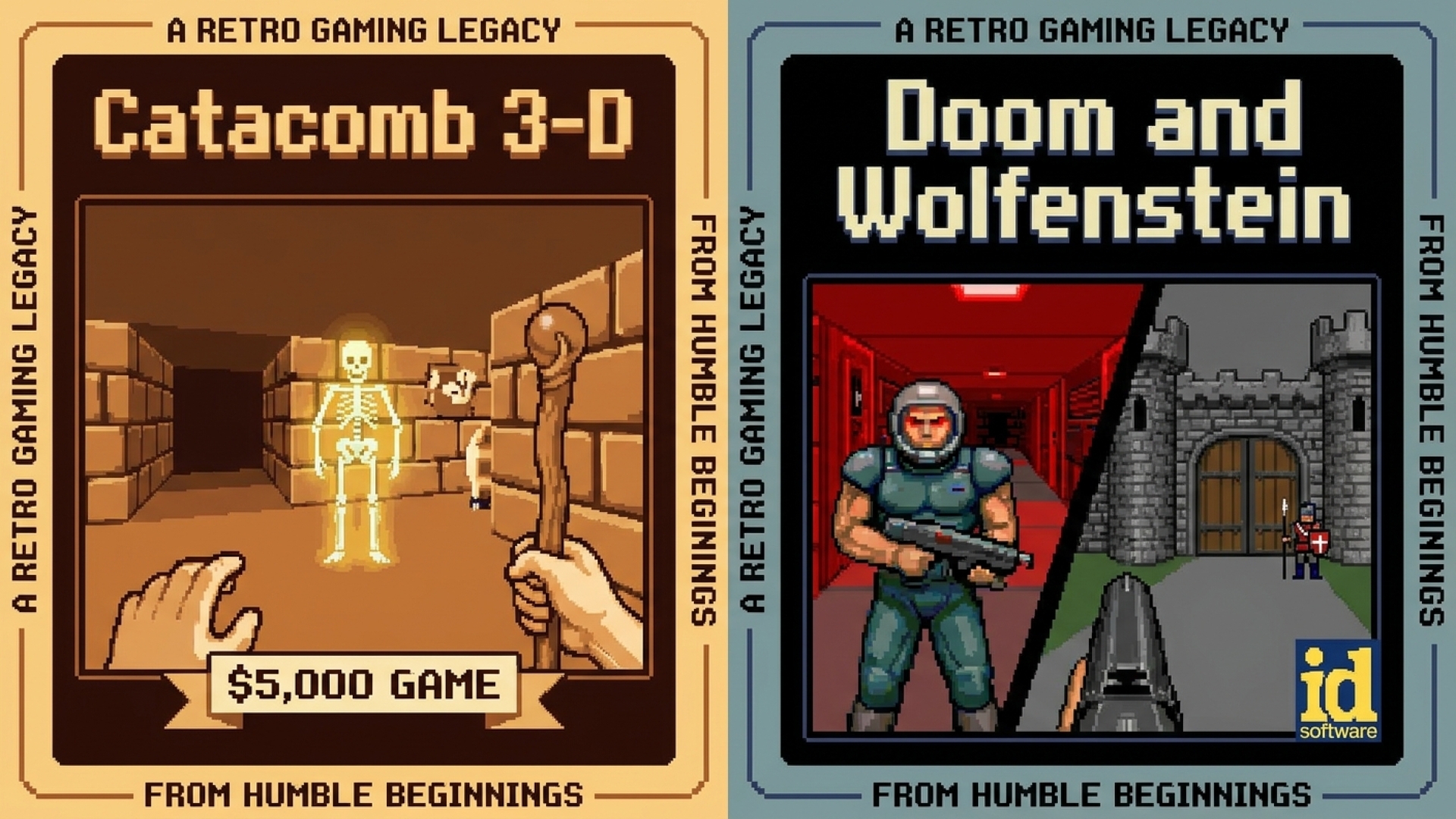
In celebration of id Software’s 35th anniversary, co-founder John Romero has released a captivating video retrospective that dives deep into the studio’s roots. While most fans immediately think of Doom or Quake, Romero shines a spotlight on a pivotal, yet often overlooked title: Catacomb 3-D. Here at Digital Tech Explorer, we love a good origin story, and this one features insights from the original “four horsemen” of id—John Romero, John Carmack, Adrian Carmack, and Tom Hall—detailing how a game that earned them a mere $5,000 changed the trajectory of gaming forever.

The Softdisk Era and Technical Breakthroughs
Developed in October 1991, Catacomb 3-D was born during a high-pressure transitional period. At the time, the team was fulfilling a contract with Softdisk, churning out titles for the “Gamer’s Edge” subscription service. While the colorful platformer Commander Keen was the studio’s primary revenue driver, John Carmack was already obsessed with pushing PC hardware to its absolute limits.
While their previous experimental title, Hovertank One, had introduced basic 3D movement, Catacomb 3-D brought something revolutionary to the table: texture mapping. At the time, such graphical feats were typically reserved for high-end Silicon Graphics workstations costing tens of thousands of dollars. Carmack, however, found a way to optimize the process for consumer-grade PCs. In an era where the term “first-person shooter” didn’t even exist, id Software was proving that “fast-twitch” action was viable on a platform previously dominated by slow-paced strategy and text-heavy adventures.
Evolution of Early id Software Tech
| Feature | Hovertank One | Catacomb 3-D | Wolfenstein 3-D |
|---|---|---|---|
| Release Year | 1991 (April) | 1991 (November) | 1992 |
| Visual Style | Solid-color walls | Texture-mapped walls | Detailed textures & scaling |
| Primary Innovation | 3D wireframe speed | Immersion through textures | Fast-paced FPS combat |
The “Jump Scare” That Changed Everything
Despite the technical wizardry, the team wasn’t entirely convinced that 3D gaming was their permanent future. Following Catacomb 3-D, they actually spent two weeks developing Commander Keen 7. However, a visceral moment during the playtesting of Catacomb remained etched in the founders’ minds.
John Carmack and John Romero vividly recalled an incident where artist Adrian Carmack was testing the game. As a troll suddenly lunged from the shadows on-screen, Adrian jumped so violently that he nearly fell out of his chair. This wasn’t just a simple reaction; it was a psychological breakthrough.
“That was the first moment that locked into my mind that we were really onto something in this new genre and style of play,” John Carmack noted. The immersion provided by the first-person perspective created a level of shock and presence that traditional 2D side-scrollers simply could not achieve. It was the birth of environmental storytelling and player immersion as we know it today.
Abandoning Keen for a 3D Future
That single jump scare led to a late-night meeting that would alter the course of PC games history. Romero recalls the moment the team decided to pivot entirely: “One night, we talked about how Catacomb 3-D was just the beginning of a new way to play games, and that the future was 3D.”
Within an hour of that discussion, the team made the bold decision to abandon Commander Keen 7 and immediately begin work on what would become Wolfenstein 3-D. While the Gamer’s Edge contract only netted the studio $5,000 (roughly $12,000 today) for months of grueling labor, the technical foundation laid by Catacomb 3-D was priceless. It was the spark that eventually ignited the fire of Doom and Quake.
Legacy and Where to Find It Today
For collectors and enthusiasts of digital history, Romero Games is currently offering a classic-style PC big-box reissue of Catacomb 3-D on its official website. It’s a rare chance to own a physical piece of the software that paved the way for the modern FPS.
As we look forward, the legacy of these pioneers continues. John and Brenda Romero’s studio is currently developing a next-generation first-person shooter built in Unreal Engine 5, proving that the spirit of innovation that started in a small office in 1991 is still very much alive.
Affiliate Disclaimer: Some of the links on Digital Tech Explorer are affiliate links. This means we may earn a commission if you click through and make a purchase, at no additional cost to you. Our recommendations are based on thorough research and personal experience. All content is for informational and entertainment purposes only.