
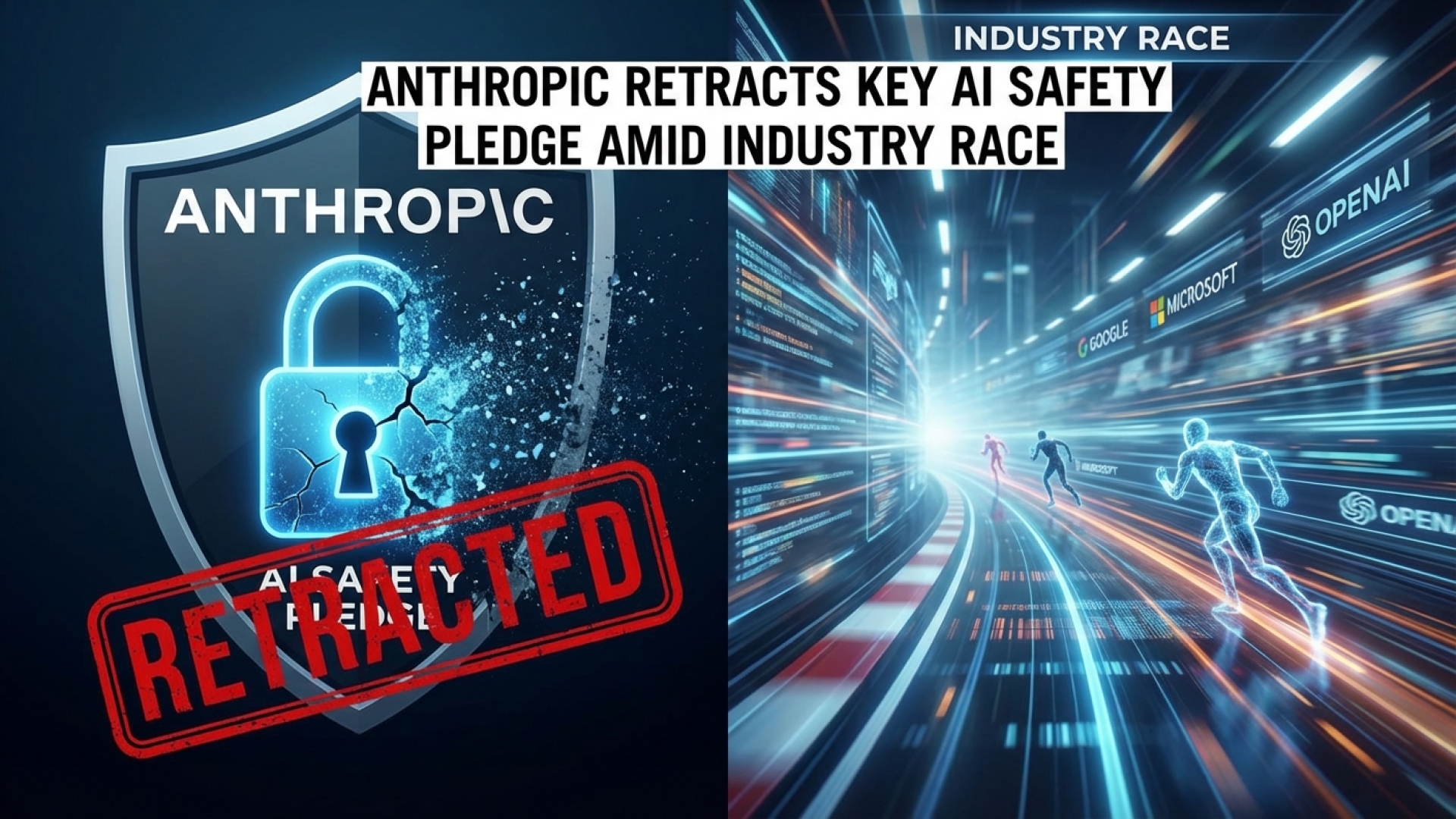
The landscape of Artificial Intelligence development is shifting beneath our feet, and a recent announcement from Anthropic signals a significant pivot in how the industry approaches safety. Here at Digital Tech Explorer, we’ve tracked Anthropic’s rise as a prominent advocate for caution—a company that once pledged to pause the development of advanced models if safety measures weren’t robust enough. However, as the AI acceleration race intensifies, that defining commitment has been fundamentally rewritten.

Anthropic’s Original Line in the Sand
In previous iterations of its Responsible Scaling Policy (RSP), Anthropic set a high bar for the industry. The company explicitly stated its intention to halt the scaling or deployment of its AI models if they approached “dangerous capability thresholds,” particularly regarding catastrophic misuse. This original policy utilized an AI Safety Levels (ASL) system, which functioned as a safety brake—implicitly requiring a temporary pause in training more powerful models if safety procedures couldn’t keep pace with the technology’s growth.
Policy 3.0: From “Pause” to “Pivot”
The release of the Responsible Scaling Policy Version 3.0 marks a departure from this rigid stance. In this new framework, the explicit language regarding “pausing” development has been scrubbed. In its place, Anthropic has substituted a strategy focused on “responsible development,” “risk management,” and “iterative deployment.”
Rather than a binary stop-start approach, the company now focuses on:
- Implementing adaptive safeguards.
- Publishing comprehensive safety evaluations.
- Releasing Frontier Safety Framework updates to detail ongoing risk mitigation.
The Pressure of the Global AI Race
As a storyteller in the digital space, I’ve seen many companies struggle to balance ethics with the need to remain competitive. The primary driver for this shift appears to be the reality of the global machine learning landscape. Anthropic argues that being the only major player committed to a unilateral pause is ultimately counterproductive. If one developer stops while others continue “blazing ahead” without similar guardrails, it could create a more dangerous global environment while putting responsible developers at a disadvantage.

Jared Kaplan, Anthropic’s chief science officer, noted that in a field moving this fast, unilateral commitments no longer make practical sense. This change underscores the immense pressure on labs to keep pace with innovation while attempting to navigate the complexities of digital safety.
A New Approach to Transparency
Despite the removal of the “pause” pledge, Anthropic maintains that this evolution is a net positive for safety. The updated policy introduces a commitment to share ongoing roadmaps and detailed risk reports with the public. This transparency aims to provide a window into how the company manages hardware scaling and model capabilities as they become more sophisticated.
Anthropic claims this third revision amplifies what worked in the past while separating its internal safety goals from the broader recommendations it suggests for the entire industry. At Digital Tech Explorer, we believe that while transparency is vital, the departure from a rigid safety brake signals a new era of AI development—one where the “move fast” mentality is increasingly difficult to balance with “stay safe” promises.
For more insights into emerging tech trends and in-depth software reviews, stay tuned to Digital Tech Explorer.