
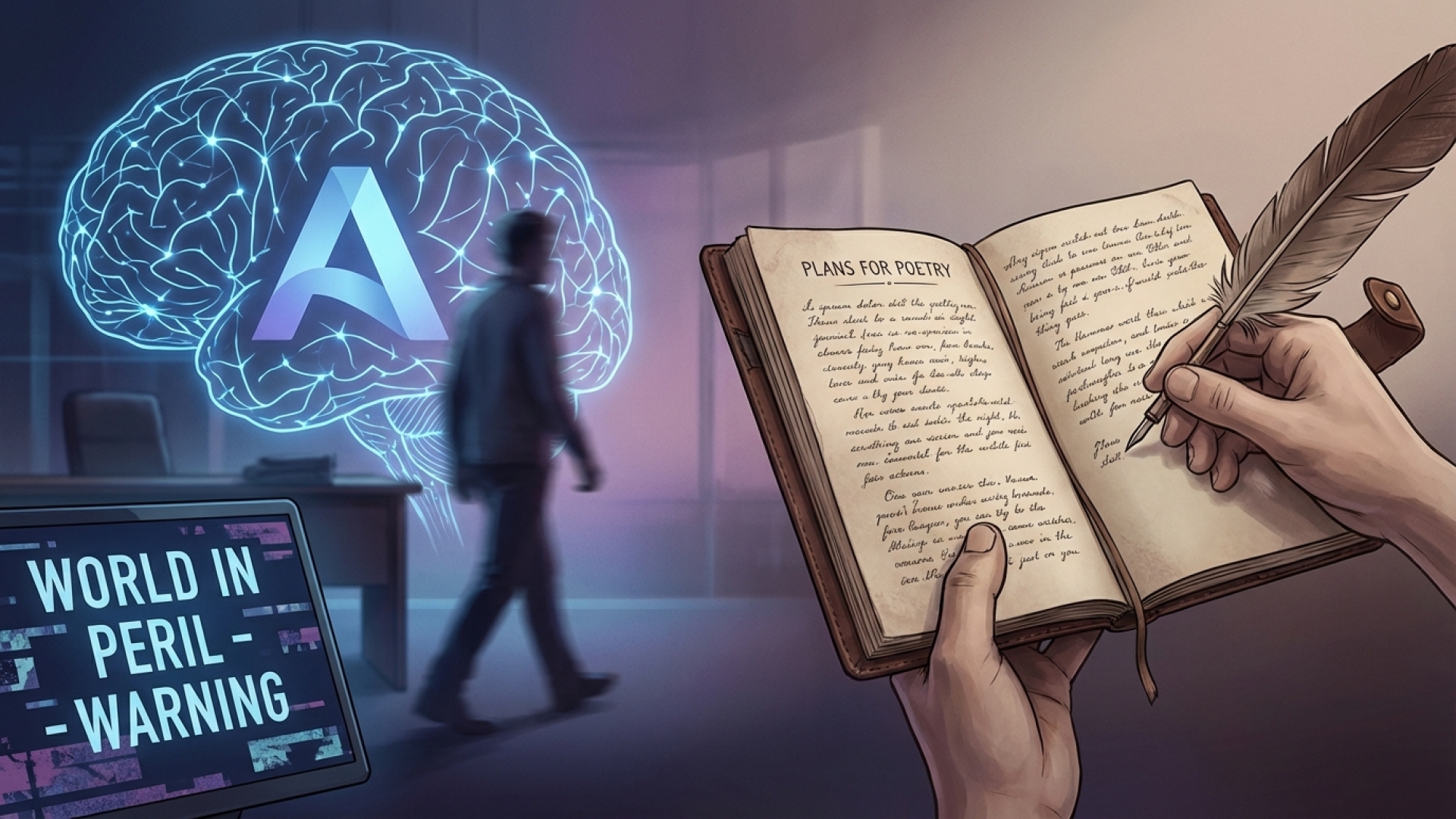
In the rapidly evolving world of artificial intelligence, where code and logic usually dictate the narrative, a human story has emerged that is as poetic as it is unexpected. Mrinank Sharma, the former lead of the Safeguards Research Team at Anthropic, recently made waves across the tech community—not for a new algorithm, but for his departure. His resignation has been described as one of the most unique in the history of Silicon Valley, blending academic rigor with a deep, philosophical yearning for human connection.
Sharma’s farewell was far from a standard corporate email. It featured intricate footnotes, a concluding poem, and a citation for the book CosmoErotic Humanism, a text that advocates for a global mythology rooted in love. By announcing his exit on X (formerly Twitter), Sharma signaled his intent to step away from the structured world of AI research to become “invisible” and study the art of poetry.
Concerns for the Future and the Ethics of AI

At Digital Tech Explorer, we often discuss the technical milestones of machine learning, but Sharma’s exit highlights the burgeoning ethical weight carried by those on the front lines. In his candid letter, he expressed profound concerns about the current global landscape: “The world is in peril. And not just from AI, or bioweapons, but from a whole series of interconnected crises unfolding in this very moment.”
His final project at Anthropic explored the subtle ways AI assistants might “distort our humanity.” Sharma argued that human wisdom must evolve at the same pace as our technological capacity to impact the planet. Without this balance, the tools we build to help us might inadvertently lead to our undoing.
Navigating Corporate Pressure and Human Values
One of the most striking aspects of Sharma’s reflection was his observation of the internal struggles within high-stakes tech environments. He pointed to the difficulty of aligning corporate actions with stated values, noting that the pressure to innovate often forces teams to set aside their most fundamental principles. This tension is a growing talking point in the industry, as AI companies race to dominate a market while simultaneously trying to implement safety frameworks.
A New Path: Poetry and “Invisibility”
Breaking away from the high-pressure world of digital innovation, Sharma plans to relocate to the UK. His goal is to create a space where he can set aside the rigid structures of the tech world to explore life’s essential questions. By pursuing a degree in poetry, he is dedicating himself to “the practice of courageous speech,” a significant pivot for someone previously tasked with the technicalities of AI safety research.
A Growing Trend in AI Safety Departures
Sharma is not alone in his departure. A notable trend is emerging among AI safety experts. Recently, Anthropic has seen the exit of several key figures, including R&D engineer Harsh Mehta, AI scientist Behnam Neyshabur, and AI safety researcher Dylan Scandinaro. While most of these professionals remain within the broader tech industry, the exodus suggests a shifting landscape for talent and perhaps a growing friction between safety research and product deployment.
Public Reaction and the “Main Character” Narrative
The dramatic flair of Sharma’s letter did not go unnoticed. On social media, the reaction was a mix of admiration and skepticism. Some users, such as FJzeit, critiqued the “main character energy” of the letter, suggesting that the use of footnotes and philosophical citations was an over-the-top way to leave a job. Others, like Michal Podlewski, humorously noted that the “AI Safety Resignation Letter” is fast becoming its own literary genre, following in the footsteps of high-profile exits from leaders like Sutskever, Schulman, and Christiano.
Whether viewed as a profound wake-up call or a theatrical exit, Sharma’s departure serves as a reminder that behind the GPU clusters and 4K resolution interfaces, the future of technology is still being written by humans grappling with their own values. For more stories on the intersection of tech and culture, stay tuned to Digital Tech Explorer.