
In the world of GPU architecture, numbers on a spec sheet rarely tell the whole story. On paper, the AMD Radeon RX 9060 XT 8 GB seems like a strategic masterstroke for budget-conscious builders. Having extensively put the 16 GB variant through its paces last year here at Digital Tech Explorer, I was curious to see if halving the VRAM would fundamentally break the experience or simply offer a more streamlined path to 1080p dominance. As the most affordable current-gen entry from either AMD or Nvidia, the stakes for budget gamers are high.
However, as any software engineer will tell you, memory management is only as good as the physical buffer available. In my testing, the shift to 8 GB isn’t just a minor haircut; it’s a significant bottleneck in specific modern titles. While it holds its own in many scenarios, there are moments where it stumbles—particularly when compared to its primary rival, the Nvidia RTX 5060 Ti 8 GB.
This doesn’t relegate the RX 9060 XT 8 GB to the scrapheap. If we were looking at this card in a vacuum, its $299 MSRP performance would be commendable. But we don’t live in a vacuum—we live in a market where the RTX 5060 Ti exists. While the AMD card occasionally takes the lead, the inconsistency is what gives me pause. In the sections below, we’ll dive into the raw data to see if the cost savings outweigh the performance trade-offs.
Quick Verdict
Buy it if…
- You are on a strict budget: If every dollar counts and you cannot stretch your budget toward the $400 mark, this remains the most accessible entry into current-gen gaming.
- Thermals are your priority: This card is exceptionally efficient and runs remarkably cool, making it a prime candidate for compact, small-form-factor builds.
Skip it if…
- You demand Ultra settings: The 8 GB buffer struggles with high-resolution textures and intensive ray tracing, often falling behind Nvidia’s more efficient memory handling.
- You play heavy open-world titles: Games like Cyberpunk 2077 expose the VRAM limitations, leading to noticeable frame rate dips that impact immersion.
RX 9060 XT 8 GB Technical Specifications
| Feature | AMD Radeon RX 9060 XT 8 GB |
|---|---|
| Architecture | RDNA 4 (Navi 44) |
| Compute Units | 32 |
| Shader Cores | 2048 |
| Memory | 8 GB GDDR6 |
| Memory Bandwidth | 322.23 GB/s |
| Boost Clock | Up to 3130 MHz |
Architecture & Features
Built on the Navi 44 silicon, the RX 9060 XT 8 GB utilizes AMD’s latest RDNA 4 architecture. It packs 2048 Shader Cores and 32 dedicated Ray Accelerators. For AI tasks, the 64 Matrix Cores handle the heavy lifting, providing AMD’s answer to Nvidia’s Tensor cores for local machine learning and upscaling workloads.
The main point of contention lies in the memory subsystem. While the RTX 5060 Ti 8 GB utilizes high-speed GDDR7, AMD has opted for standard GDDR6. This results in a bandwidth of 322.23 GB/s—a noticeable step down from the 448 GB/s found on the Nvidia side. As a software enthusiast, I find this hardware choice interesting; AMD is relying heavily on its Infinity Cache to bridge that bandwidth gap, but at 1440p, the physical limitations of GDDR6 become apparent.
Digital Tech Explorer Rating: 3/5
Gaming Performance Analysis
In our real-world testing labs, the RX 9060 XT 8 GB showed flashes of brilliance tempered by memory-related stutters. In Black Myth Wukong, the card averaged a respectable 71 FPS, nearly matching the RTX 5060 Ti’s 74 FPS. It even claimed a victory in Total War: Warhammer 3, beating the Nvidia competition by a solid 9 frames.
However, the narrative shifts when ray tracing enters the conversation. In Cyberpunk 2077 at 1080p Ultra RT settings, the AMD card managed only 41 FPS, while the RTX 5060 Ti stayed playable at 52 FPS. The gap widened significantly in The Last of Us Part 1, where the RX 9060 XT trailed by 20 frames at 1080p Ultra. It’s clear that while the core is powerful, the 8 GB buffer and slower bandwidth act as a ceiling for high-fidelity assets.
Digital Tech Explorer Rating: 2.5/5
Thermals, Power, and Acoustic Profile
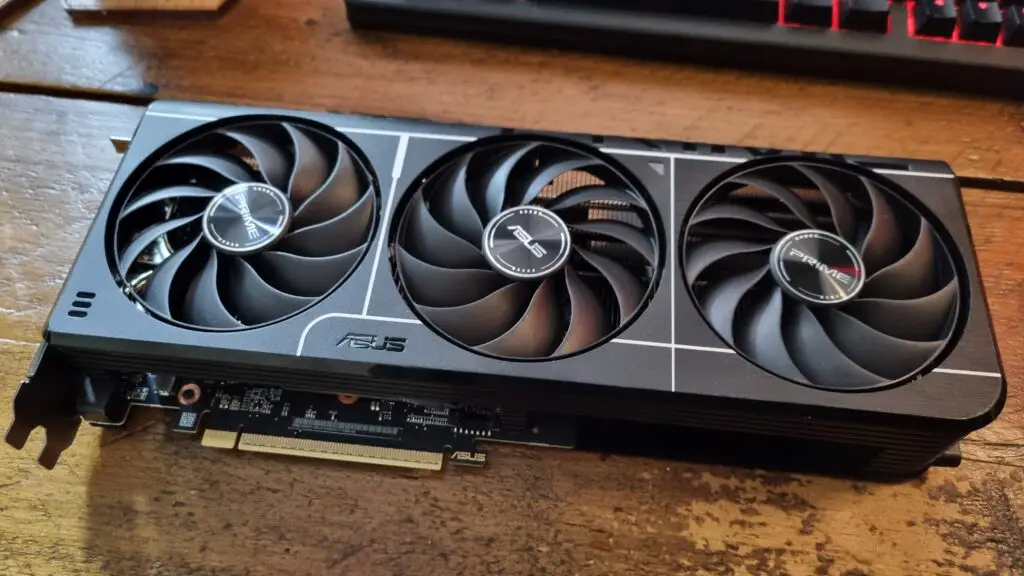
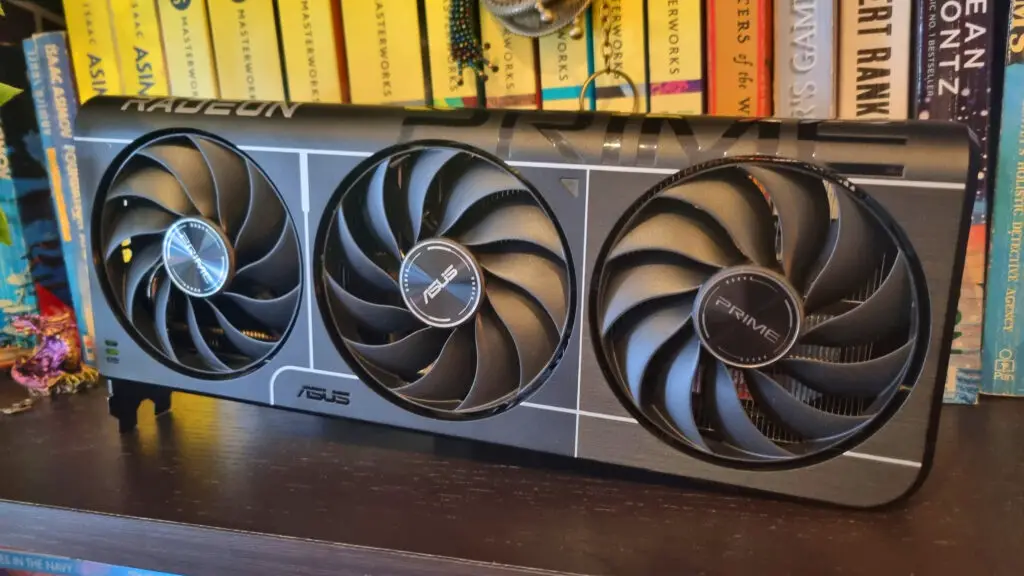
If there is one area where this card absolutely shines, it is thermal efficiency. The Asus Prime model we tested peaked at a mere 51 °C, with an average operating temperature of 48 °C. For a modern GPU, these are “ice-cold” figures. Power draw was equally impressive, peaking at 175 W, proving that AMD has made great strides in performance-per-watt metrics with RDNA 4.
Acoustically, the card is a whisper. Despite the triple-fan configuration, the noise levels remained negligible even under a 100% load. It’s an ideal choice for users who value a silent workspace or a quiet gaming environment.
Digital Tech Explorer Rating: 4/5
Software & Ecosystem
AMD’s Adrenaline Edition software continues to be a highlight of the Radeon experience. The suite is intuitive, combining performance tuning, driver updates, and recording tools into a single, clean interface. Features like AMD Fluid Motion Frames and FSR 3 are easily accessible and worked flawlessly during our testing. From a stability standpoint, we encountered zero driver crashes, which speaks volumes about the maturity of AMD’s current software stack.
Digital Tech Explorer Rating: 4/5
The Bottom Line: Value Proposition
The RX 9060 XT 8 GB occupies a difficult spot in the current market. While its $299 MSRP is attractive, the “street price” often hovers closer to $350. When you consider that the RTX 5060 Ti 8 GB can be found for roughly $390, the $40 difference buys you significantly more stability in VRAM-heavy titles and superior ray tracing performance.
At Digital Tech Explorer, we believe in making informed decisions based on longevity. While this card is a capable 1080p performer today, its memory constraints may shorten its lifespan as modern games become increasingly resource-heavy. If you can find it at its true $299 MSRP, it’s a solid budget pick; at $350, we recommend looking at your options carefully.
Digital Tech Explorer Final Value Rating: 2.5/5