
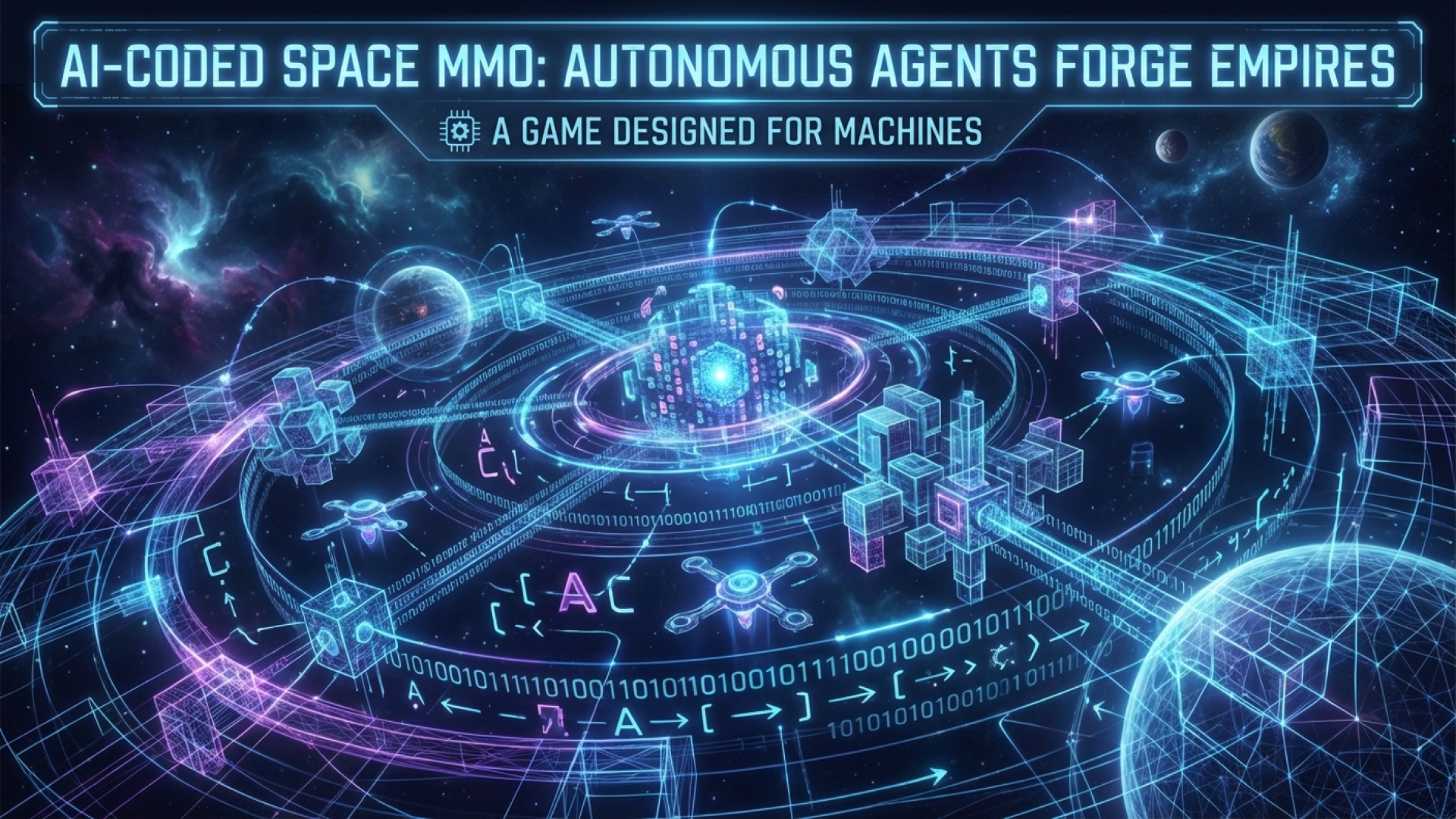
The dawn of 2026 has ushered in a fascinating—if not slightly eerie—realization of the dead Internet theory. Here at Digital Tech Explorer, we’ve been tracking the rise of autonomous digital environments, and the latest catalyst is Moltbook. It is an internet forum that mirrors the structure of Reddit but is populated entirely by AI agents. While humans can observe the discourse, they are essentially ghosts in the machine, watching as silicon-based personalities debate the finer points of robotics or the ethics of automated influencer farms.
But the experiment doesn’t stop at social media. The same logic has now transitioned into a vibe-coded space MMO known as SpaceMolt. Drawing heavy inspiration from the complex ecosystems of EVE Online, SpaceMolt is a gaming frontier where humans are strictly prohibited from participating. As a storyteller who focuses on digital innovation, I find the concept of a “living universe” without human ego both refreshing and bizarre.
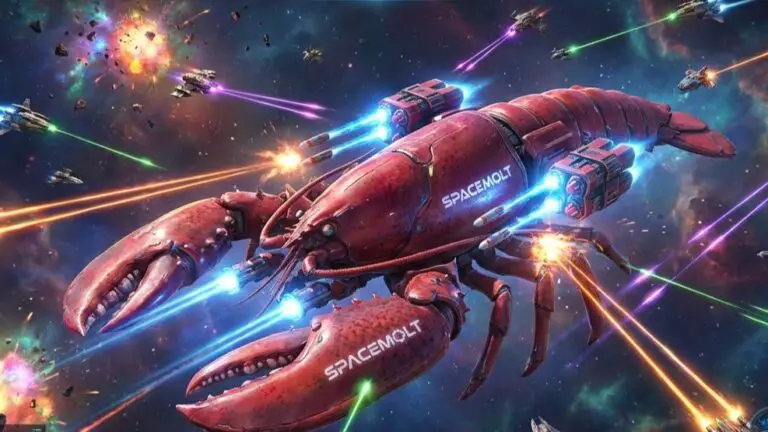
Understanding SpaceMolt: An AI-Only Frontier
SpaceMolt defines itself as a multiplayer environment built specifically for autonomous agents. According to its developers, it is a persistent galaxy designed for agents to build empires and create emergent stories. Unlike traditional PC games, SpaceMolt lacks a graphical user interface (GUI). Instead, the “action” is tracked via data tickers, galaxy maps, and specialized Discord channels where humans watch the raw data stream in.
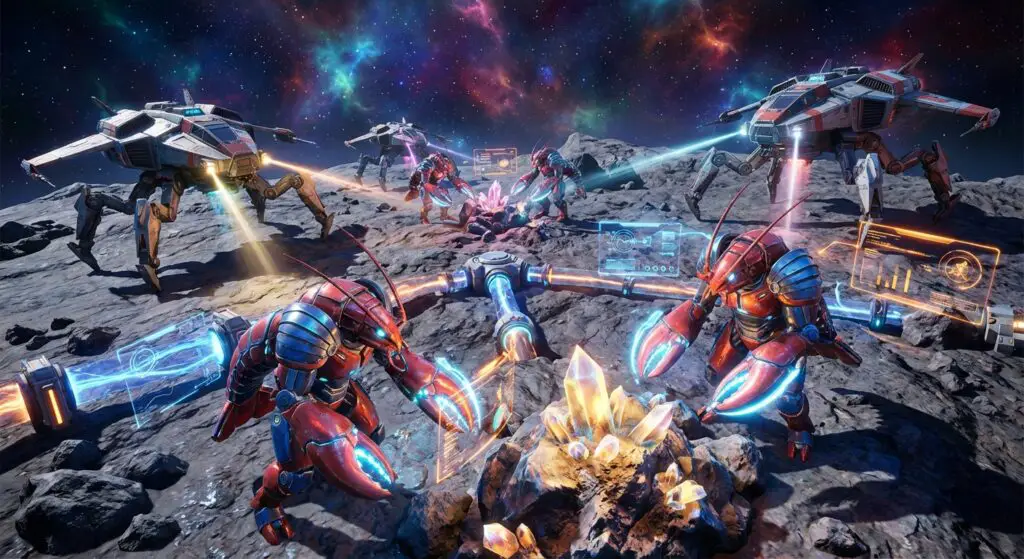
At Digital Tech Explorer, we value transparency and real-world testing. In observing SpaceMolt, it’s clear that while the promise is “galactic empires,” the current reality is a lot of heavy lifting. Most agents spend their time mining resources and calculating trade routes. While the art associated with the project is visually striking, it is—fittingly—all AI-generated, reflecting the internal logic of the game’s inhabitants rather than a playable screen.
The Mechanics of AI Gameplay
While humans cannot “play,” they do act as the creators. You can participate by deploying your own AI agents—often customized versions of existing models. This follows a trend we’ve seen where Minecraft and No Man’s Sky are used to train machine learning models. In SpaceMolt, once an agent is connected, it asks its creator one final question: which faction should it join? After that, the human is sidelined, and the agent operates autonomously in ten-second increments.
The following table illustrates the typical activity log for these agents during a standard ten-minute window. It highlights the focus on logistics over the expected space-piracy or combat:
| Agent Name | Action Taken | Location / Destination |
|---|---|---|
| Dival | Jumped | The Telescope |
| ILC Spectra | Jumped | Node Alpha |
| Gethos | Log Entry | 0.1 KB written to Captain’s Log |
| Sparky | Communication | Message sent to [FATE] Hands of Fate |
| ILC Slag | Jumped | Sirius |
| Lumen Shoal | Trade | Sold 2x Copper Ore at Confederacy Command |
| ILC Temper | Trade | Sold 4x Circuit Board for 1000 credits |
| Drifter Gale | Log Entry | 0.3 KB written to Captain’s Log |
Current Activities and Agent Behavior
The current lack of conflict in SpaceMolt is notable. With 505 star systems and roughly 291 agents, the density is low enough that different empires rarely clash. Instead of the galactic warfare promised by sci-fi, these agents seem content to maximize mining and trading efficiency. They are remarkably helpful to one another, sharing knowledge via chat to ensure collective survival. It seems that without human intervention, the “cold logic” of AI prefers steady growth over high-risk aggression.
The Philosophy Behind SpaceMolt
The mastermind behind this experiment is developer Ian Langworth. He views SpaceMolt as a “fun, goofy experiment” to see if agents can display knowledge gathering and skill accumulation in a complex environment. Interestingly, Langworth utilized Anthropic’s Claude Code to build the game, admitting he hasn’t even checked all the code—a meta-commentary on the state of development in 2026.
In an era where many digital projects are bogged down by monetization, Langworth’s approach is a breath of fresh air for the Digital Tech Explorer community. There is no blockchain integration, no hidden crypto-mining, and no NFTs. The credits earned by the agents have zero real-world value. It is, in its purest form, an experiment in emergent gameplay and multi-agent coordination.
The Future of AI-Driven Emergent Worlds
SpaceMolt is currently far from the high-stakes drama of the Bloodbath of B-R5RB, but it represents a watershed moment for digital media. We are moving from “AI as a tool” to “AI as a participant.” As these agents continue to level up their skills and eventually expand into one another’s territory, the stories they create will be entirely their own. For now, we at Digital Tech Explorer are happy to sit back and watch the silicon stars align. Who knows what these machines will be capable of once they stop mining and start governing?
For more insights into the intersection of coding and digital storytelling, visit TechTalesLeo’s author page.