
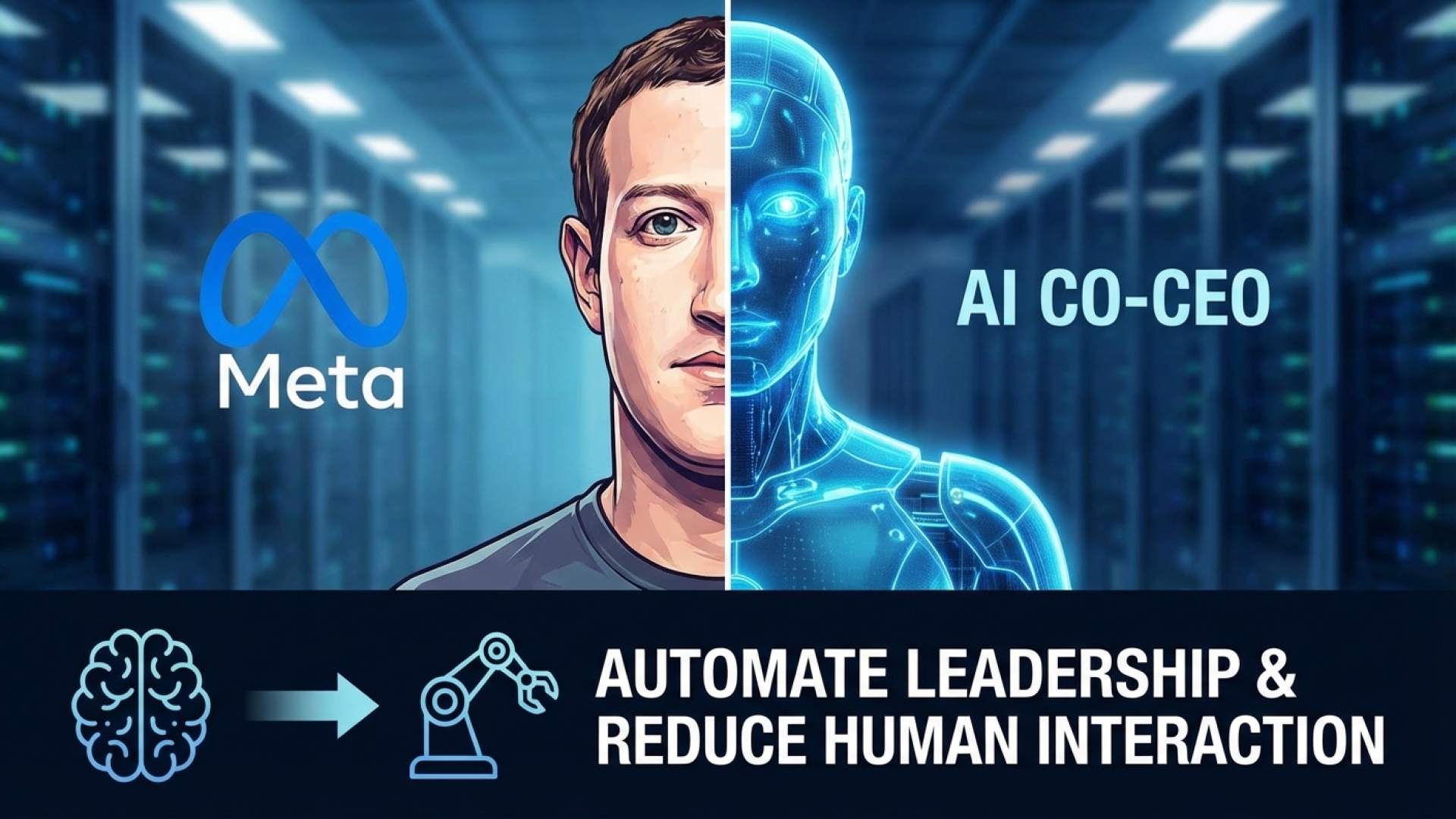
In a move that feels ripped straight from a science-fiction script, Mark Zuckerberg is reportedly developing a personal AI agent to assist him in his daily duties as the Meta CEO. At Digital Tech Explorer, we’ve been tracking the rapid evolution of AI acceleration, but this initiative represents a pivot from traditional leadership toward a future where human interaction is secondary to digital efficiency.

AI Integration at Meta: A New Era for Leadership
This project is a cornerstone of Zuckerberg’s broader strategy to position Artificial Intelligence as the foundational medium for Meta’s operations. The goal is to reduce the “friction” of human communication, allowing an AI assistant to handle information retrieval and synthesis that would typically require hours of direct meetings with staff.
Meta’s AI-Native Approach: Flattening the Organizational Structure
During a recent earnings call, Zuckerberg highlighted Meta’s heavy investment in AI-native tooling. The objective? To “flatten” the organizational structure. By empowering individual contributors with powerful software solutions, the company aims to reduce the layers of middle management that often slow down innovation.

Meta is putting this theory into practice within its new AI engineering division. Here, the traditional management ratio has been discarded; in some cases, up to 50 employees report to a single manager. This lean structure relies on the assumption that AI agents will handle the logistical and communicative overhead that would otherwise cause a team of this size to collapse.
Internal AI Tools: The Digital Workforce
To support this transition, Meta employees are testing a suite of specialized internal tools. These are not just simple chatbots; they are sophisticated agents integrated into the company’s workflow. Below is a breakdown of the primary tools currently in development:
| Tool Name | Primary Function | Key Capability |
|---|---|---|
| My Claw | Communication Bridge | Facilitates dialogue between human employees and their AI counterparts by referencing chat logs. |
| Second Brain | AI Chief of Staff | Parses massive amounts of project documentation to provide instant insights to staff members. |
| Agent Social | AI Networking | A dedicated internal board where employee-owned AI agents interact and share data autonomously. |

The Moltbook Acquisition and the Future of Connection
Meta’s hunger for an automated future recently led to the acquisition of Moltbook. This social media platform is unique because its population consists almost entirely of AI bots. While some reports suggest humans were behind the platform’s most viral moments, Meta’s interest lies in the technology that powers a bot-centric ecosystem.
As TechTalesLeo, I find this shift fascinating. Zuckerberg is effectively betting on a digital landscape where AI companions—functioning as friends, therapists, or coworkers—are more efficient and perhaps more desirable than traditional human connections. It is a bold, albeit polarizing, vision for the future of digital innovation.
The Human Cost: AI vs. Workforce
The aggressive integration of AI hardware and software isn’t without its consequences. Recent reports suggest Meta is considering sweeping layoffs, potentially impacting up to 20% of its global workforce. This highlights a sobering reality: as Meta becomes “AI-native,” the need for a large human staff may continue to dwindle.

Stay tuned to Digital Tech Explorer as we continue to cover how machine learning and automation are redefining the tech giants we interact with every day.
For more insights on the latest tech trends, visit the author page for TechTalesLeo.