
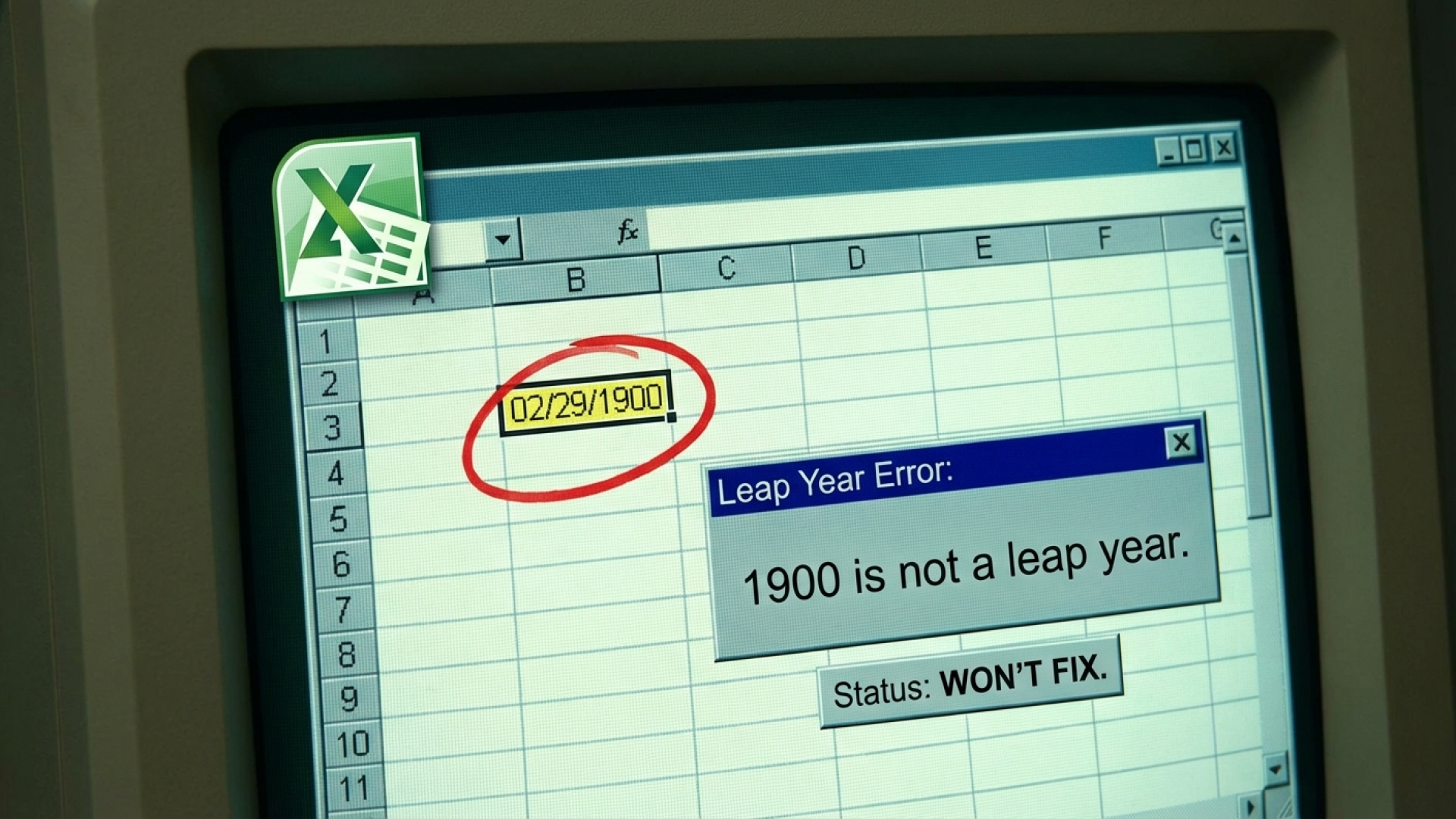
At Digital Tech Explorer, we often dive deep into the documentation that keeps our modern world running. Recently, tucked away within the technical archives of Microsoft’s Learn site, a curiously titled article resurfaced: “Excel incorrectly assumes that the year 1900 is a leap year.” For seasoned developers and spreadsheet veterans, this isn’t news—it’s a legendary piece of software lore. However, for those of us tracking the evolution of digital innovation, it serves as a startling reminder of how legacy code can become an unshakeable foundation.

The 1900 Leap Year Anomaly Explained
The crux of the issue is a mathematical falsehood: Microsoft Excel treats the year 1900 as a leap year, even though the Gregorian calendar dictates it was not. In the calendar system we use today, a year is a leap year if it is divisible by 4, except for years divisible by 100—unless they are also divisible by 400. Therefore, 1600 and 2000 were leap years, but 1700, 1800, and 1900 were not.
By including February 29, 1900, Excel shifts every date prior to March 1, 1900, by exactly one day. While this sounds like a minor oversight, it was a calculated decision rooted in the cutthroat tech landscape of the 1980s.
| Date | Actual Calendar Status | Excel’s Calculation |
|---|---|---|
| February 28, 1900 | Correct | Day 59 |
| February 29, 1900 | Does Not Exist | Day 60 |
| March 1, 1900 | Correct | Day 61 (Should be 60) |
Inheriting the Bug: The Lotus 1-2-3 Legacy
As TechTalesLeo, I find the origin story of this bug fascinating. It traces back to Lotus 1-2-3, the software that effectively pioneered the spreadsheet industry. When Lotus was first developed, the engineers intentionally (or perhaps accidentally, though records vary) included the 1900 leap year to simplify their date-handling code and save precious memory—a commodity in short supply during the early days of personal computing.
When Microsoft launched Multiplan and eventually Excel, they faced a massive hurdle: if they wanted users to migrate from Lotus, their software had to be 100% compatible with existing Lotus worksheets. If Excel had “fixed” the date bug, any spreadsheet imported from Lotus involving dates would have broken. To win the market, Microsoft chose to replicate the error, ensuring a seamless transition for business professionals.

Why Microsoft Will Never Fix It
Today, there are an estimated 750 million to 1 billion Excel users worldwide. Microsoft has openly admitted that while correcting the bug is technically possible, doing so would be catastrophic. It is the ultimate “house of cards” scenario in the world of software development and data integrity.
If Microsoft were to issue a patch to correct the 1900 leap year anomaly, the following would occur:
- Formula Breakdown: Almost every date in existing workbooks would shift back by one day, breaking financial models, historical tracking, and project timelines.
- Function Failure: The
WEEKDAYfunction would return incorrect values for decades of historical data. - Interoperability Issues: Serial date compatibility between Excel and other databases or blockchain data structures relying on this standard would be severed.
The Impact on Modern Users
Fortunately, for the vast majority of us at Digital Tech Explorer, the impact is negligible. Unless you are a historian or a researcher specifically calculating day-of-the-week data for January or February of 1900, you will likely never encounter an error. Microsoft notes that “because most users do not use dates before March 1, 1900, this problem is rare.”

A Feature Defined by History
In the tech world, we often talk about “bugs” and “features.” The 1900 leap year problem has officially transcended bug status to become a permanent feature of our digital infrastructure. It’s even codified in the Open Office XML (OOXML) standard. This story reminds us that in the race for innovation, sometimes the path is dictated by the legacy of those who came before us. For more deep dives into the quirks of the tech that powers your life, keep exploring with us here at Digital Tech Explorer.