
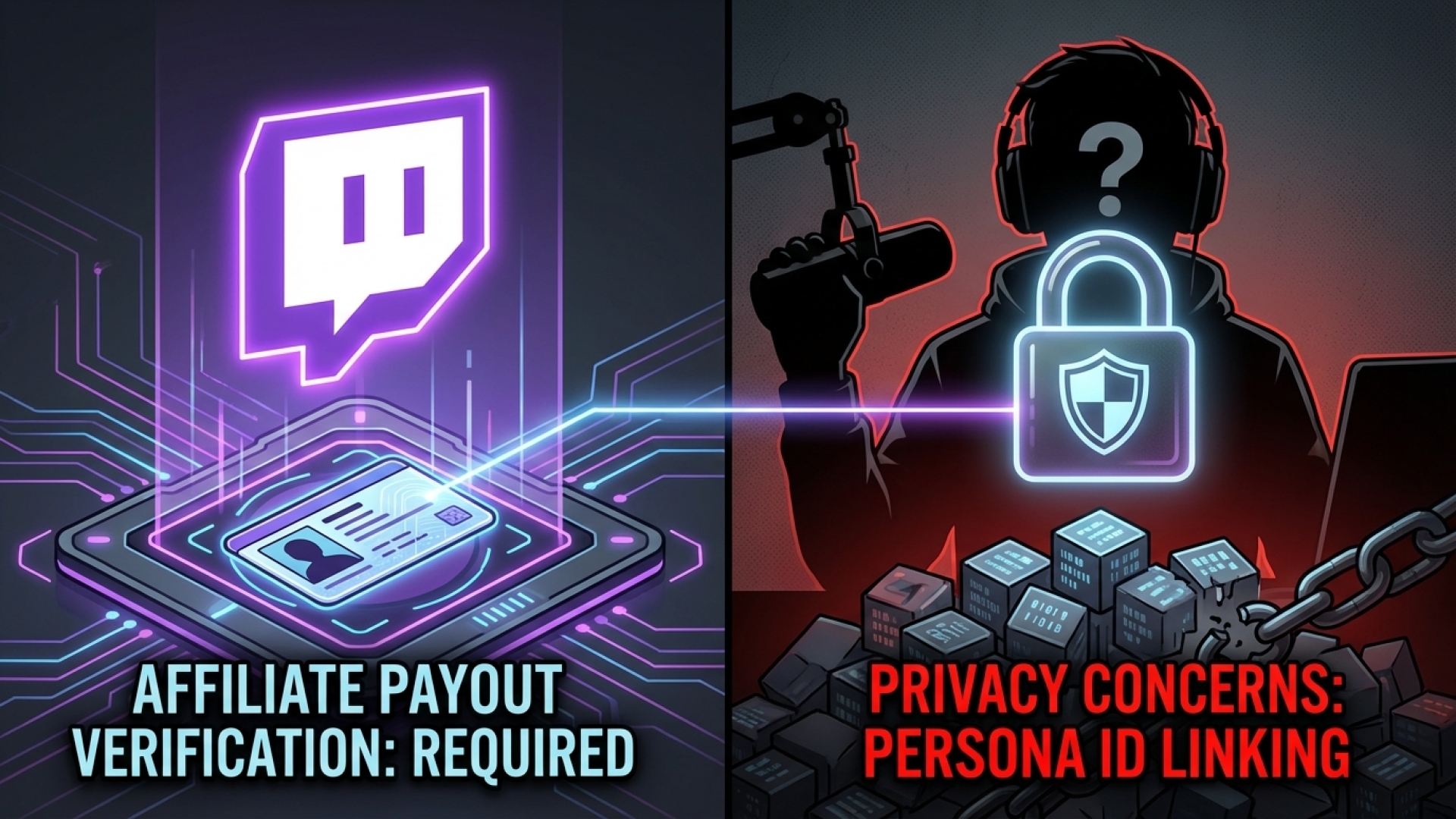
In the ever-evolving digital landscape, where AI-generated content and “brain rot” trends dominate our feeds, a more serious shift is quietly taking place: the normalization of mandatory identity verification. At Digital Tech Explorer, we’ve been tracking how platforms balance security with user privacy. Most recently, Twitch has sparked a significant conversation by introducing new requirements for its streamers, outsourcing the process to a third-party provider that has raised more than a few eyebrows in the tech community.

The New Standard for Twitch Payouts
As a storyteller in the digital space, I’ve seen many platforms tighten their gates, but Twitch’s latest move feels particularly impactful for emerging creators. Reports from the streaming community, including insights from users like Tawny Code Cat, reveal that Twitch now requires new Affiliate streamers to verify their identities through Persona, a third-party ID-checking service, before they can access their hard-earned payouts.
The platform has formalized this in its official documentation, noting that verification is triggered when payments are placed “on hold.” According to the walkthrough, streamers will receive specific email notifications and see alerts in their Payout Eligibility Panel if they are selected for this mandatory ID check. While security is the stated goal, the reliance on an external vendor has triggered a wave of skepticism.
Who is Persona? The Privacy Debate
At Digital Tech Explorer, we believe in transparency, and the concerns surrounding Persona are worth exploring. Much of the apprehension stems from the company’s financial roots—specifically, significant investment from Peter Thiel, the co-founder of Palantir. For many in the coding and privacy sectors, this association is a red flag, as Palantir is well-known for its deep ties to government surveillance and big-data analytics.
Critics argue that Persona is more than a simple age verification tool. Some tech analysts suggest the service could be integrated into broader surveillance frameworks, creating a permanent digital footprint that links a creator’s real-world identity to their online persona in ways that are difficult to retract.
| Platform | Verification Provider | Primary Reason for ID Check |
|---|---|---|
| Twitch | Persona | Affiliate Payout Eligibility |
| Discord | Persona (Limited Test) | Access to Age-Restricted Content |
| X (Twitter) | Au10tix | Premium Account Authentication |
| OnlyFans | Ondato / Various | Compliance and Age Assurance |
The “Discord Connection” and the Verification Trend
Twitch isn’t the first gaming-adjacent giant to leverage Persona. Discord recently faced its own backlash when it rolled out facial scanning and ID checks for users in the UK. While Discord eventually clarified that the use of Persona was part of a “limited test” that has since concluded, the experiment left a sour taste in the mouths of privacy advocates.
This trend toward mandatory identification is driving some users to seek Discord alternatives and more decentralized software solutions. For Twitch streamers, the stakes are higher; because their livelihood is tied to the platform, opting out isn’t as simple as switching apps.
Looking Ahead: Data Privacy in the Digital Age
As we navigate these emerging technology trends, the question remains: how much personal data is a “free” or “monetized” platform worth? For now, the Persona requirement is limited to a subset of Affiliate streamers, but the precedent it sets is clear. Whether you are a seasoned professional or a novice in the PC gaming world, understanding who holds your data—and why—is the first step in staying ahead of the curve.
For more in-depth tech news and software reviews, stay tuned to Digital Tech Explorer.
Disclaimer: All content on Digital Tech Explorer is for informational and entertainment purposes only. Some links may be affiliate links, meaning we earn a commission at no extra cost to you. We do not provide financial or legal advice.