
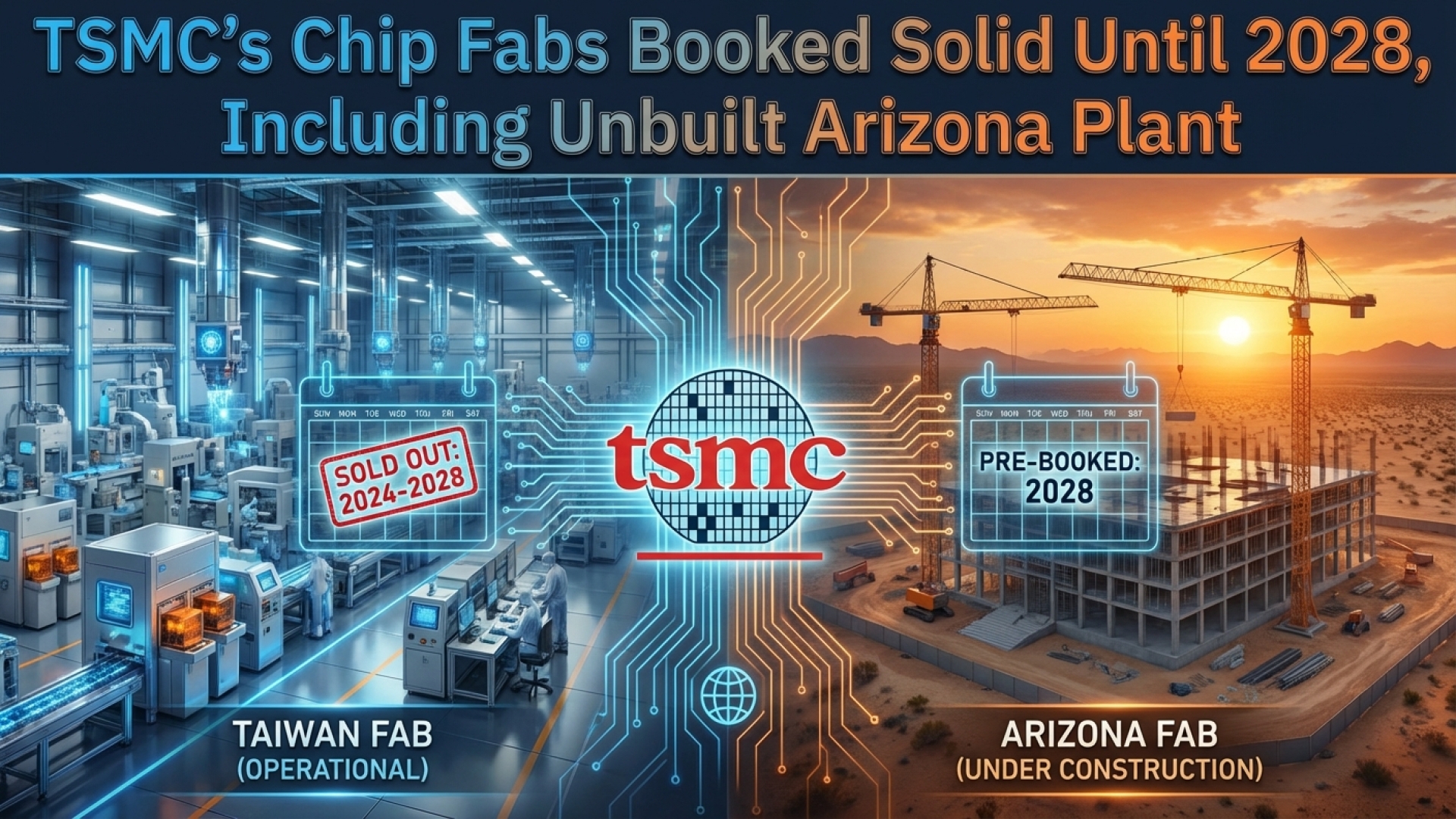
The global silicon landscape is witnessing a seismic shift as the Taiwanese megafoundry TSMC is reportedly sold out through 2028. This production bottleneck includes the highly anticipated N2 node, a cutting-edge architecture expected to power the next generation of hardware from industry titans like Apple, Nvidia, AMD, and Intel. Recent reports suggest that the demand is so intense that TSMC has already fully booked capacity for fabrication plants that haven’t even finished construction.
According to insights from South Korean outlet Chosun, this surge is driven by a “perfect storm” of traditional chip buyers and new, AI-driven entrants like Google and Amazon. With TSMC’s manufacturing capacity entirely allocated for the foreseeable future, a unique window of opportunity may be opening for Samsung to position itself as a necessary alternative in the foundry market.
The Race for Future Fabs
While TSMC is aggressively expanding its footprint, the timeline for new capacity to come online is measured in years, not months. Interestingly, the reservation list is closing faster than the concrete can dry. For instance, the fourth TSMC plant in Arizona, which is slated for mass production in 2030, is reportedly already fully booked. This highlights a staggering level of forward-planning by tech giants desperate to secure their future hardware pipelines.
The Arizona Fab 4 is being tailored for the N2 node, illustrating the long-term roadmap for current semiconductor technology. While TSMC continues to keep its most advanced “crown jewel” nodes—like the upcoming A14 node expected in 2028—primarily within its Taiwan-based facilities, the global expansion is a clear nod to the geopolitical and logistical pressures of modern tech manufacturing.
Foundry Market Share Comparison
The following table illustrates the current dominance of TSMC in the global foundry market compared to its primary competitors.
| Manufacturer | Market Share | Next-Gen Node Target | Primary Focus |
|---|---|---|---|
| TSMC | 72% | N2 / A14 | Apple, Nvidia, AMD, AI |
| Samsung | 7% | 2nm (GAA) | Mobile, Tesla, Nvidia |
| Intel | <5% (External) | 18A / 14A | Internal, Data Centers |
The Competitive Landscape: Samsung and Intel
Currently, TSMC holds a commanding 72% of the global chip foundry market. By contrast, Samsung holds roughly 7%. While some industry analysts argue that only TSMC and Samsung are currently positioned to deliver 2nm chip manufacturing, Intel remains a wild card. With its 18A and 14A nodes on the horizon, Intel is positioning itself as a domestic alternative, though the company has been notably quiet regarding high-profile external foundry clients.
Recent whispers suggest that both Tesla and Nvidia have begun exploring or committing to Samsung’s latest fabrication tech. This diversification is a logical move; if TSMC is truly “sold out,” the rest of the industry must find a home for their designs or risk missing the AI acceleration wave entirely. However, shifting production between foundries is a multi-year process that requires significant architectural adjustments.
What This Means for PC Enthusiasts
For those of us in the gaming and developer communities, these corporate capacity struggles have a very real impact on our wallets. As long as cutting-edge silicon is prioritized for high-margin AI applications, the cost of consumer components like GPUs and CPUs is unlikely to drop.
At Digital Tech Explorer, we keep a close eye on these supply chain shifts because they dictate the next decade of performance. With PC games becoming increasingly demanding and RAM and storage costs climbing alongside processor prices, the era of “cheap” high-end computing may be on a permanent hiatus. The narrative of the next few years will not be about who has the best design, but who has the actual physical capacity to build it.
Stay tuned to Digital Tech Explorer for more in-depth analyses on how semiconductor trends are shaping the future of technology. For more stories from the intersection of coding and hardware, visit my author page.