

The explosive growth of Artificial Intelligence (AI) has done more than just dominate headlines; it has fundamentally reshaped the global technology landscape. At Digital Tech Explorer, we have been closely monitoring how this “AI gold rush” has triggered a systemic memory crisis, pushing manufacturers to their absolute limits. Perhaps no company better illustrates this tectonic shift than TSMC (Taiwan Semiconductor Manufacturing Company), which recently unveiled financial results that didn’t just meet expectations—they shattered every internal and external record on the books.
TSMC’s Record-Breaking Financial Performance
In a detailed analysis of the first quarter of 2026, TSMC’s financial trajectory reached unprecedented heights. While the semiconductor giant had previously guided investors toward revenues between $34.6 billion and $35.8 billion, the actual results for the January-to-March window revealed a staggering net revenue of $35.90 billion.
This represents a massive 40% year-on-year increase, marking the company’s eighth consecutive quarter of double-digit growth. To put this momentum into perspective, TSMC has already adjusted its Q2 projections upward to a range of $39.0 billion to $40.2 billion—a giant leap from the $30.07 billion recorded during the same period in 2025.
| Metric | Q1 2025 Performance | Q1 2026 Performance | Year-over-Year Growth |
|---|---|---|---|
| Net Revenue | $25.64 Billion | $35.90 Billion | 40% |
| Wafer Shipments | Baseline | +28% Increase | N/A |
| Projected Q2 Revenue | $30.07 Billion | $39.0 – $40.2 Billion | ~30-34% |
The Driving Force: AI Demand and Advanced Node Production
As a storyteller in the tech space, it’s fascinating to see how the narrative of AI translates into physical silicon. TSMC Chief Executive C.C. Wei recently described AI-related demand as “extremely robust,” a sentiment backed by a 28% year-on-year surge in wafer shipments. The hunger for high-performance computing (HPC) chips is essentially outstripping the current manufacturing capacity of the planet.
The revenue breakdown by technology reveals a clear shift toward cutting-edge nodes:
- 3-Nanometre (3nm) Wafers: Now accounting for 25% of total wafer revenue, these are being utilized for the next generation of AI processors, including Nvidia’s upcoming Rubin architecture.
- 5-Nanometre (5nm) Wafers: These remain the current workhorse of the industry, contributing a significant 36% to the total revenue stream.
Global Impact: Why Your PC Upgrade Is Getting More Expensive
For our community of builders, developers, and tech enthusiasts at Digital Tech Explorer, this corporate success story has a challenging side effect: the price of hardware. The intense focus on AI-grade silicon has strained the supply chain for consumer-grade components. The current memory crisis has driven up prices for system memory (RAM) and SSDs significantly.
As manufacturers pivot their production lines to satisfy the high-margin AI market, the average consumer is left facing a “perfect storm” of low supply and high demand, making it more difficult than ever to find affordable storage and memory solutions for gaming rigs or professional workstations.
The Road Ahead: Arizona and Future Capacity
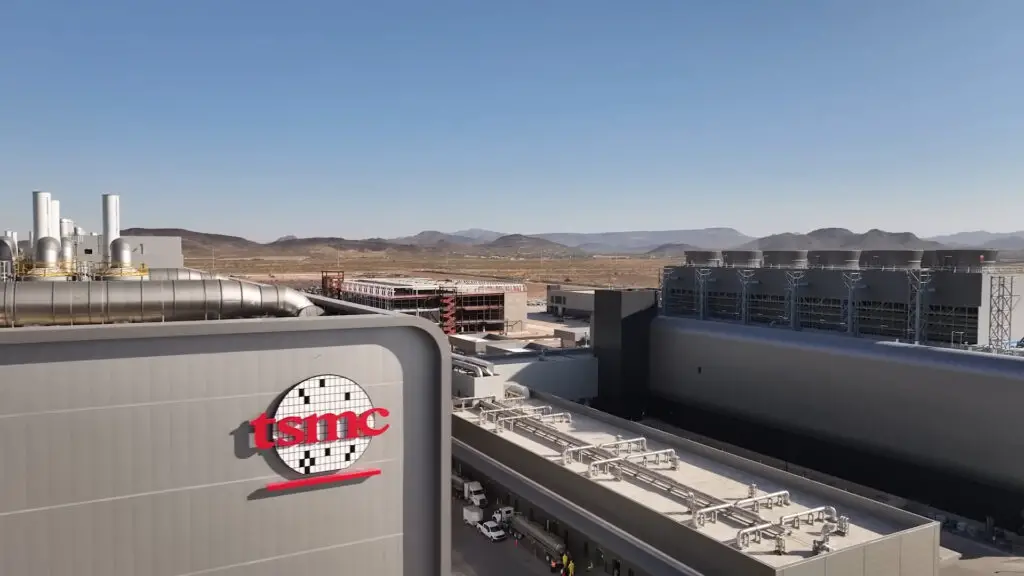
To mitigate these supply constraints, TSMC is investing heavily in global expansion. The company has committed a staggering $165 billion to its “gigafab” cluster in Phoenix, Arizona. This site is already producing 4-nanometre wafers, with 3-nanometre production slated to begin next year.
However, relief may not be immediate. Current industry reports suggest that TSMC’s total production capacity is effectively booked solid until 2028. Even the output for the Arizona fabs, which are still under construction, is reportedly fully reserved by major tech players. For the tech world, this signals that while innovation is moving at light speed, the physical infrastructure required to support it is still racing to catch up.
Stay tuned to Digital Tech Explorer as we continue to track these developments and provide you with the deep-dive analyses you need to navigate the evolving world of hardware and digital innovation.