
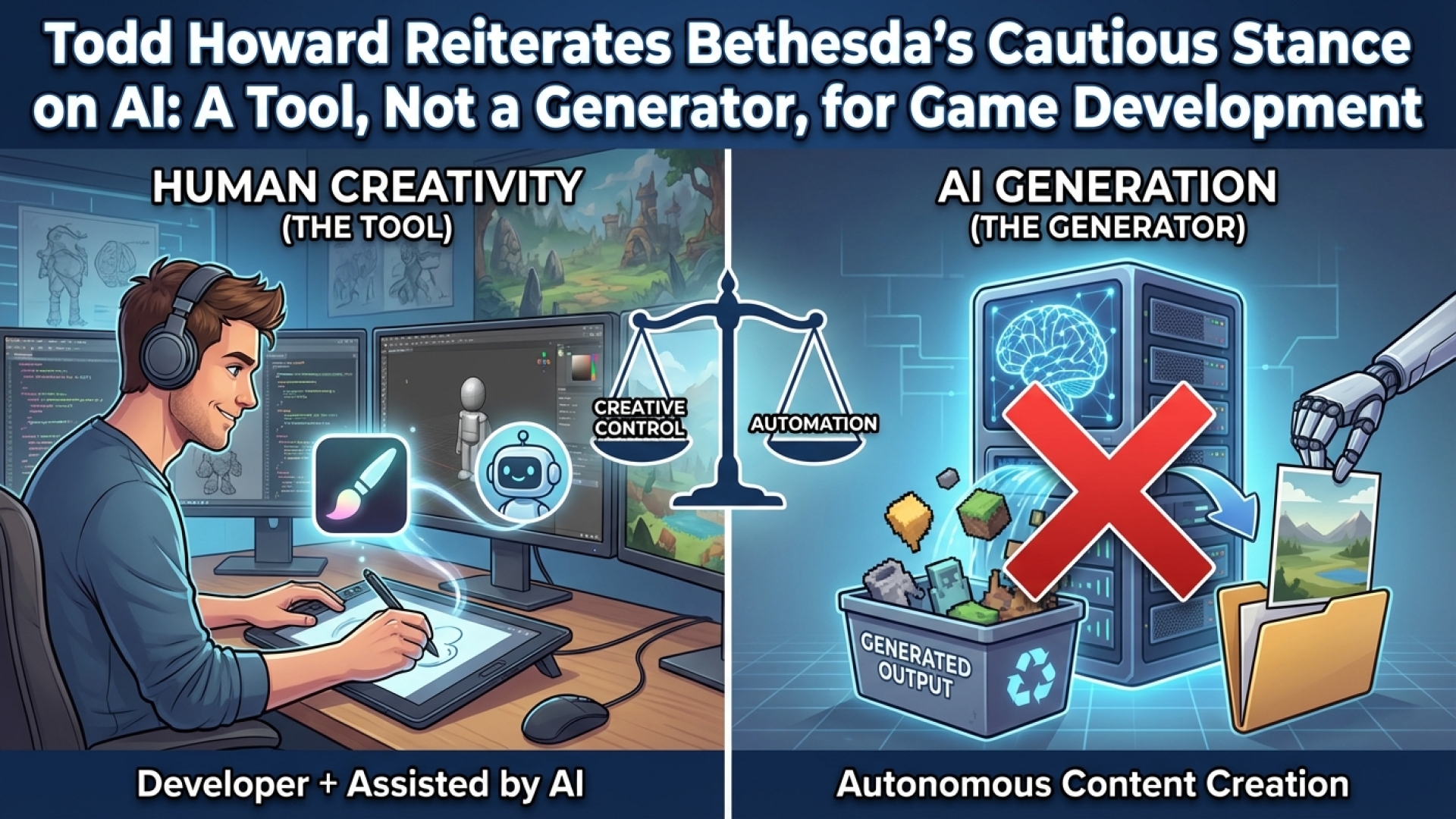
At Digital Tech Explorer, we closely monitor how emerging technologies reshape the creative landscape. Recently, Bethesda CEO Todd Howard revisited the conversation surrounding Artificial Intelligence (AI) in game development, offering a perspective that balances modern efficiency with traditional craftsmanship. Howard firmly stated that AI is “not a fad,” yet he emphasized that Bethesda remains committed to human-driven design rather than automated content generation.
Todd Howard on AI: A Tool, Not a Creator

In his latest insights, Howard acknowledged the rapid evolution of AI technology, noting that new models for coding and productivity surface every few months. However, Bethesda’s philosophy remains rooted in the “craftsman” approach. While many studios are looking toward generative AI to build worlds, Bethesda is prioritizing the specific artistic vision that only human creators can provide.
This stance is a testament to the studio’s dedication to quality. By focusing on manual design, Bethesda ensures that every environment and narrative beat in their PC games feels intentional and unique, rather than a product of algorithmic probability. For TechTalesLeo, this narrative underscores a vital truth: technology should enhance the storyteller’s voice, not replace it.
Utilizing AI for Data Analysis and Backend Efficiency

While Bethesda avoids generative AI for creative assets, they are actively exploring machine learning as an analytical utility. Howard described the technology as a sophisticated “analyst” capable of parsing through massive datasets within their games. By automating these “big data tasks,” the studio can identify bugs, balance gameplay mechanics, and streamline production pipelines.
This strategic use of AI acceleration allows developers to offload repetitive, time-consuming technical work. The result? Creative teams can spend more time on the nuances of world-building and character development. At Digital Tech Explorer, we value this transparent look at how high-end studios use software to maintain their competitive edge without compromising artistic integrity.
The Industry Divide: Comparing Perspectives on AI
The gaming industry is currently split on how to integrate AI. To help you stay ahead of these trends, we’ve summarized the varying viewpoints from some of the industry’s most influential figures below:
| Industry Leader | Company | Primary Stance on AI |
|---|---|---|
| Todd Howard | Bethesda | Uses AI for data analysis; rejects it for content generation. |
| Tim Sweeney | Epic Games | Believes AI will be involved in nearly all future production. |
| Dan Houser | Rockstar (Co-founder) | Highly critical; questions the humanity and motives behind its adoption. |
As Tim Sweeney suggests, the industry may eventually view AI as an invisible part of the toolkit, much like GPU rendering techniques. However, the “slippery slope” remains a concern for many. The challenge for developers in 2024 and beyond will be defining exactly where machine assistance ends and creative autonomy begins.
Looking Ahead: The Future of Handcrafted Experiences
Bethesda’s cautious trajectory serves as a blueprint for studios that value brand identity over rapid, automated expansion. By keeping the “artistic soul” of their games human-centric, Bethesda aims to preserve the magic that has defined their most acclaimed titles. Whether it’s a massive sandbox adventure or a complex RPG, the human touch remains the gold standard in gaming.
As technology evolves, TechTalesLeo and the Digital Tech Explorer team will continue to provide in-depth analysis and real-world testing of these innovations. We believe that informed developers and enthusiasts make better decisions, and Bethesda’s current path highlights a commitment to that very principle.

- Stay updated on the latest 2024 releases and upcoming 2024 game trends.
- Explore our top-rated PC games for this year.
- Discover how hardware advancements are changing the way we play.
- Check out our deep dives into 3D gaming and high-resolution 4K experiences.
Disclaimer: All content on Digital Tech Explorer is for informational and entertainment purposes only. We do not provide financial or legal advice. Some of the links on our site are affiliate links, which may earn us a commission at no additional cost to you.