
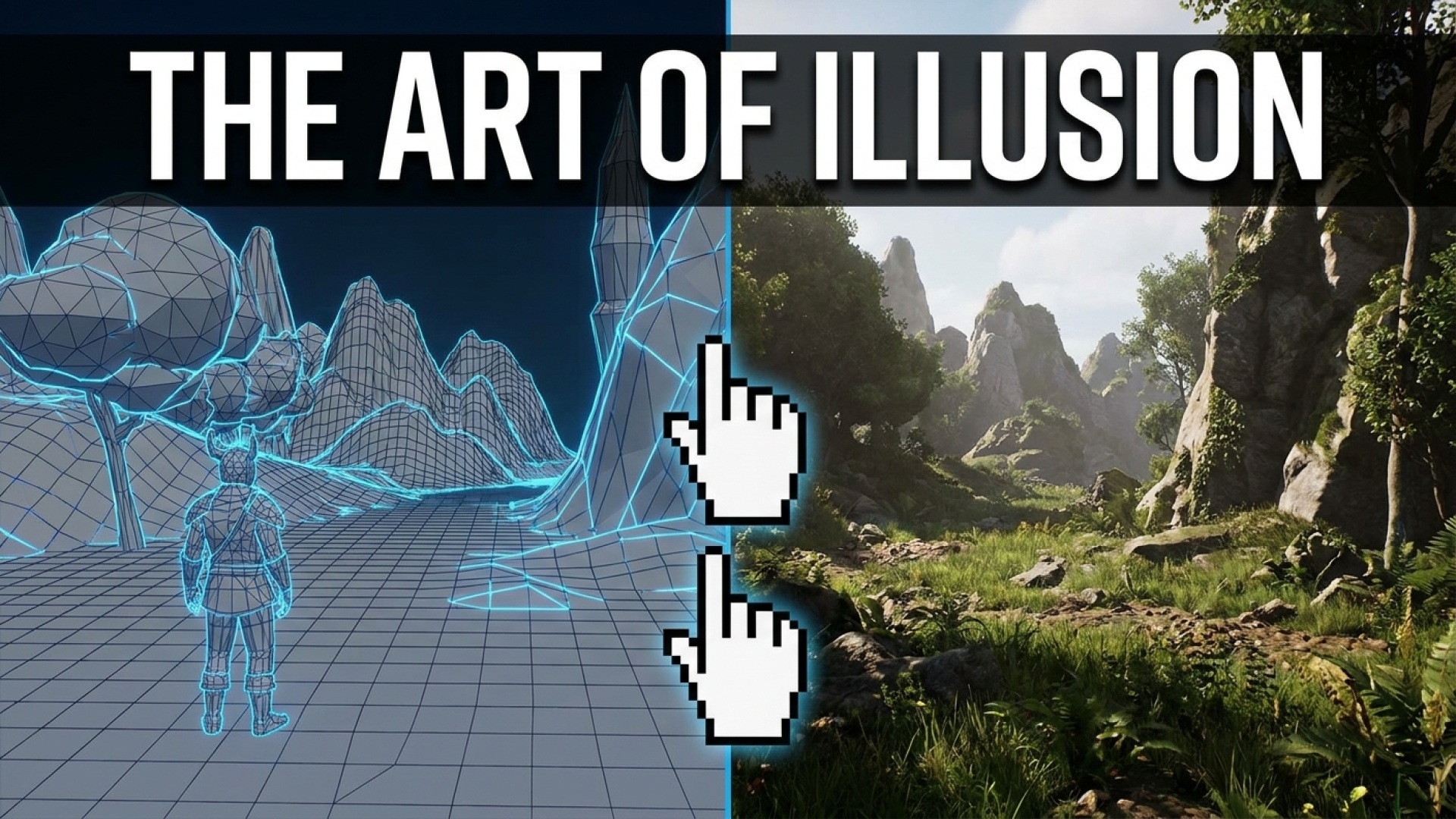
If you’ve ever trundled around on the back of a Warthog in the original Halo: Combat Evolved Anniversary, you might remember how its tires seemed to melt into a noisy blur at high speeds. As we often discuss here at Digital Tech Explorer, what looks like advanced processing is often just clever engineering. In this case, there is no actual blur effect; the game simply swaps the standard tire texture for a hazy one when the rotation speed hits a specific threshold. It’s an economical yet remarkably effective solution for the hardware of the time.
This “cheap but brilliant” approach is a recurring theme in the world of game development. Recently, designer Joe Wintergreen, known for his work on Weird West, sparked a fascinating discussion on social media regarding these smoke-and-mirror tactics. For instance, the ceiling fan shadow in Epic’s VR shooter Robo Recall isn’t a dynamic shadow or a complex light function. Instead, it is a rotating translucent mesh placed on the floor to simulate the illusion of depth and movement without taxing the GPU.
Mastering Visual Deception in Game Design
Wintergreen’s insights shed light on several classic graphical tricks that paved the way for modern gaming. He highlights a “classic fake reflection” in Half-Life: Blue Shift. Rather than rendering real-time reflections, the developers built an inverted duplicate of the room beneath a translucent floor. While early Unreal Engine 1 titles like Deus Ex were ahead of their time with actual reflective surfaces, many developers preferred the “mirrored room” trick to maintain high framerates.
Another fascinating example is found in the Unreal Engine 4 mobile tech demo. To simulate the refraction of a swimming pool, the engine doesn’t calculate complex light physics. Instead, it uses a shader to offset the vertices of the underwater concrete. By making the geometry itself “wobble,” the developers created a convincing distortion effect that costs a fraction of the processing power required for true water simulation.
| Game / Tech | Perceived Effect | The “Cheap” Reality |
|---|---|---|
| Halo: CE | Motion Blurred Tires | Texture Swap (Static Hazy Image) |
| Robo Recall | Dynamic Shadows | Rotating Translucent Mesh |
| Half-Life: Blue Shift | Floor Reflections | Inverted Duplicate Room Beneath Floor |
| UE4 Mobile Demo | Water Refraction | Vertex Wobble Shader on Concrete |
Why Economical Effects Still Matter

As TechTalesLeo, I find these “tales” of technical trickery inspiring because they demonstrate the intersection of art and coding. While modern PC games often rely on brute-force power, these economical effects prove that immersion is often about what the player perceives rather than what is actually there. This principle explains why Cyberpunk 2077 breaks when viewed through a third-person mod, or why Banjo-Kazooie displays visual artifacts in ultra-widescreen; the developers only built what was meant to be seen from a specific perspective.
At Digital Tech Explorer, we believe understanding these shortcuts helps both developers and enthusiasts appreciate the craftsmanship behind our favorite titles. Whether it’s a wobbly floor or a texture swap, these illusions are the foundation of digital storytelling, making technology accessible and intriguing for us all.