
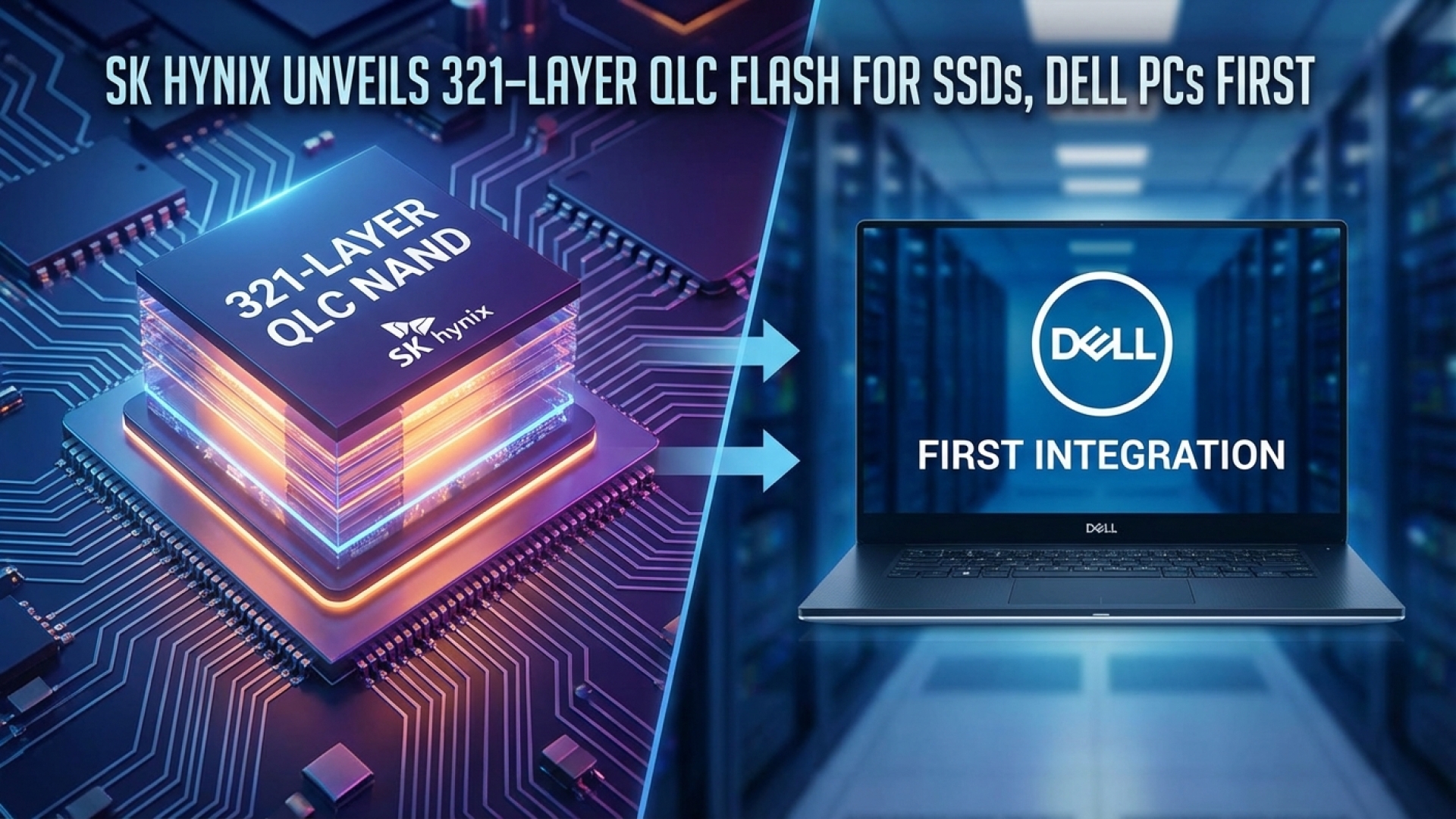
The global memory landscape is shifting once again as SK hynix, a titan in the semiconductor industry, officially announced the mass production of its groundbreaking 321-layer QLC PQC21 flash chips. With 1 TB and 2 TB modules now rolling off the lines, the industry is watching closely. However, if you were hoping this would immediately slash SSD prices for your next gaming build, there is a catch: Dell has currently secured first dibs on these high-density modules.
At Digital Tech Explorer, we often dive deep into what makes your favorite tech tick. When you look under the hood of a modern solid-state drive, you’ll find a complex ecosystem: a flash memory controller, occasionally a DRAM cache, and the NAND storage chips themselves. Because NAND is often the most expensive and supply-constrained component, SK hynix’s leap to 321 layers is a significant move to stabilize the SSD supply chain and meet the demands of the AI-driven era.
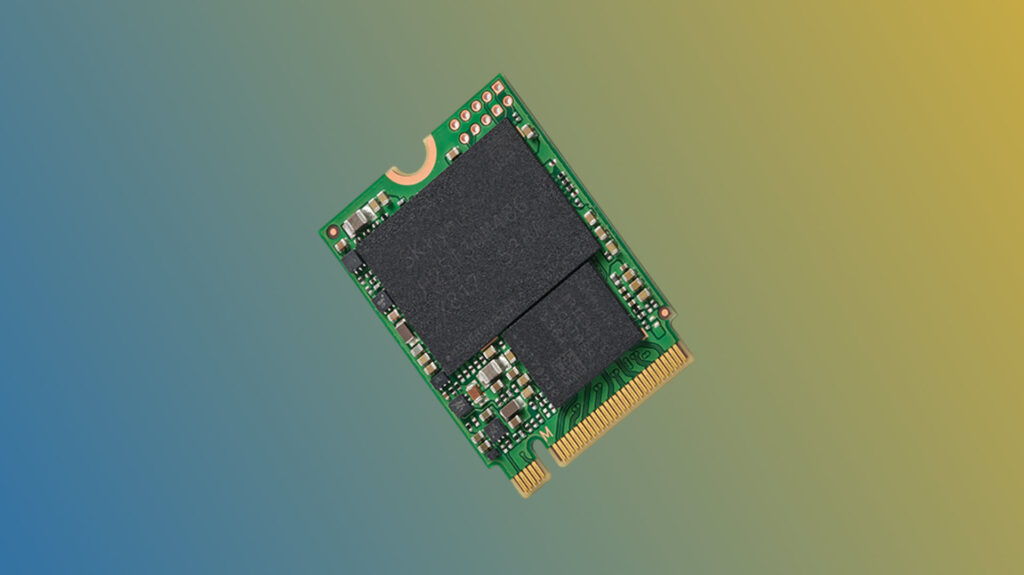
Understanding QLC (Quad-Level Cell) Technology
To understand why this matters, we have to look at how data is packed. QLC, or quad-level cell memory, stores 4 bits of data per individual cell. This density is a game-changer for cost-effectiveness. By packing more data into fewer cells, manufacturers can hit higher capacities—like 1 TB on a single module—using less physical material.
Of course, technology always involves trade-offs. Traditionally, QLC drives have faced criticism for shorter lifespans and slower write speeds compared to TLC (3 bits per cell) or MLC (2 bits) alternatives. However, for the average user or professional focused on PC gaming and general productivity, these differences are becoming increasingly negligible. SK hynix is positioning the PQC21 as a solution built for efficiency and rapid manufacturing, specifically designed to fill the growing void in global storage availability.
| Feature | QLC (Quad-Level Cell) | TLC (Triple-Level Cell) |
|---|---|---|
| Bits Per Cell | 4 Bits | 3 Bits |
| Storage Density | Highest | High |
| Manufacturing Cost | Lower | Moderate |
| Primary Use Case | Read-heavy, AI PCs, Budget Storage | Performance Gaming, Workstations |
Market Strategy: The “AI PC” and Beyond
While you might not find these specific chips on store shelves today, they are already making waves in the enterprise and OEM sectors. Dell is the primary partner for this initial rollout, but SK hynix has expressed clear intentions to expand partnerships with other global leaders. This move reinforces their position in the AI PC storage market, where massive datasets require high-density, cost-efficient storage solutions.
As we navigate the 2024 tech releases, it is clear that while these PQC21 chips might not break speed records for enthusiast GPU setups, they are vital for the “budget” guides of the future. In an era where “budget” components are becoming rarer, SK hynix’s innovation offers a path toward keeping high-capacity storage accessible for everyone, from software engineers to casual enthusiasts.
Stay tuned to Digital Tech Explorer as we continue to track the evolution of AI-driven hardware and digital innovation. Our mission is to keep you ahead of the curve with real-world testing and transparent research.
Disclaimer: All content on Digital Tech Explorer is for informational and entertainment purposes only. Some links may be affiliate links, meaning we may earn a commission at no additional cost to you. For more insights from TechTalesLeo, visit our author page.