
At Digital Tech Explorer, we have a deep appreciation for the hardware that paved the way for today’s high-performance rigs. But even for a seasoned software engineer, seeing a 43-year-old machine tackle modern physics simulations is a sight to behold. It turns out the ZX Spectrum is better at a few things than most of us: complex mathematics, maintaining its status as an iconic retro computer, and—somewhat unbelievably—landing a spacecraft on the Mun in Kerbal Space Program (KSP).
Renowned YouTuber and space enthusiast Scott Manley recently shared a fascinating experiment on X (formerly Twitter). He demonstrated how his very first computer, powered by the Sinclair BASIC programming language, was able to pilot a lunar lander to a perfectly efficient touchdown on the Mun’s surface. For those of us who grew up “bit banging” and tinkering with early coding scripts, this is the ultimate nostalgia trip with a high-tech twist.
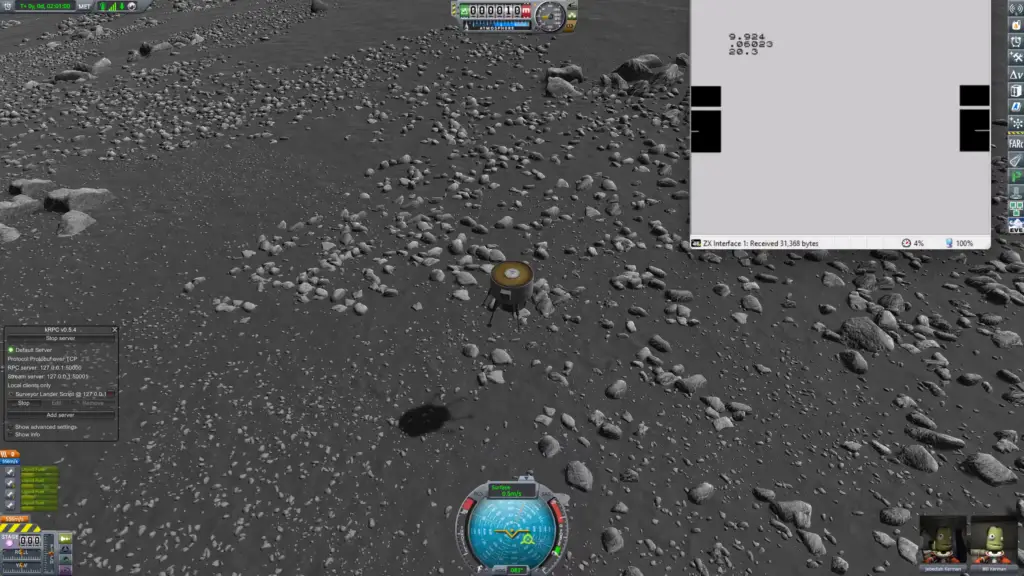
Flying a simulated spacecraft controlled by a ZX Spectrum and Sinclair BASIC—my first computer and programming language. Terribly inefficient right now because the serial port is so slow and the CPU spends lots of cycles bit banging to talk to it.
Scott Manley via X
The technical hurdles Manley navigated are a testament to the ingenuity of the gaming and coding communities. Because the original Spectrum lacks modern connectivity, the setup is currently “terribly inefficient.” The CPU is forced to spend significant cycles on manual signal manipulation—a process known as bit banging—just to communicate with the simulation.
Navigating the Retro Tech Challenges
To put this achievement in perspective, the original 1982 ZX Spectrum didn’t even come with a serial port. Users had to rely on the ZX Interface 1, an RS-232 adaptor that supported what were then “blazing” speeds of 19.2 kbit/s. Bridging the gap between 1980s hardware and a modern physics engine required a clever daisy-chain of software.
Manley utilized a Python program acting as a translator between the Spectrum and kRPC. For the uninitiated, kRPC is a robust mod that allows for remote control of Kerbal Space Program via external scripts. By linking these disparate technologies, Manley proved that even vintage silicon can still find a place in the modern digital frontier.
| Feature | ZX Spectrum (1982) | Modern Gaming PC (2024) |
|---|---|---|
| CPU Speed | 3.5 MHz (Zilog Z80) | Up to 5.0+ GHz |
| RAM | 16 KB / 48 KB | 16 GB / 32 GB+ |
| Graphics | 256 x 192 (8 Colors) | 4K / 8K Resolution |
| Storage | Cassette Tape | NVMe SSD |
A Masterclass in Mun Landings
Anyone who has spent time in PC games like KSP knows the sheer terror of a Mun landing. Usually, it involves frantic tapping of the Shift and Control keys, eyeing a rapidly depleting fuel gauge, and praying that your velocity isn’t high enough to turn your Kerbal into a permanent part of the lunar landscape. Most of my personal missions end with a stranded pilot and a very expensive pile of debris.
Yet, the ZX Spectrum—running on logic designed decades before KSP was a concept—managed a touchdown so smooth it looked effortless. This project highlights a core philosophy here at Digital Tech Explorer: technology is limited only by the creativity of the person using it. Whether it’s AI or 40-year-old Sinclair BASIC, the logic remains the same.
As TechTalesLeo, I find stories like this vital for bridging the gap between complex tech history and today’s usability. It’s a humbling reminder that while our GPUs may have gotten faster, the foundational thrill of coding and problem-solving remains unchanged. That ancient piece of hardware may have claimed a victory today, but it inspires the next generation of developers to see just how far they can push the tools they have.