
At Digital Tech Explorer, we are constantly tracking the frontier of digital innovation where physics meets practical hardware engineering. One of the most captivating developments in recent months involves terahertz waves—a segment of the electromagnetic spectrum that is rapidly emerging as a powerful tool for non-invasive analysis. Unlike traditional X-rays, which carry ionizing radiation risks, these waves can peer inside active electronics without damaging the delicate silicon or the humans operating the equipment. Our latest deep dive explores how researchers are now using this technology to “see” the internal logic of functioning transistors, potentially unlocking a new era of hardware debugging and security analysis.

Unveiling the Power of Terahertz Waves in Electronics
A multinational research team—featuring engineers from top-tier institutions in Australia, Germany, and the USA—has published findings on the behavior of “packaged semiconductor devices” within the low/sub-terahertz range. This specific frequency band sits comfortably between microwaves and infrared waves. As TechTalesLeo, I find the narrative of “invisible sight” particularly compelling here; the team’s work, detailed in IEEE Spectrum and Tom’s Hardware, marks a significant milestone in our ability to monitor hardware components in real-time without physical probes.
Inside the Experiment: Homodyne Detection
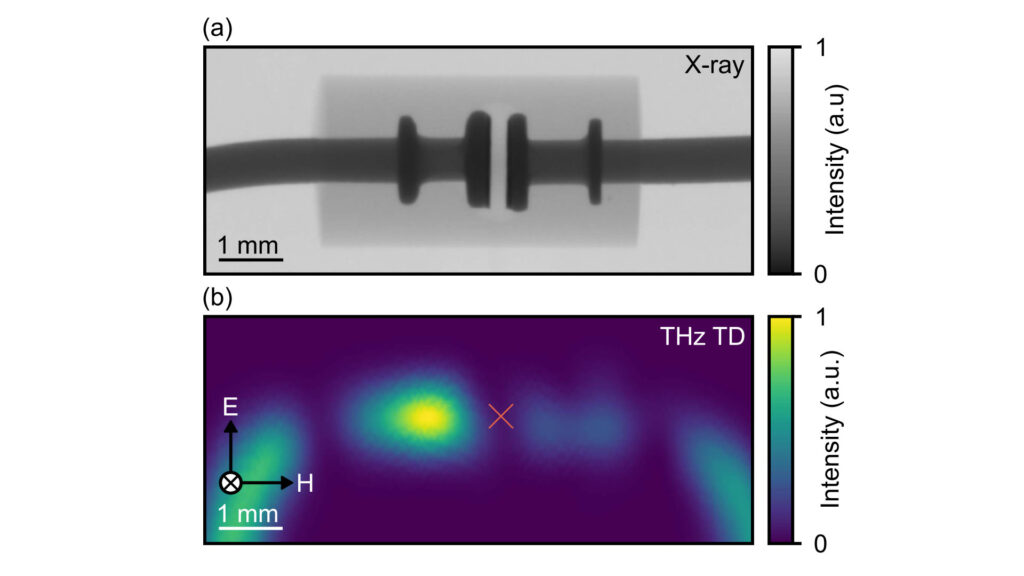
Because terahertz waves are significantly larger than the microscopic transistors found in a modern gaming PC or AI-accelerated chip, the research focused on discrete components commonly found on circuit boards. The team specifically analyzed the 1N4007 diode and the BC548B transistor.
To capture the internal state of these components, they utilized a technique called homodyne detection. Daniel Mittleman, a professor of engineering at Brown University, noted that this approach allows for real-time observation of component behavior that would be impossible with standard detection schemes. This breakthrough bridges the gap between complex physics and everyday usability for hardware engineers.
| Feature | X-Ray Analysis | Terahertz Analysis |
|---|---|---|
| Safety | Ionizing Radiation (Health Risks) | Non-Ionizing (Safe) |
| Internal Probing | Structural Only | Operational/Functional States |
| Material Limitation | Penetrates most metals | Blocked by metals/heatspreaders |
| Application | Structural Integrity | Real-time logic & data monitoring |
Future Applications and Security Implications
Withawat Withayachumnankul, lead researcher and professor at Adelaide University, highlights that this technique is invaluable for monitoring critical systems where shutdowns aren’t an option. Think of power grids or mission-critical servers where continuous uptime is vital. However, the tech storytelling takes a darker turn when considering AI and data security.
The ability to observe a chip’s internal state means researchers (and potentially bad actors) could eventually read encrypted data directly from the silicon. Fortunately, current hardware designs offer a natural defense: terahertz waves cannot penetrate metal. This means any processor equipped with a standard integrated heatspreader (IHS) or a heavy copper heatsink is effectively shielded. Furthermore, the dense, multi-layered copper interconnects in modern high-performance chips act as a natural barrier to this type of analysis.
At Digital Tech Explorer, we believe these hurdles are exactly what will drive the next wave of innovation in GPU design and secure computing. As we continue to bridge the gap between complex tech and real-world application, terahertz technology remains a space to watch closely.
Disclaimer: All content on Digital Tech Explorer is for informational and entertainment purposes only. We do not provide financial or legal advice. Some of the links on Digital Tech Explorer are affiliate links. This means we may earn a commission if you click through and make a purchase, at no additional cost to you. Our recommendations are based on thorough research and personal experience.