

Most web users navigate their favorite sites with a seamless flick of a finger, rarely pausing to consider the complex calculations firing off behind every pixel. For developers, however, the struggle is real: balancing high-performance speeds with the heavy lifting of rendering text and layouts correctly across thousands of different devices. At Digital Tech Explorer, we are always on the lookout for tools that bridge the gap between complex engineering and elegant usability. Enter Pretext—a revolutionary code library that might just change how we think about the “sluggish” web.
The Visionary Behind Pretext: Cheng Lou
Created by California-based coder Cheng Lou—whose impressive resume includes stints at Meta, React, and Midjourney—Pretext is a high-speed system designed to calculate text size and positioning within browsers almost instantaneously. Lou famously described the development process as “crawling through the depths of hell” to ensure the logic was sound. For those who want a technical deep dive into the mechanics, the Fireship YouTube channel offers a fantastic breakdown of why this matters for the future of web development.
Experience the Power of Pretext Demos
To truly appreciate the speed, you have to see it in action. On Lou’s Pretext demo page, the most striking example is the “Editorial Engine” created by somnai-dreams. It allows users to drag UI elements across a screen while the text fluidly rearranges itself in real-time, matching the speed of your cursor without the typical stuttering associated with traditional browser rendering.
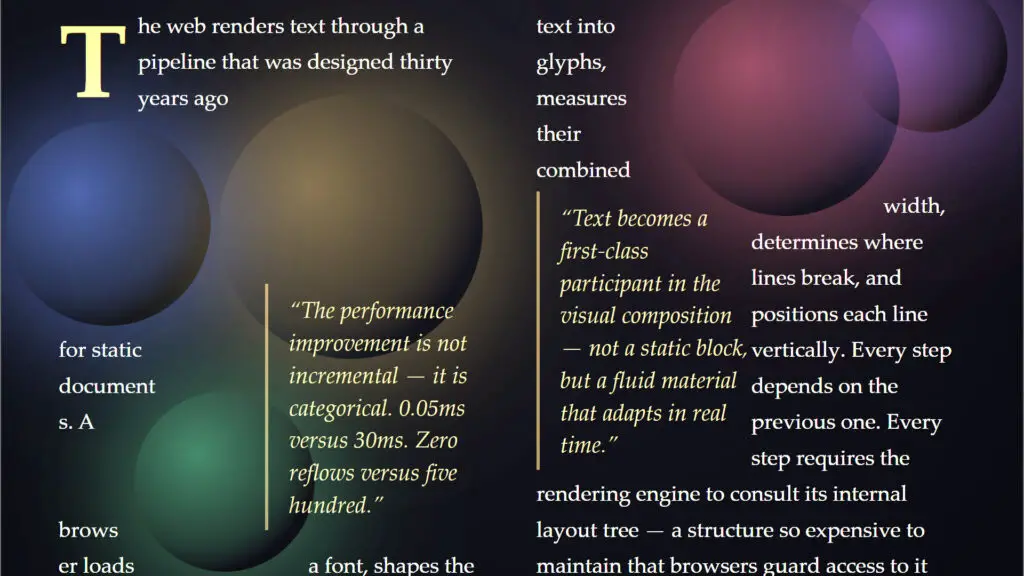
Currently, Pretext isn’t intended to replace full-scale browser engines. Instead, it focuses on a specific, high-performance selection of text setups. However, given the initial reception from the coding community, it is clear that this project has the potential to influence how future frameworks handle typography and layout logic.
AI Acceleration: Solving the Browser Fragment Problem
One of the most intriguing aspects of this project is how Lou utilized AI acceleration to solve a massive engineering hurdle. To ensure Pretext could handle text rejigging across every conceivable browser and language pack, Lou leveraged AI to generate logic structures and iteratively test them across hundreds of thousands of combinations. This is a prime example of AI acting as a force multiplier for individual developers, handling a workload that would be humanly impossible to complete in a single lifetime.
Looking Ahead: A Faster Web for Everyone
The feedback from the tech community has been overwhelmingly positive, with many praising Lou’s dedication to solving one of the web’s oldest pain points. Despite Lou’s tongue-in-cheek comment about “hating the web,” his contribution is a gift to the digital landscape. By leveraging AI for testing and rethinking the fundamentals of text rendering, Pretext marks a significant step toward a faster, more responsive internet.
At Digital Tech Explorer, we’ll be watching closely as this library evolves. For developers looking to stay ahead of the curve, Pretext is a project worth following on GitHub.