At Digital Tech Explorer, we’ve always been fascinated by the intersection of hardware innovation and software intelligence. However, the recent reveal of Nvidia’s DLSS 5 has sparked a level of debate that even our seasoned team didn’t anticipate. While our internal reaction at Digital Tech Explorer ranged from cautious skepticism to outright opposition, it’s clear that the broader PC gaming community is grappling with what this means for the future of digital rendering. After the dust settled from the GTC 2026 announcements, we took a closer look at whether this new iteration of Deep Learning Super Sampling is truly the “smart” evolution Nvidia claims it to be.
Jen-Hsun Huang introducing DLSS 5 at GTC 2026, signaling a new era of AI-driven graphics.
The Pulse of the Community: Reader Sentiment Towards DLSS 5
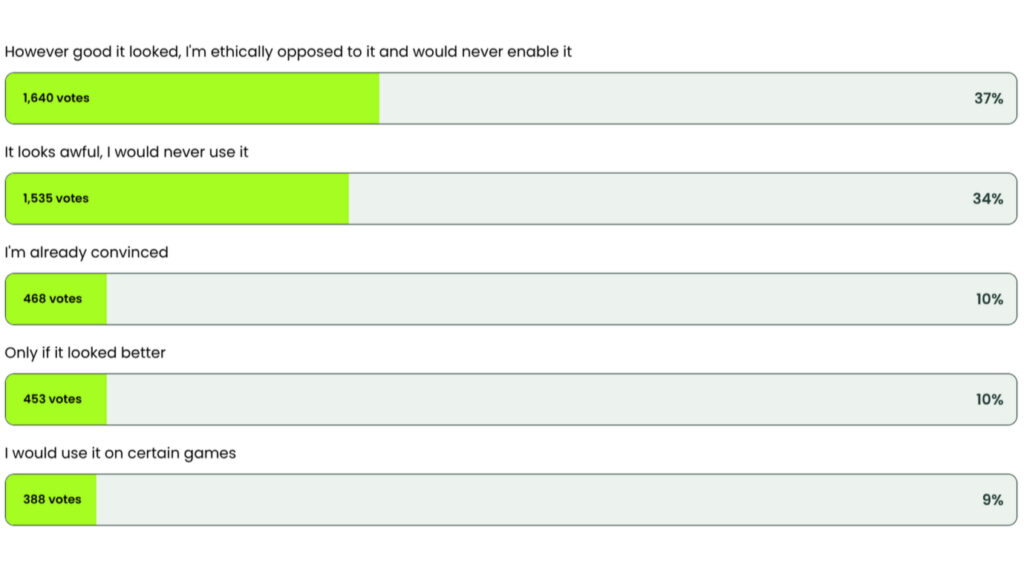
To understand the real-world impact of these AI-acceleration trends, we examined community sentiment regarding the adoption of DLSS 5. The feedback is a stark narrative of resistance. A significant 71% of respondents stated they have no intention of enabling the feature. Perhaps most interestingly for those of us following the ethics of machine learning, 37% cited ethical opposition as their primary reason, suggesting that for many, visual fidelity takes a backseat to the principles of how that image is generated.
Response Category
Percentage of Respondents
Would not use DLSS 5 (Total)
71%
Ethically opposed to the technology
37%
Eagerly awaiting the feature
10%
Would enable it if visual quality improves
10%
Would enable it only in specific titles
9%
Community Sentiment regarding the adoption of Nvidia DLSS 5
Visual breakdown of community sentiment showing a strong lean toward caution.
While the current stance is firm, the history of PC gaming shows that convictions are often tested by performance. If Nvidia and developers can demonstrate that future titles—perhaps the next iterations of Starfield or FC26—can achieve photorealism on a single graphics card without sacrificing visual integrity, the “no” might slowly turn into a “maybe.” However, the burden of proof lies entirely on the hardware giant.
Navigating the “AI Look” and Technical Hurdles
For the 10% of our audience waiting for better visual output, the concern is rooted in the “AI-generated” aesthetic. Because DLSS 5 extrapolates frame context from static 2D images and motion vectors, there is a legitimate fear of visual homogeneity. As TechTalesLeo, I’ve seen how digital storytelling can be diluted when every world begins to look the same due to identical processing algorithms. If the technology isn’t implemented with a nuanced touch, we risk losing the unique artistic signatures that developers work so hard to create.
On the other hand, 9% of gamers are open to using the feature selectively. These are likely players seeking maximum 4K resolution performance in titles where atmosphere and lighting are paramount. For this group, the trade-off is simple: if the game looks better than the native output and doesn’t act as a resource hog, the technology is a welcome tool in the kit.
Broadening the Horizon: Shifting Trends in Gaming
These insights into Nvidia’s DLSS 5 reflect a larger shift in the hardware landscape. We are seeing a more critical consumer base that doesn’t just accept every new AI feature by default. This mirrors other trends we’ve tracked at Digital Tech Explorer, such as the growing movement toward open-source alternatives and the ongoing debate regarding gaming resolutions.
As we move toward the fall release window, we will continue to monitor how these technologies evolve. Whether you are a developer looking to optimize your next project or a gamer looking to maximize your rig, staying informed is the only way to navigate this rapidly changing digital frontier.