
As we navigate the rapidly shifting landscape of hardware innovation here at Digital Tech Explorer, a new narrative is emerging from the high-end GPU sector. French tech outlet Overclocking, citing what they describe as “direct, credible, and reliable contacts,” has sparked significant conversation regarding a new halo product in the NVIDIA lineup. According to these reports, a ultra-premium RTX 50-series graphics card is slated for a third-quarter 2026 debut, potentially hitting shelves around September.
This news suggests that we might see the arrival of an RTX Blackwell Titan AI or perhaps a GeForce RTX 5090 Ti. While the prospect of a new flagship is always exciting for enthusiasts, we must approach these GPU rumours with a healthy dose of skepticism. Recent industry whispers have suggested a potential delay for any “Super” variants of the Blackwell architecture, with some even hinting that the future RTX Rubin generation could be pushed back further than originally anticipated.
The History of Flagship Prototypes
In the world of tech storytelling, history often repeats itself. Rumours of a top-tier Blackwell card began circulating long before the standard RTX 5090 launched in early 2025. However, as TechTalesLeo, I’ve seen many of these “monster” cards fail to reach the consumer market. A prime example is the RTX 4090 Ti from the Ada Lovelace generation; despite reports that it reached the design and prototyping stages, it was ultimately shelved, leaving the standard 4090 as the reigning champion of its era.
Speculative Specifications: What Could a 2026 Flagship Look Like?
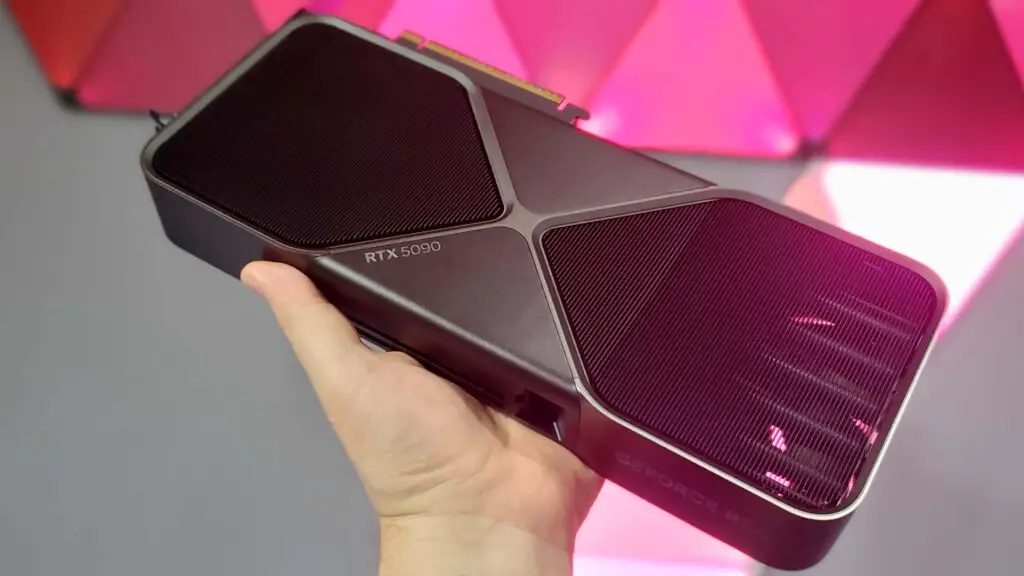
While specific technical data remains under wraps, our analysis at Digital Tech Explorer allows us to project what this “Titan” class card might offer. The current RTX 5090 does not utilize the full potential of the GB202 core, leaving at least one full Graphics Processing Cluster (GPC) disabled. A hypothetical 5090 Ti or Titan AI would likely unlock this hidden power.
| Feature | Estimated Specification |
|---|---|
| Architecture | Blackwell (GB202 Full Core) |
| CUDA Cores | 24,064 to 24,576 |
| Memory Type | GDDR7 |
| Memory Capacity | 48 GB |
| Target Release | Q3 2026 |
The Impact of the Global Memory Crisis
The current state of the hardware market is heavily dictated by the soaring costs of high-speed memory. This “memory crisis” is the primary reason we see a stagnation in the mid-range market, where 8 GB configurations remain the norm and 16 GB variants are becoming increasingly expensive to produce. While there were concerns that the RTX 5070 Ti might face an early “End-of-Life” (EoL) status due to these costs, NVIDIA and its partners have maintained its availability, though finding one at MSRP remains a significant challenge for PC gamers.
NVIDIA’s Strategic Market Positioning
NVIDIA’s current strategy appears to prioritize the high-margin enthusiast segment. With the RTX 5080 already commanding a premium price point and the RTX 5090 reaching the $4,000 mark in some regions, a $5,000 to $6,000 Blackwell Titan AI is not outside the realm of possibility. Such a card would likely target professionals and AI developers who need more VRAM than a standard gaming card but don’t want to step up to the $9,000+ RTX Pro 6000.
At Digital Tech Explorer, we believe this trend highlights a growing divide in the tech world: while flagship silicon pushes the boundaries of machine learning and 8K rendering, the average gamer is left waiting for more affordable innovation. Whether the 2026 halo card becomes a reality or remains a prototype in a lab, it signals NVIDIA’s commitment to maintaining its lead in the AI-accelerated future.
Disclaimer: All content on Digital Tech Explorer is for informational and entertainment purposes only. Some of the links on our site are affiliate links, which may earn us a commission at no additional cost to you.