
At Digital Tech Explorer, we have been closely tracking the evolution of integrated graphics, and after the early promises surrounding Intel’s Xe3 GPU architecture, the narrative is finally shifting from theory to reality. Following Intel’s detailed breakdown of their architectural overhaul, I finally had the opportunity to put a Panther Lake laptop through its paces. The results confirm what many of us suspected: Intel has managed to pull off something truly impressive in the mobile space.
On paper, the performance jump should be expected. Intel’s Arc B390 features 1536 shaders, 16 MB of L2 cache, and a boost clock of 2.5 GHz. This combination makes it significantly more potent than the majority of integrated solutions currently on the market. To provide our readers with the most transparent analysis, I wanted to see how this hardware stands up against the established giants.
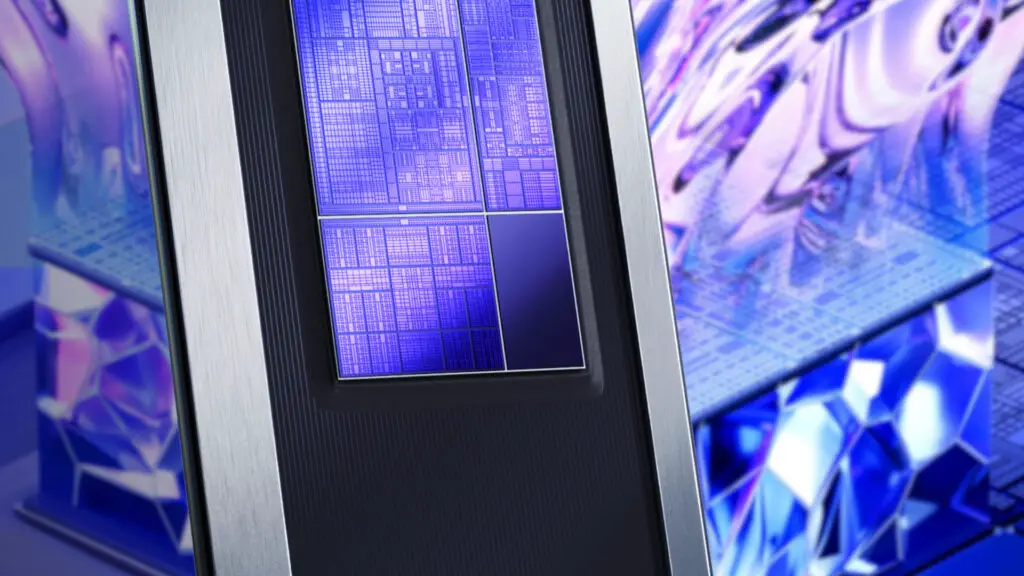
While AMD’s Ryzen AI Max (Strix Halo) chips are in a category of their own—essentially a small GPU with CPU cores attached—the more traditional rivals for the B390 are AMD’s Radeon 890M and Nvidia’s GeForce RTX 5050. Since the newest mobile chips are still trickling into the testing lab, I benchmarked the B390 against the current heavyweights: the Radeon 780M and the RTX 4050 (found in popular machines like the Acer Nitro series).
In this deep dive, I focused on three critical metrics: peak instruction throughput, cache/VRAM bandwidth, and latency. These are the pillars that determine whether a GPU will stutter or soar during gaming sessions or intensive creative workloads.
| GPU Model | Architecture Type | Primary Memory Type | Core/Shader Count |
|---|---|---|---|
| Intel Arc B390 | Xe3 (Integrated) | LPDDR5x (Shared) | 1536 Shaders |
| Nvidia RTX 4050 | Ada Lovelace (Discrete) | GDDR6 (Dedicated) | 2560 CUDA Cores |
| Radeon 780M | RDNA 3 (Integrated) | LPDDR5/x (Shared) | 12 Compute Units |
| Intel Arc A770 | Xe Alchemist (Discrete) | GDDR6 (Dedicated) | 4096 Shaders |
Peak Shader Throughput: Power in Small Packages
We started with “fused multiply-add” (MADD) instructions, a fundamental command for graphics rendering. This single instruction multiplies two values and adds a third, and its efficiency is a massive factor in overall GPU speed. Using the GPUPerfTest suite, I examined how the B390 handled different data formats.
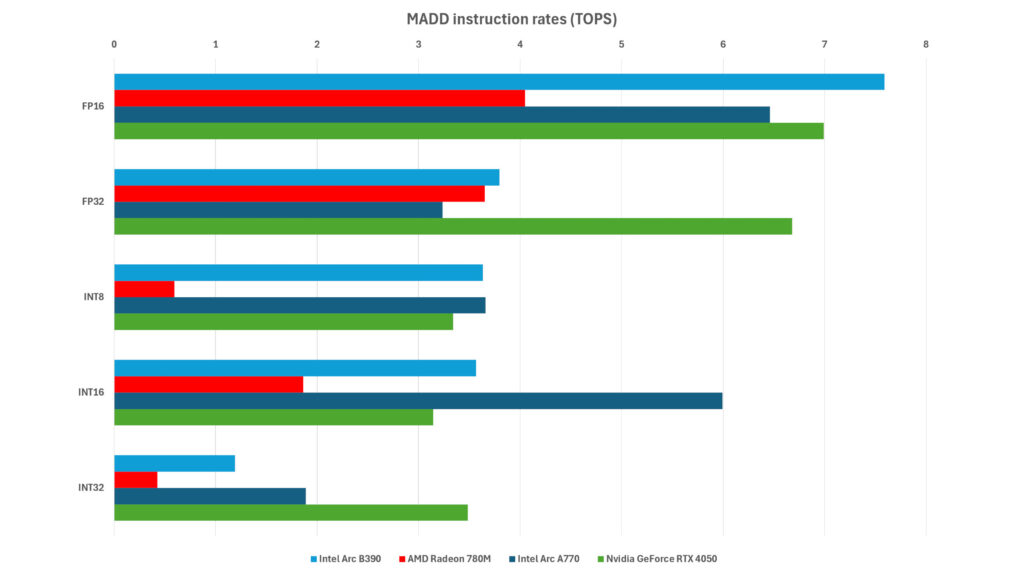
Instruction throughput is heavily tied to shader count and clock speeds. While the RTX 4050 has a theoretical peak of 9 TFLOPS, real-world constraints—like the 75W power limit in many laptops—often pull that number down. The Arc B390, despite being an integrated chip, kept the discrete Arc A770 in its sights. It is staggering to see a “little” iGPU competing with a full-sized desktop-class card in these micro-tests.
Cache and Memory Bandwidth
The next phase of my research focused on data throughput. A GPU can have all the logic in the world, but it’s useless if those logic units aren’t being “fed” data quickly enough. This test highlights how well the processor pulls data from its various cache levels.
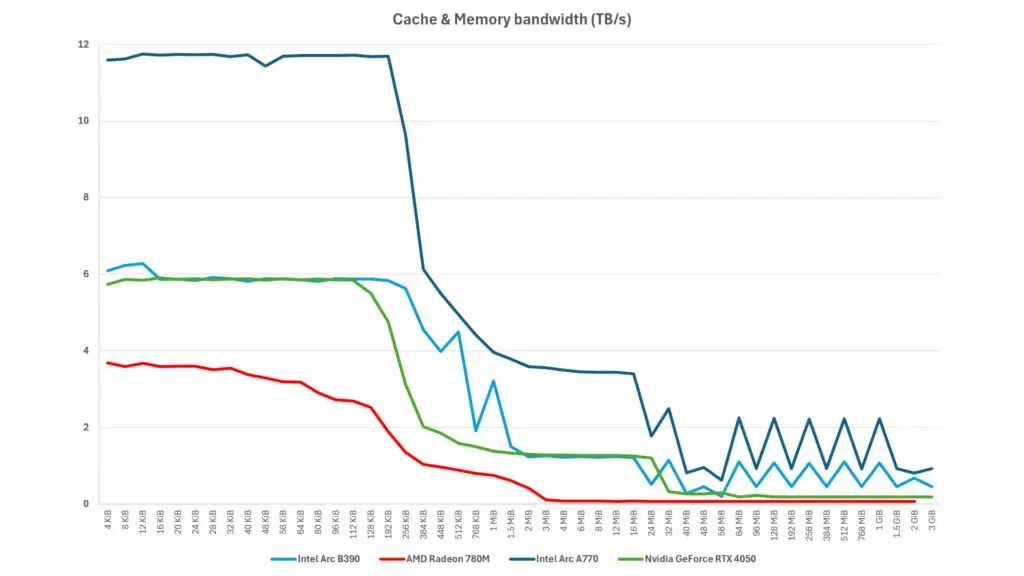
The Xe3 iGPU performed exceptionally well here, rivaling Nvidia’s dedicated mobile silicon. Pulling 6 TB/s from the L1 cache is a feat usually reserved for high-end discrete GPUs, suggesting that Intel has designed a very wide internal data bus for Panther Lake. Conversely, the Radeon 780M struggled in this specific test, likely due to the slower driver cadence on handheld devices like the ROG Ally.
Addressing the Latency Bottleneck
Bandwidth is only half the battle. If the cache system takes too long to respond to a request, the shader pipelines stall, leading to dropped frames. I measured cache latency—the nanoseconds between a request and data delivery—to see where the Xe3 architecture might stumble.
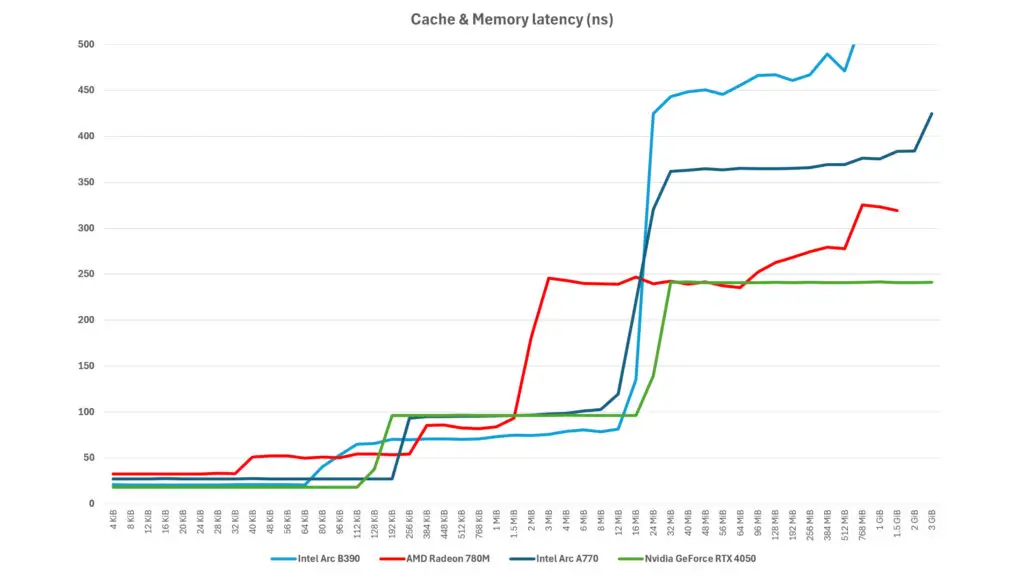
The B390 reported the lowest L2 latencies in the group, outperforming even the RTX 4050. However, the Achilles’ heel for Xe3 remains its reliance on LPDDR5x system memory. Unlike the RTX 4050 or A770, which have dedicated GDDR6 modules, the B390 has to share memory with the CPU. This results in higher DRAM latency when data requests have to leave the chip, which can limit the GPU’s potential in memory-intensive titles.
The Digital Tech Explorer Verdict: Xe3’s Future
Our thorough testing reveals that Intel has built a phenomenal foundation with the Xe3 architecture. It is an efficient, high-bandwidth design that punches well above its weight class. The only real limitation is the environment it lives in: the lack of dedicated VRAM. Currently, the shared system memory acts as a bottleneck, preventing the Arc B390 from reaching its absolute peak performance in every scenario.
However, as a storyteller in this tech landscape, I can’t help but imagine what this architecture could do on a discrete card paired with high-speed GDDR7. If Intel brings an Xe3-variant (like the rumored X3P) to the discrete market, AMD and Nvidia will have a serious fight on their hands. For now, Panther Lake is a massive win for mobile users, proving that integrated graphics are finally ready for the big leagues.
Affiliate Disclaimer: Some of the links on Digital Tech Explorer are affiliate links. This means we may earn a commission if you click through and make a purchase, at no additional cost to you. Our recommendations are based on thorough research and personal experience. All content is for informational purposes only.