
At Digital Tech Explorer, we are always tracking the pulse of digital innovation. In the ever-evolving narrative of GPU competition, Intel has just turned a significant page. Following the initial reveal of the Panther Lake architecture and XeSS 3 back in October, the tech giant has officially released its AI-powered graphics suite featuring multi-frame generation to the public. Originally slated for the Core Ultra 300-series, this cutting-edge technology is now accessible to all Intel GPU owners via the latest driver update.
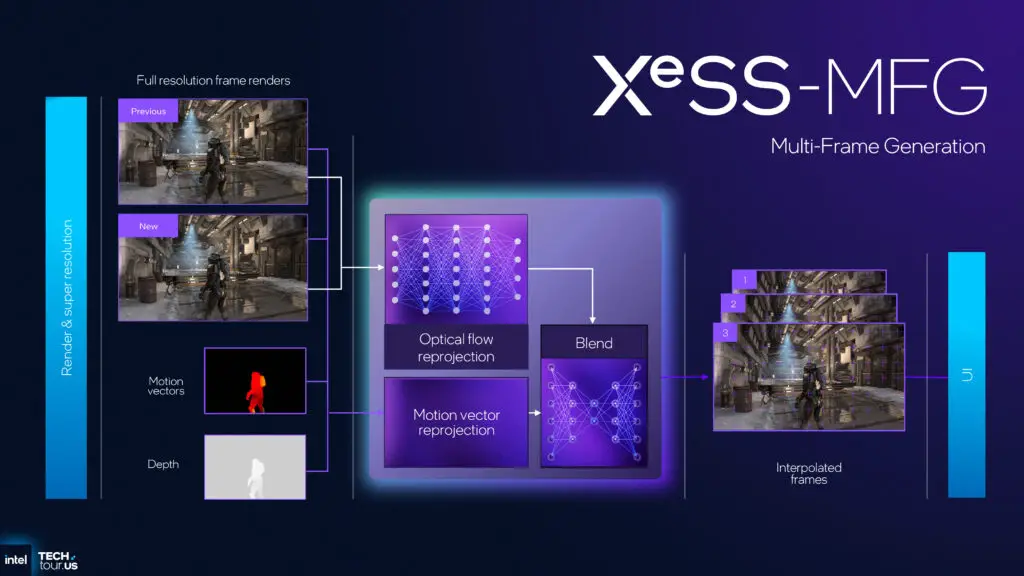
By installing the new WHQL-certified 32.0.101.8509 drivers, enthusiasts wielding Intel Alchemist or Battlemage GPUs can activate XeSS 3 Multi-Frame Generation (MFG) as a direct override within the Intel Graphics Software application. This update isn’t limited to discrete powerhouses like the Arc A770 or B850; it also brings a performance boost to integrated GPUs found in Meteor Lake, Lunar Lake, and Arrow Lake processors. This broad compatibility is a result of Intel’s strategic decision to equip every tier of its Xe graphics architecture with XMX units (Xe Matrix Extensions)—dedicated hardware pipelines designed to handle complex AI calculations far more efficiently than traditional shader cores.

As we often emphasize here at Digital Tech Explorer, transparency is key to understanding these updates. For XeSS 3 MFG to function, the game must natively support XeSS version 1.1 or higher. While Intel’s library of supported titles is currently trailing behind NVIDIA’s DLSS or AMD’s FSR, this rollout represents a major milestone. Intel has effectively advanced its position in the frame generation race, utilizing dedicated AI hardware to differentiate its interpolation solution from software-based competitors.
Our team conducted initial real-world testing on a Core Ultra 9 285K test bench using the demanding Cyberpunk 2077. Testing the integrated Intel Graphics (512 Xe shaders) at 1080p Medium settings, the baseline performance averaged a sluggish 20 fps. By engaging the XeSS 3 MFG override at a 2x multiplier, we saw performance climb to 31 fps. While the increased frames were welcome, the output felt somewhat inconsistent, and the override occasionally bypassed standard screen scaling, requiring manual resolution tweaks in Windows to maintain a full-screen display.
| Setting (Cyberpunk 2077, 1080p Medium) | Average Frame Rate (FPS) | Percentage Increase |
|---|---|---|
| Native (iGPU) | 20 FPS | – |
| XeSS 3 MFG (2x Override) | 31 FPS | 55% |
| XeSS 3 MFG (4x Override) | 48 FPS | 140% |

The most intriguing aspect of XeSS 3 is the addition of 3x and 4x frame generation tiers. When we pushed the override to its maximum setting, the average frame rate surged to nearly 48 fps. While frame generation is traditionally most effective when applied to a stable baseline or to alleviate CPU bottlenecks, the flexibility Intel is offering to Arc owners is a significant development for the gaming community.
Intel’s decision to provide this technology to all Arc users through a simple driver update—without the need for complex mods—sets a high bar for accessibility in the AI graphics space. As we continue to explore the boundaries of digital innovation, we’ll be watching closely to see how competitors respond to Intel’s aggressive push for AI-enhanced performance. For developers and enthusiasts looking to stay ahead of the curve, the latest Arc drivers are an essential download.