
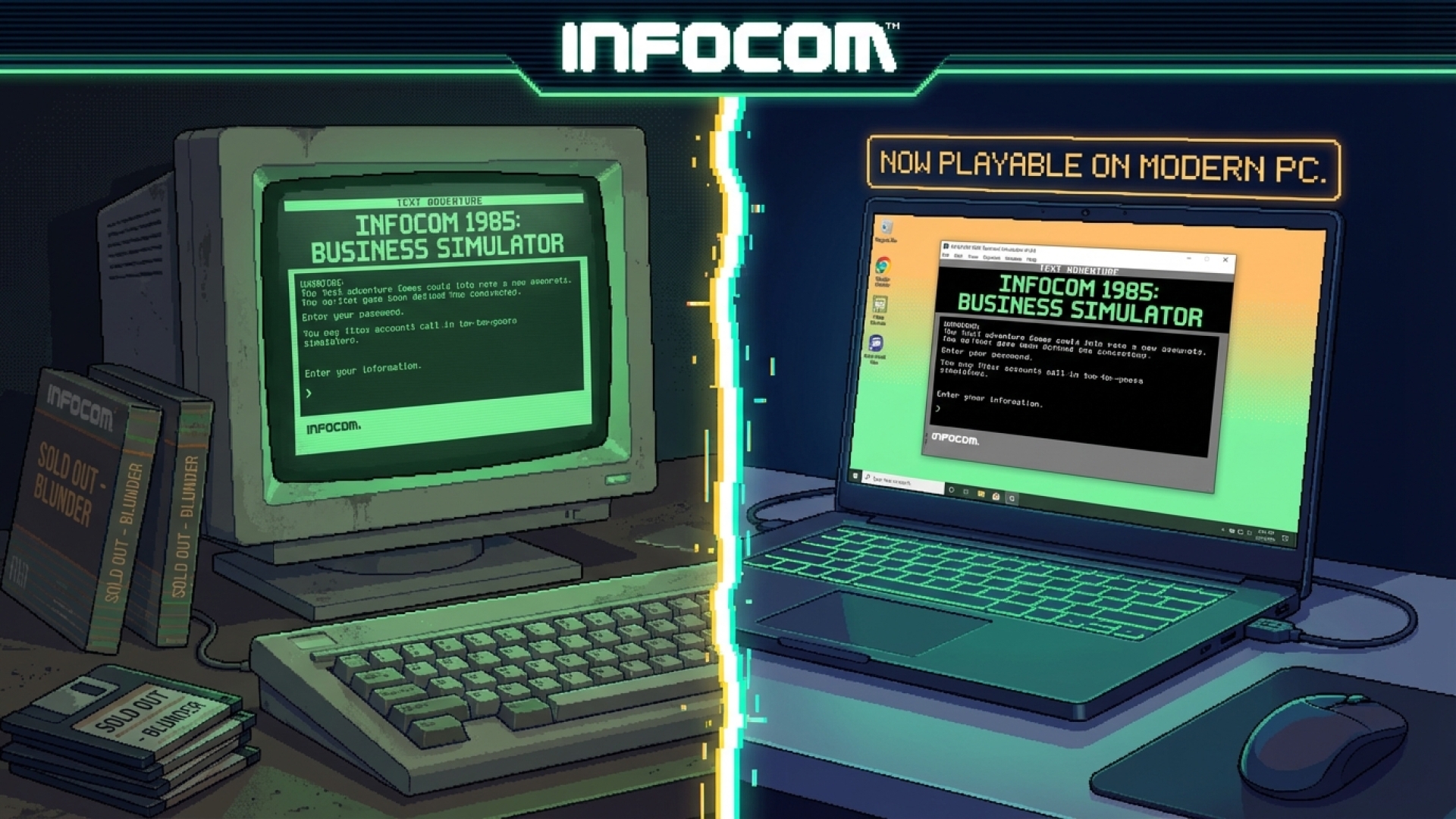
At Digital Tech Explorer, we love a good redemption story—especially one involving forty-year-old code. Infocom is a name etched into the history of interactive fiction, fondly remembered by developers and gamers alike as the studio behind legendary titles like the Zork series, The Hitchhiker’s Guide to the Galaxy, and A Mind Forever Voyaging. However, behind the prose and puzzles lies a cautionary tale of software engineering and market miscalculation.
While Infocom’s mastery of the “Z-machine” allowed their games to run on almost any hardware, their attempt to apply this same cross-platform logic to the business world resulted in Cornerstone—a 1985 database program that many historians believe ultimately sank the company. Now, decades after it was relegated to the digital graveyard, this obscure piece of software is back from the dead.
The Engineering Hubris: Why Cornerstone Failed
Infocom’s success was built on a brilliant technical foundation: a virtual machine that decoupled game logic from hardware-specific code. When they decided to pivot into business software, they applied the same philosophy to Cornerstone. They built it to run on its own virtual machine, theoretically allowing it to be ported to any system with ease.
However, what worked for text-based PC games was a disaster for data processing. The overhead of the virtual machine made Cornerstone notoriously slow. Furthermore, by the mid-1980s, the “browser wars” of the era were already being won by IBM-compatible PCs. The need for a cross-platform database was vanishing just as Cornerstone hit the shelves.

Cornerstone vs. The 1985 Market Standards
| Feature | Cornerstone (Infocom) | Industry Standards (dBase III) |
|---|---|---|
| Architecture | Virtual Machine (Slow) | Native Code (Fast) |
| Portability | High (Multi-platform) | Hardware Specific (IBM PC) |
| Market Focus | General Business | Data Professionals |
| Outcome | Commercial Failure | Market Leader |
Linchpin: The Modern Revival of Failed Tech
For years, the preservation of Infocom’s legacy focused almost exclusively on their games. The Z-machine has been ported to everything from smartwatches to refrigerators. However, the virtual machine powering Cornerstone—the “B-machine”—remained a lost relic. That changed recently thanks to the efforts of a dedicated programmer known as TaradinoC.
TaradinoC has developed Linchpin, a modern interpreter that finally allows tech enthusiasts to run Infocom’s forgotten business product on contemporary hardware. As noted by game developer Andrew Plotkin, “It’s a new age for aficionados of failed 1985 database products!” This project isn’t just about running old hardware emulations; it’s about preserving the full scope of software history, even the parts that didn’t go according to plan.
The Financial Ripple Effect and Activision’s Shadow
The development of Cornerstone wasn’t just a technical misstep; it was a financial drain. Infocom struggled to find outside investors for their business division, forcing them to divert funds away from their thriving game department. This meant less money for experimental gaming features, such as early multiplayer concepts or advanced graphics systems.

The resulting debt forced Infocom into a merger with Activision in 1986. Within three years, Activision shuttered the studio entirely. Despite this tragic end, the Infocom spirit remains vibrant in the AI and coding communities today. With recent news of Zork going open-source and the release of the Linchpin interpreter, the complete technical history of Infocom is finally accessible to a new generation of developers.
As we continue to explore the intersection of digital innovation and tech storytelling here at Digital Tech Explorer, stories like the revival of Cornerstone remind us that in the world of software, nothing is ever truly gone if there is a programmer willing to write the interpreter.
For more deep dives into software history and the latest in digital innovation, follow the latest updates from TechTalesLeo on our author page.