
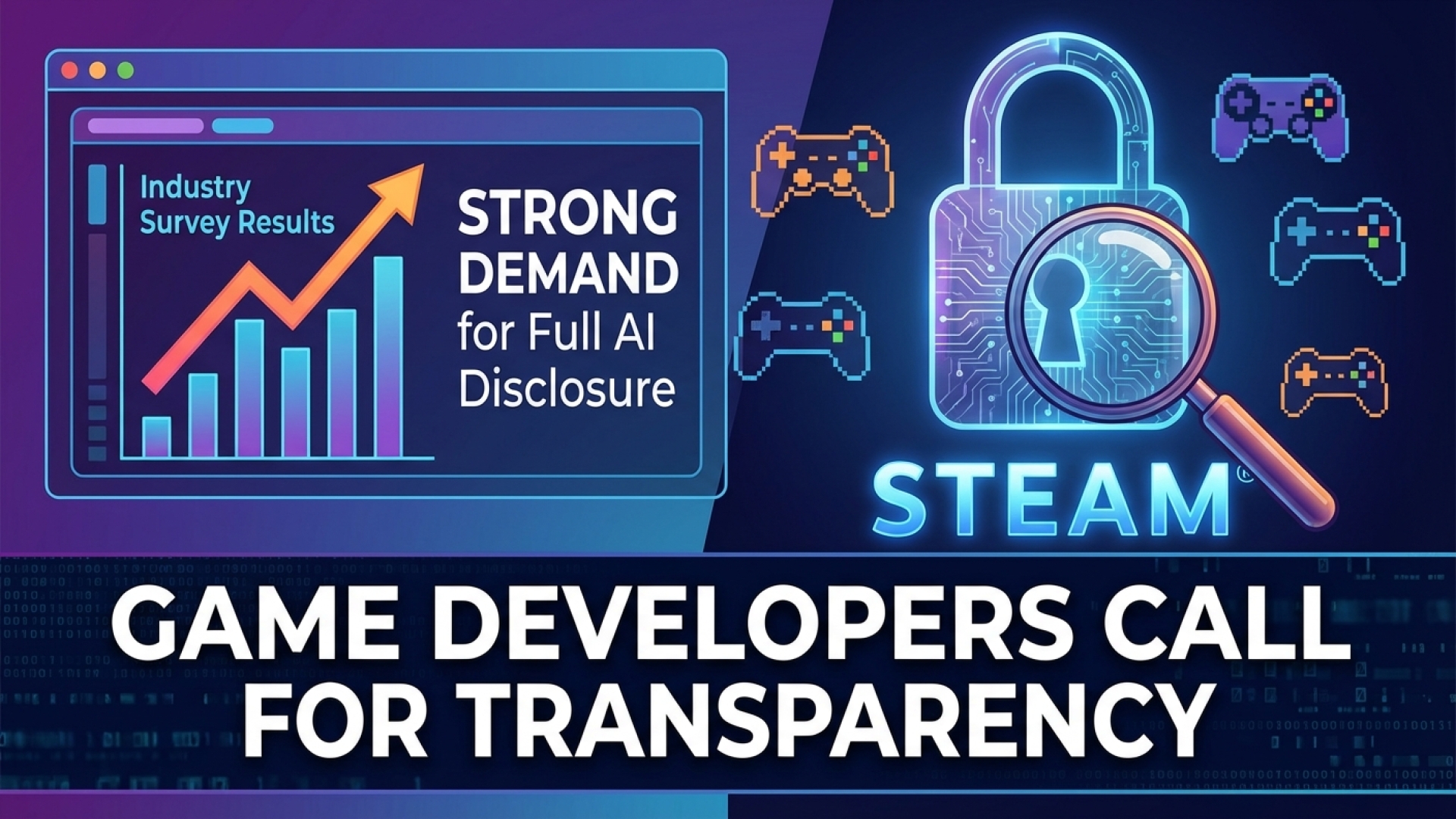
In a rapidly shifting digital landscape, the integration of artificial intelligence within game development has become one of the most polarizing topics of the decade. A major new survey by GamesIndustry.biz has revealed that the vast majority of industry professionals—nearly nine out of ten workers (88.4%)—believe Valve should mandate that developers declare any use of generative AI. This overwhelming call for transparency comes on the heels of Valve’s January update to Steam’s AI disclosure policy, which narrowed the focus to AI-generated content “consumed by players” rather than internal “efficiency gains.”
The GIBiz survey highlights a significant rift between platform policy and worker sentiment. Nearly half of the respondents (48.7%) disagreed with Valve’s current approach of excluding efficiency tools from disclosure requirements. Only 32.1% supported the policy, while 19.2% remained undecided, suggesting that for many in the field, any AI involvement is worth noting for the sake of integrity.

Developer Stance on AI Disclosure
Despite the complexities of production, a significant 76.8% of developers indicated they would choose to self-declare AI usage on their Steam page, even if it were only used for conceptual work or behind-the-scenes efficiency. This trend toward radical transparency suggests that creators value the trust of their audience over the convenience of omission. When asked how these disclosures should be presented, the industry showed a preference for granular detail:
- 51.9% favored a comprehensive checklist detailing specific AI applications.
- 28.4% believed a simple “yes/no” disclosure would suffice.
- 13.7% argued for a full, detailed disclosure statement to accompany every game.
The survey, which gathered insights from 826 respondents over a two-week period, revealed a surprising reality regarding current adoption rates. While AI dominates tech headlines, 66.1% of respondents reported that their studios do not use generative AI tools at all. Only 30.6% noted some level of implementation. It is worth noting that the survey skewed toward smaller-scale environments, with 64.8% of participants working in studios of 49 members or fewer.
Current AI Applications in the Industry
While 78.1% of developers claim they never use AI for any task, those who do utilize it primarily for administrative and technical support rather than creative “soul” work. Below is a breakdown of how generative AI is currently being utilized by those who have adopted the technology:
| Application Category | Usage Percentage |
|---|---|
| Brainstorming & Ideation | 9.3% |
| Code Generation | 9.1% |
| Reporting & Documentation | 7.9% |
| Code Review | 7.7% |
| Prototyping | 5.8% |
| Translation & Localization | 5.3% |
| Asset Generation | 3.5% |

Interestingly, the areas that spark the most concern among players—such as voice generation (2.3%), text generation (1.8%), and music/audio generation (1.3%)—are the least utilized. Approximately 85% of respondents believe AI should never be used for these specific creative outputs. The only notable exception is the use of AI for “placeholder” audio during early development, a practice supported by 82.9% of developers, provided it is replaced by professional human actors before release.
A Commitment to Transparency
The feedback from the developer community highlights a cautious approach to innovation. One respondent noted, “The only reason we are declaring the usage is because currently players care… In the near future, players will no longer care and then we won’t disclose it anymore.” However, this remains a minority view in an industry currently pushing for stricter guardrails than those Steam has implemented.
At Digital Tech Explorer, we believe that empowering developers means fostering an environment of honesty. As TechTalesLeo often explores in our product analyses, the value of a digital product is tied to its authenticity. The consensus is clear: whether for efficiency or final content, players and professionals alike deserve to know exactly how their games are being built.