
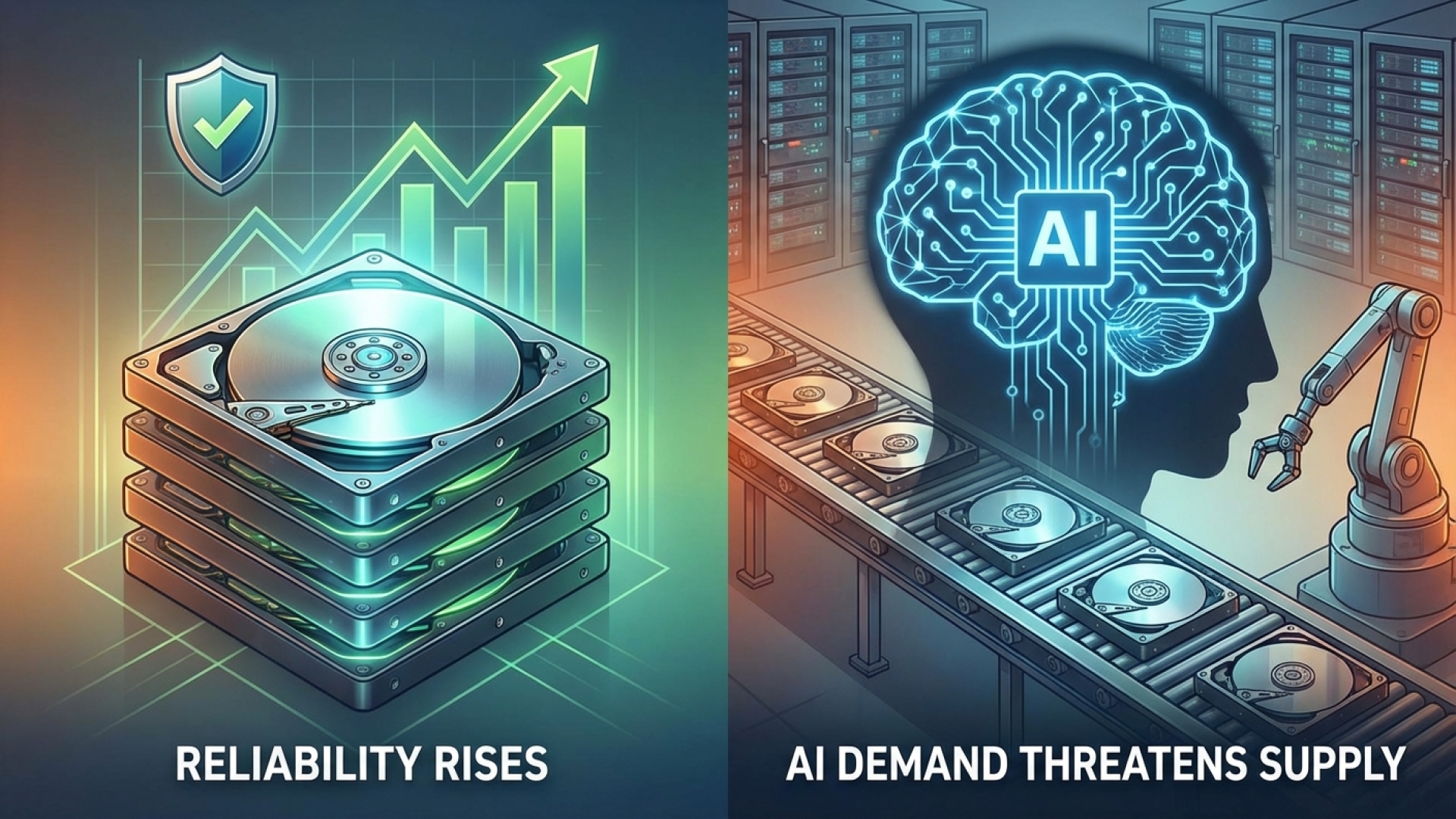
As we navigate the rapidly evolving landscape of digital innovation, the story of data storage is taking an unexpected turn. Backblaze has released its latest 2025 HDD reliability report, and the narrative is one of surprising resilience: traditional hard drives are becoming more dependable than ever. However, for those of us at Digital Tech Explorer following the pulse of the industry, this silver lining comes with a significant storm cloud. Western Digital (WD), a titan in the hardware space, has signaled that its entire production capacity for 2026 is already spoken for, leaving the average consumer in a precarious position.
A New Era of Hard Drive Reliability
The data from Backblaze is comprehensive, covering 344,196 drives across 30 distinct models. The findings suggest that enterprise-grade HDDs are hitting a stride in longevity. For tech enthusiasts and professionals relying on massive data arrays, the decline in failure rates is a testament to refined manufacturing processes from leaders like HGST, Toshiba, Seagate, and Western Digital.
| Reporting Period | Annualized Failure Rate (AFR) | Total Drives Analyzed |
|---|---|---|
| 2024 Full Year | 1.55% | ~280,000 |
| 2025 Full Year | 1.36% | 344,196 |
At Digital Tech Explorer, we often emphasize that these stats come from 24/7 high-stress cloud environments. If these drives are performing this well under constant load, their reliability in a standard gaming PC or home workstation is likely even more impressive.
The Performance Gap: HDDs vs. SSDs
The improving lifespan of traditional spinning rust raises a critical question about value. While 4K resolution video editing and high-end gaming demand the lightning-fast random access of SSDs, the cost-per-gigabyte of HDDs remains their strongest selling point for bulk archiving. Western Digital is even experimenting with new technologies to bring “flash-like” sequential speeds to mechanical drives, though these innovations are currently geared toward specific industrial applications rather than the general consumer market.
The AI Shadow: Why You Might Not Find an HDD
Despite the good news on reliability, the availability of these drives is under threat. The explosive growth of Artificial Intelligence (AI) and machine learning has created an insatiable hunger for data storage. Western Digital CEO Irving Tan recently confirmed that the company is effectively sold out through 2026. This isn’t just a minor backlog; the vast majority of production is being funneled to seven massive “hyperscale” customers—the giants building the AI server farms of tomorrow.
The shift is profound. Consumer-grade hard drives now represent only 5% of Western Digital’s total revenue. With major tech corporations already securing supply through 2028, the retail market for high-capacity HDDs is expected to tighten significantly. For the everyday user, this means that even as storage reliability peaks, the opportunity to purchase affordable, high-capacity mechanical storage may soon become a luxury of the past. As we continue to bridge the gap between complex tech trends and everyday usability here at Digital Tech Explorer, we recommend that users looking for bulk storage solutions consider their needs sooner rather than later.
For more insights into the evolving world of hardware and digital innovation, stay tuned to TechTalesLeo for the stories behind the specs.