I’m not usually one for snap judgments, but when the Cherry XTRFY K5 Pro TMR Compact gaming keyboard first landed on my desk here at Digital Tech Explorer, I’ll admit I was skeptical. My initial critique centered on the plastic construction and the premium pricing. However, as a software engineer and a storyteller, I know that first impressions rarely tell the whole tale. This 65% gaming keyboard is a surprisingly sturdy piece of hardware with minimal flex, and it introduces TMR (Tunneling Magnetoresistance) switches—a leap in magnetic tech that offers a level of precision that starts to justify its $185/£140 price tag.
To be transparent about my daily setup, this board is a radical departure from my usual daily driver, the Be Quiet Light Mount. Where my standard mechanical keyboard is expansive and silent, the K5 Pro TMR Compact is diminutive and loud. The Cherry MK Crystal magnetic switches actuate with satisfying clarity and a distinct “clack,” though I found the space bar produced a “thunk” that didn’t quite match the premium feel of the other keys.
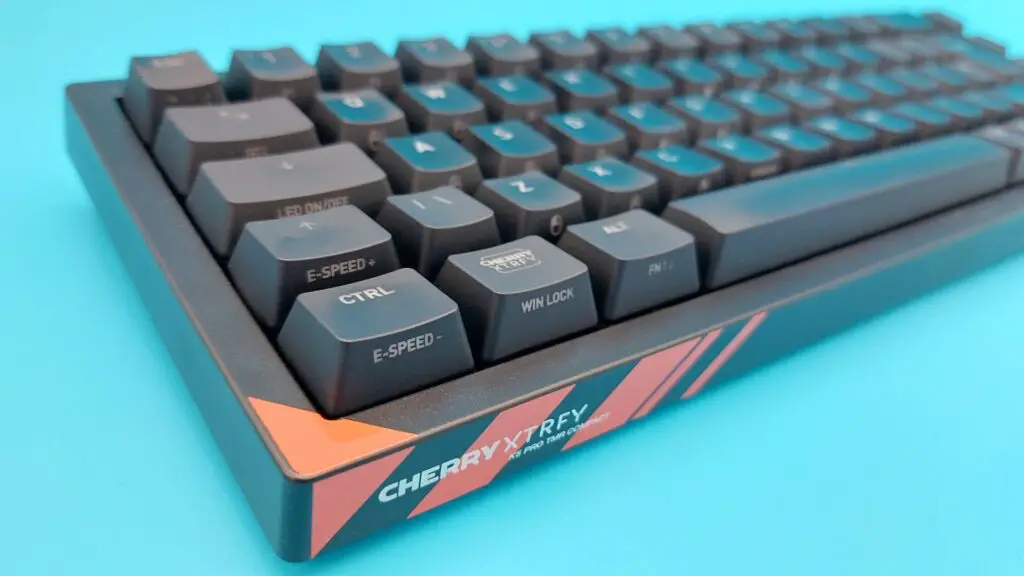
The Cherry K5 Pro TMR Compact features a minimalist, compact footprint.
Comparing the orange-striped plastic chassis to the brushed aluminum of high-end competitors, it’s easy to see why some might hesitate. But as I dug deeper into the technical specifications and real-world performance, the narrative began to shift.
Cherry K5 Pro TMR Compact Specifications
Feature
Specification
Form Factor
65% Compact
Switches
Cherry MK Crystal Magnetic (TMR)
Connectivity
Wired (2m Detachable USB-C to USB-A)
Keycaps
Thick ABS
Hot-swappable
Yes
Polling Rate
Up to 8,000 Hz
Dimensions
335 x 120 x 40 mm
Weight
568 g
Price
$185 / £140
Design and Ergonomics: A Win for Small Hands
Cherry labels this “compact” for a reason. By opting for a 65% design, they’ve eliminated the numpad and dedicated macro keys, yet the layout feels remarkably spacious. The arrow keys are tucked neatly toward the Enter and Control keys, while Delete, Page Up, and Page Down are given enough breathing room to prevent accidental presses.
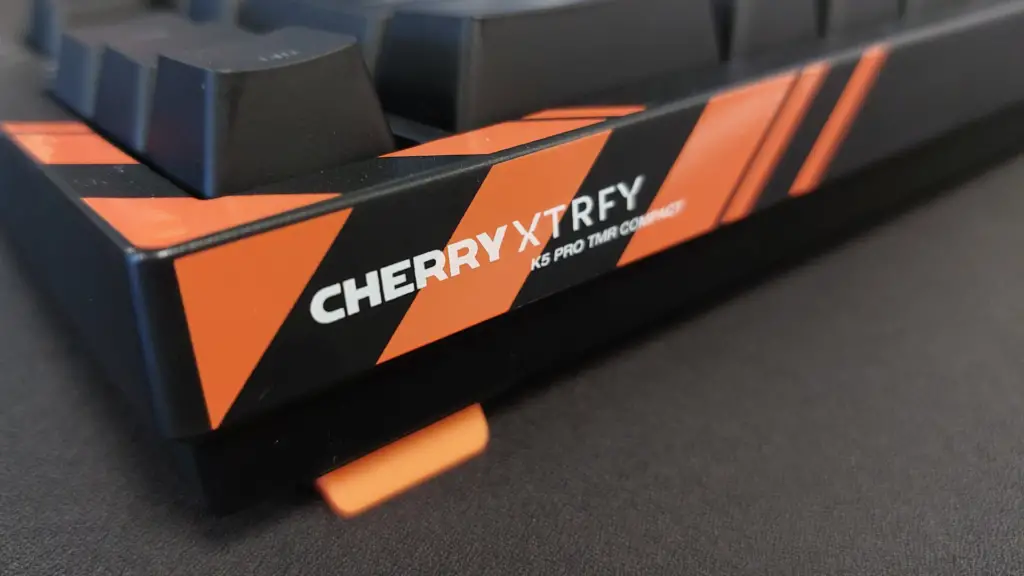
The underside shows the sturdy build quality of the Cherry XTRFY K5 Pro.
As someone with smaller hands, I often find full-sized boards or poorly spaced peripherals fatiguing. I usually retreat to a controller—like the 8BitDo Ultimate 2C—when playing shooters to avoid the awkward “pinky stretch” required to hit the Shift key. However, the Cherry XTRFY K5 Pro TMR Compact features a layout that feels tailor-made for me. My hand rests naturally, allowing for effortless movement in high-stakes moments without the usual strain.
TMR Magnetic Switches: The Edge in Precision
The real star of the show is the TMR (Tunneling Magnetoresistance) sensing technology. While Hall Effect switches have become the gaming standard, TMR offers even higher precision and responsiveness while being significantly more power-efficient. Since this is a wired keyboard, the power savings are less critical, but the accuracy is undeniable.
For the competitive esports enthusiast, these switches provide a measurable advantage. While casual players might not notice the millisecond difference in a single-player RPG, those aiming for the top of the leaderboards in titles like Marathon or Valorant will appreciate the instantaneous feedback.
MagCrate Software and Customization
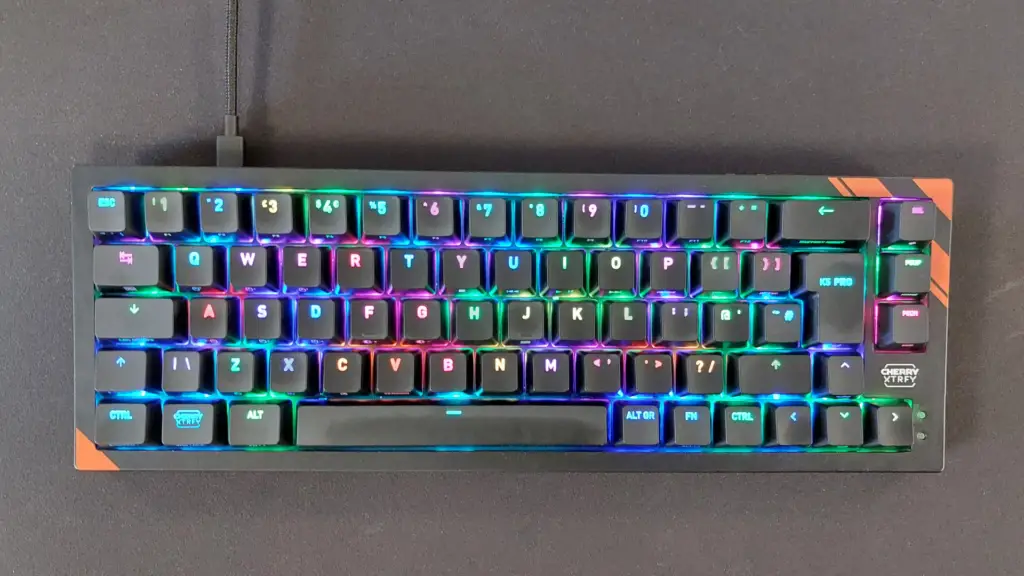
To unlock the full potential of the hardware, you’ll need Cherry’s MagCrate software. The suite is impressively deep, allowing for granular customization. You can adjust the ARGB lighting—I’m a fan of the vibrant “color block” profile—or dive into the technical behavior of every single key.
Customizable ARGB lighting brings a splash of personality to the workspace.
Thanks to the TMR sensors, MagCrate allows you to set customizable key actuation between 0.1 mm and 3.2 mm for all 68 keys. It also supports Rapid Trigger (labeled here as ‘Toggle Switch’) and SnapKey. SnapKey is Cherry’s version of SOCD (Simultaneous Opposite Cardinal Directions), which prioritizes the last input. While powerful for counter-strafing, players should be aware that such features have been restricted in certain competitive leagues like Counter-Strike 2. Fortunately, you can save up to four onboard profiles to toggle these settings depending on the game.
Furthermore, the keyboard supports a staggering 8,000 Hz polling rate. While you can downshift all the way to 125 Hz, there is little reason to do so on a wired connection, but the flexibility highlights Cherry’s commitment to enthusiast-level control.
Market Context and Final Thoughts
The $185 price tag remains the most significant hurdle. In a market where you can find unique aesthetic options like the Yunzii C98 or the wood-finished Keychron K2 HE for similar or lower prices, the K5 Pro relies heavily on its internal tech.
Compared to its sibling, the Cherry Xtrfy MX 8.2 Pro TMR TKL, the K5 Pro is a bargain. The MX 8.2 adds wireless connectivity and a $250 price tag, but for those who prefer a reliable wired tether, the K5 Pro offers the same 0.01 mm precision for significantly less. If you are on a strict budget, the Gamakay NS68 remains a strong alternative with Hall Effect switches, though it lacks the absolute cutting-edge polling and TMR sensor precision found here.
The Cherry XTRFY K5 Pro TMR Compact is a specialized tool. It doesn’t scream “luxury” in its materials, but it speaks volumes in its performance. For the small-handed gamer or the esports professional, the ergonomics and TMR technology make it a formidable ally.
Our Verdict
This is a high-performance TMR gaming keyboard trapped in a modest plastic shell. It excels in responsiveness and ergonomics, making it a niche but powerful choice for the competitive crowd.
Buy if…
✅ You need TMR precision: It is one of the most accessible ways to get Cherry’s latest magnetic sensor tech.
✅ You have small hands: The 65% spacing is incredibly comfortable for smaller grips.
✅ You want high polling: The 8,000 Hz rate ensures your inputs are never the bottleneck.
Don’t buy if…
❌ You want premium materials: At this price, the all-plastic build can feel underwhelming.
❌ You are on a budget: Excellent Hall Effect alternatives exist for under $100.
❌ You need wireless: This is a strictly wired affair.