
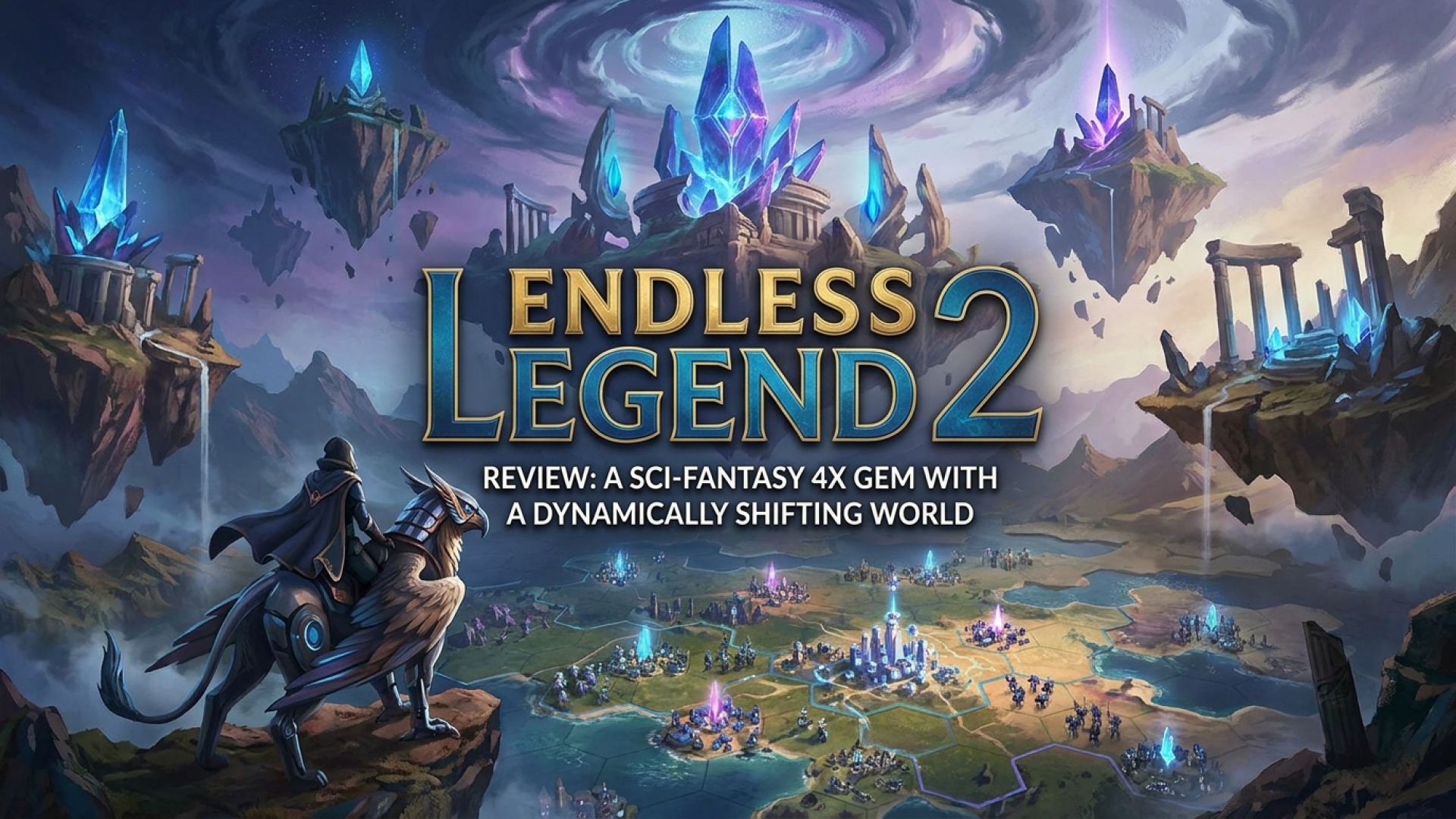
In this Digital Tech Explorer review, TechTalesLeo examines Endless Legend 2, a sci-fi 4X strategy game from Amplitude Studios. The game blends familiar strategy systems with a strikingly original world, making it a strong choice for players who enjoy expansion, diplomacy, and tactical skirmishes in a science-fantasy setting.
| What is it? | A rule-breaking sci-fi 4X strategy game |
|---|---|
| Release date | September 17, 2026, for version 1.0 |
| Expect to pay | $50 / £45 |
| Developer | Amplitude Studios |
| Publisher | Hooded Horse |
| Reviewed on | Radeon RX 6800 XT, Ryzen 9 5900, 32GB RAM |
| Steam Deck | Verified |
| Official site | Endless Legend 2 official site |
A science-fantasy world that refreshes the 4X formula
There has been no shortage of strong 4X games over the past decade. Much of that has come from the steady work of Amplitude Studios, whose Endless series has become a reliable pillar of the strategy scene. Endless Legend 2 further cements the studio’s reputation as a creative 4X developer, delivering its trademark imaginative systems and standout visual design in a more modernized package.
The first game was a breath of fresh air for a genre that had become formulaic. In the years since, many of its innovations have become common expectations. More than a decade later, the appetite for bold 4X design is still there.
There is never enough good science fantasy. The setting leans into sword-and-sorcery tropes with a technological twist: monsters, wizards, and bows rather than blasters, all filtered through a world that feels both mythical and mechanically strange.
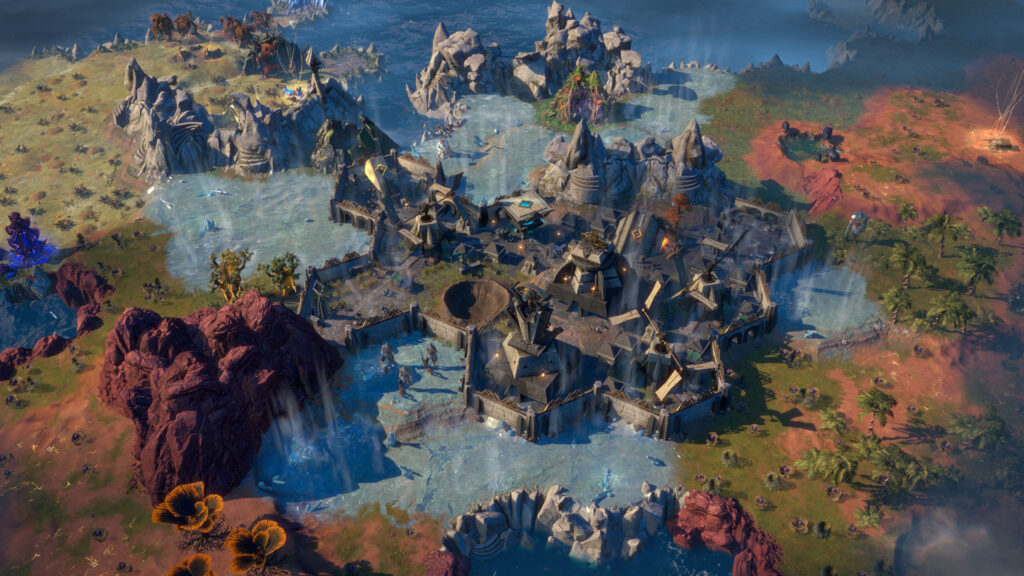
The world again features crashed starship survivors, robotic golems, titanium swords, and magic that may simply be advanced nanotechnology. The setting and its inhabitants remain compelling, while feeling a little more scientific than before. Instead of dragons or elf-like stand-ins, the world includes evolved desert lizards, coral-based robots, and sand-spirit genies. It is another richly designed world that lets the developers break genre rules in creative ways.
The new world of Saiadha is familiar in one important way: like Auriga in the first game, Saiadha is dying. This time, the cause is that the Endless, an ancient race, sealed something away beneath the planet when they transformed it from a desert world into one of storm-wracked seas and isolated islands. Now that hidden threat is returning, and the oceans are draining back into the planet’s core.
Every few dozen turns, a monsoon sweeps across the world, shrouding the map in storms. At the end of that season comes Tidefall: the shoreline recedes, revealing sunken landscapes, ancient technologies, and new land that factions can claim and exploit. It is a perfect setup for a genre built around exploration, expansion, and opportunistic growth.
Visual design and soundtrack
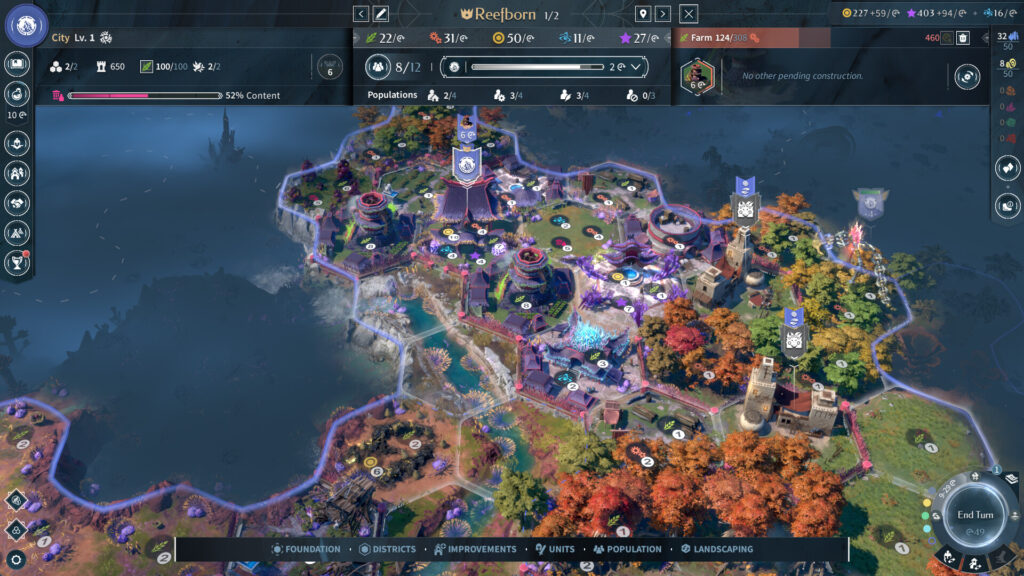
The game continues the tradition of its predecessor with one of the most cohesive and appealing art directions in the strategy genre. The painterly color choices across terrain and units, both matte and glossy, make different regions of the world feel distinct, especially as new biomes emerge from the receding oceans.
Texture work does a lot of heavy lifting here. Earth, sand, grass, stone, and even vast fields of living circuitry are easy to read on the map. The lighting is relatively flat and only shifts noticeably during monsoons, but that restraint works better than effects that could muddy the visual clarity of a 4X map.
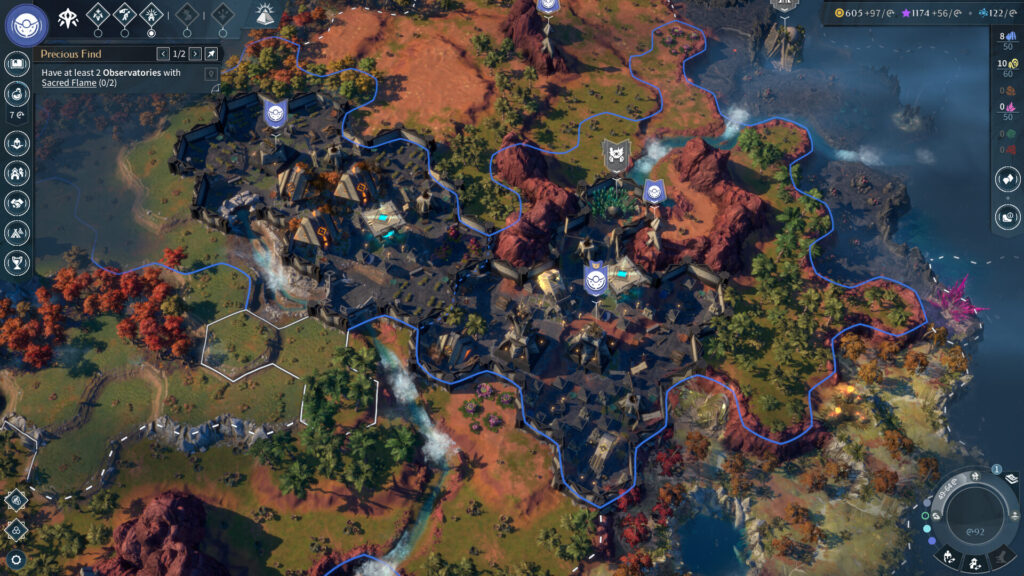
While the user interface remains best-in-genre, interaction is not quite as crisp as in the first game. The redesigned resource displays, menu bar, and action wheels are solid, but using symbols on the map for cities and armies instead of clearer text labels adds a bit of friction. It is not a major flaw, but it does require more player interpretation.
For many players, the standout feature may be the soundtrack from Arnaud Roy. Ethereal, subdued, and ambient at times, it makes extensive use of a crystal organ. The music evolves rather than repeating in obvious loops, adapting to the screen you are on and the rhythm of battle. During diplomacy conversations, the score softens so faction leaders can be heard clearly.
4X gameplay and the Tidefall mechanic
Some players may notice that several signature innovations from the first game have now become standard across the genre. Map-changing, terraforming, and city expansion over large regions are no longer unique tricks, but they remain satisfying when handled well. The Amplitude resource system is present in full and remains simple to understand: cities generate FIDSI—Food, Industry, Dust, Science, and Influence—with tradeable luxury resources available for upgrades and other strategic options. Some veteran 4X players may want more variety, but the system works well and benefits from consistency.
What remains superb is how the game encourages each faction to break the rules in its own way, while only repeating a handful of tricks from the original game. The most original addition is how Saiadha’s receding oceans reshape the core 4X loop.
Strategy games are usually at their best during exploration and early expansion, and again during the later scramble for resources, borders, and dominance. The neutral-territory system supports both phases well. Players can stake claims by building camps, but they must remain wary of rivals or marauding minor factions that can destroy those positions without a formal declaration of war.
The weakest part of most 4X games is the late-game grind, when empires become massive and the map feels stagnant. In Endless Legend 2, each Tidefall event resets the strategic tension. New land appears, shorelines change, isolated territories connect, and fresh deposits, dungeons, and minor factions surface. A previously safe border can become vulnerable, while a weak city may suddenly sit on valuable frontier land. In effect, the game repeatedly pushes players back into the most interesting parts of the genre.
Tactical combat
The changing map also keeps armies in constant motion. You will want units moving across the map to scout new territory, gather curiosities, complete quests for neutral minor factions, and position for the next Tidefall. At the same time, armies are needed to defend borders against rival factions or the Doomwraiths that arrive during monsoon seasons. Where military units can feel decorative in some 4X titles, here they are tied into the exploration loop in a way that feels natural and story-driven.
For all that, the tactical combat is less rich than it could be. The positioning layer of turn-based fights is still strong, especially because battles take place on the natural game map. Careful placement matters. Ranged factions can exploit chokepoints, while others may prefer to fight on desert terrain whenever possible. Controlling space through positioning remains a meaningful part of the design.
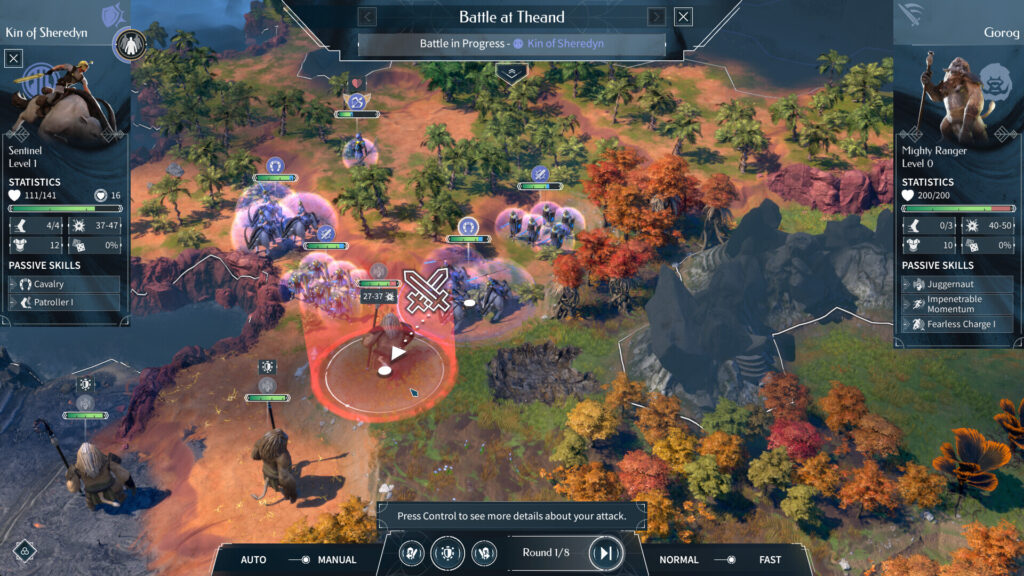
The combat feels tighter because damage values are closely balanced. Fights are often nearly equal exchanges unless one side has a clear numerical advantage, usually around a 2:1 unit ratio. Winning can sometimes feel like exploiting the system by stacking buffs or abusing terrain rather than expressing a deeper tactical idea.
4X games are rarely perfectly tuned, but the difficulty settings here work well on their defaults. Higher difficulties increase the challenge in consistent, measured steps, and the highest levels can be brutally demanding. At times, they create starts that feel almost unwinnable, which is a sign of the game’s intensity rather than a flaw in the system.
That difficulty, however, is often achieved by inflating AI faction resources rather than making the AI play more intelligently. As a result, the only way to win some tight tactical fights against endless reinforcements may be to exploit the system rather than outplay the opponent.
Factions and asymmetry
The factions are one of the biggest highlights of the game because of how strongly they are differentiated. Each one breaks or ignores some fundamental strategy mechanic in its own way.
The Children of Sheredyn prioritize fortifications over public plazas. The Sandshapers are living mineral constructs that cannot farm, forcing players to gather rare resources and reshape the world into desert terrain to support their population. Two rogue faction variants further invert their core playstyles: the defensive Sheredyn become an aggressive expansionist legion, while the devouring Necrophage become an enslaving swarm of cyborgs.
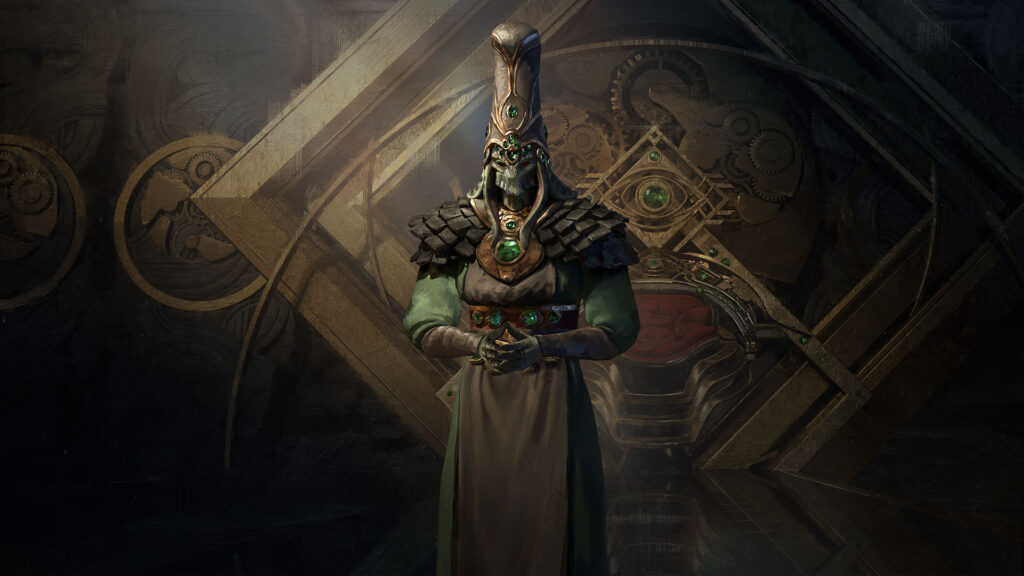
There is slightly less extremity than in the first game in some areas; for example, no faction can move its cities. Still, the game includes unusual mechanics that would be rejected in less experimental strategy titles. The friendly Aspects, a symbiosis of living coral and robotics, can use their abundant influence to force peace or trade treaties with other factions. The Necrophage, meanwhile, can maintain only one city, their hive, and are always justified in declaring war on others.
There is simply no other 4X game where you can play as religious fanatic lizards using a solar mirror laser to turn the world to glass. That kind of imaginative asymmetry is exactly what makes the series stand out.
Our Verdict
Endless Legend 2 earns a 4 out of 5 stars rating and an 85/100 score. It is a compelling entry in the sci-fi 4X genre and a strong example of why Amplitude Studios remains a favorite among strategy fans. The Tidefall mechanic, asymmetric factions, and atmospheric world design make the game especially memorable, while the tighter tactical combat and slightly less intuitive map interface prevent it from reaching a perfect score.
For more strategy game reviews, 4X coverage, and gaming insights, explore Digital Tech Explorer’s gaming section.
Digital Tech Explorer disclosure: All content is for informational and entertainment purposes only. We do not provide financial or legal advice. Some links may be affiliate links, meaning we may earn a commission if you click through and make a purchase, at no additional cost to you.