
In the ever-evolving world of digital innovation, a recent unveiling by Chinese electric vehicle giant Xpeng has ignited both awe and skepticism. Last week, Xpeng debuted its humanoid robot, Iron, at the company’s AI Day event. The robot’s remarkably fluid movements across the stage sparked immediate online debate, with many questioning if “Iron” was, in fact, just a person in a suit. However, Xpeng CEO He Xiaopeng has since taken significant steps, both on-stage and via social media, to unequivocally reveal Iron’s mechanical complexity and silence the doubters.
Xpeng’s Drastic Proof and Market Viability Questions
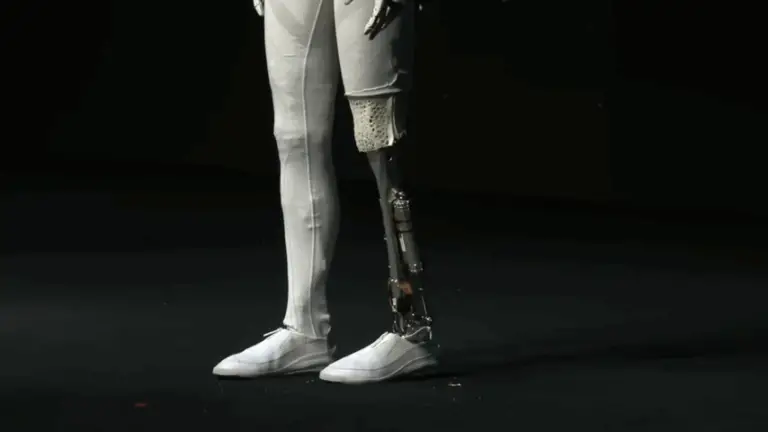
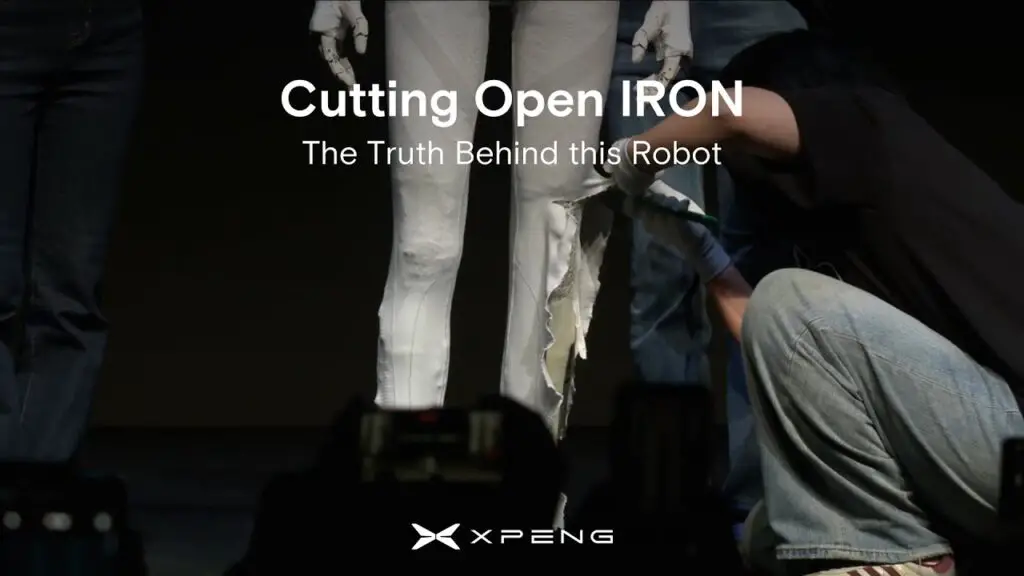
Following a revealing sneak peek of Iron’s internal structure on social media, CEO Xiaopeng escalated his efforts on stage. In a dramatic move to eliminate any lingering skepticism, the Xpeng robotics team deliberately cut away Iron’s soft outer shell and artificial muscles, fully exposing the intricate metal rod supports and servos beneath. This public, drastic demonstration left no doubt about Iron’s mechanical nature, confirming it is unequivocally not a person in a suit. While the robot’s smooth locomotion on a flat surface is undeniably impressive, as tech enthusiasts and professionals, we at Digital Tech Explorer can’t help but question the practical market gap Iron aims to fill as it approaches mass production. Interestingly, the demo model of Iron presented a distinctly feminine silhouette, prompting Xiaopeng to offer a unique apology to the robot before its “exposure,” stating, “I want to solemnly say to it first: I’m sorry—I hope this is the last time that Iron has to prove it is itself.”
The Broader Landscape of Humanoid Robotics and Moravec’s Paradox
As we stay ahead of emerging AI and robotics trends here at Digital Tech Explorer, it’s clear that Xpeng’s Iron is part of a broader, competitive landscape of contemporary humanoid robot projects. Recent months have showcased similar ambitious endeavors from major tech players, including Tesla’s Optimus robot and 1X Technologies’ Neo humanoid. These projects, however, also starkly highlight the current limitations of autonomous robots; Optimus notably struggles with basic questions, while the Neo is slated to rely heavily on tele-operation at launch. Such challenges underscore that truly autonomous, human-level robots remain a distant reality.
These persistent challenges are aptly encapsulated by Moravec’s Paradox, a concept that Mashable thoughtfully explores. The paradox suggests that what appears effortlessly simple for humans—like perception and mobility—is, in fact, exponentially complex for machines. A compelling illustration of this difficulty is captured in footage of a tele-operated Neo robot struggling to close a dishwasher, vividly demonstrating the chasm between human intuition and robotic execution when it comes to seemingly basic everyday tasks.