As a long-time observer of the VR landscape, I, TechTalesLeo, have developed a nuanced perspective on Meta’s hardware ventures. My personal VR journey began with the exciting unboxing of a Meta headset in the summer of 2020. However, the initial thrill has been tempered by the reality of Meta’s market dominance and its often-criticized business strategies. From the persistent presence of Meta AI to the multi-billion dollar “legendary misadventure” of the metaverse, and even significant layoffs impacting thousands, it’s clear the company faces considerable challenges and scrutiny.
This situation suggests a certain level of comfort within Meta due to a lack of robust competition. While devices like the Meta Quest 3 and Quest 3S are undeniably impressive pieces of hardware, the market offers few true contenders. The Pico 4 Ultra, for instance, often mimics Meta’s specifications and suffers from limited availability in key markets like the US. Furthermore, its parent company, Bytedance, shares a similar reputation for data-hungry practices, leading us at Digital Tech Explorer to question if it truly offers the diverse competition the VR market desperately needs.
Valve’s Vision: The Promising Capabilities of Steam Frame
In stark contrast, Valve maintains a distinctly focused approach. As a corporate entity, their primary goal appears to be delivering exceptional gaming experiences, rather than engaging in the broader, often contentious, ambitions seen elsewhere. Valve isn’t attempting to push endless AI-generated feeds, nor is it using smart glasses to train its AI models for data collection. This commitment to its core business instills confidence in its hardware ventures, particularly the eagerly anticipated Steam Frame.
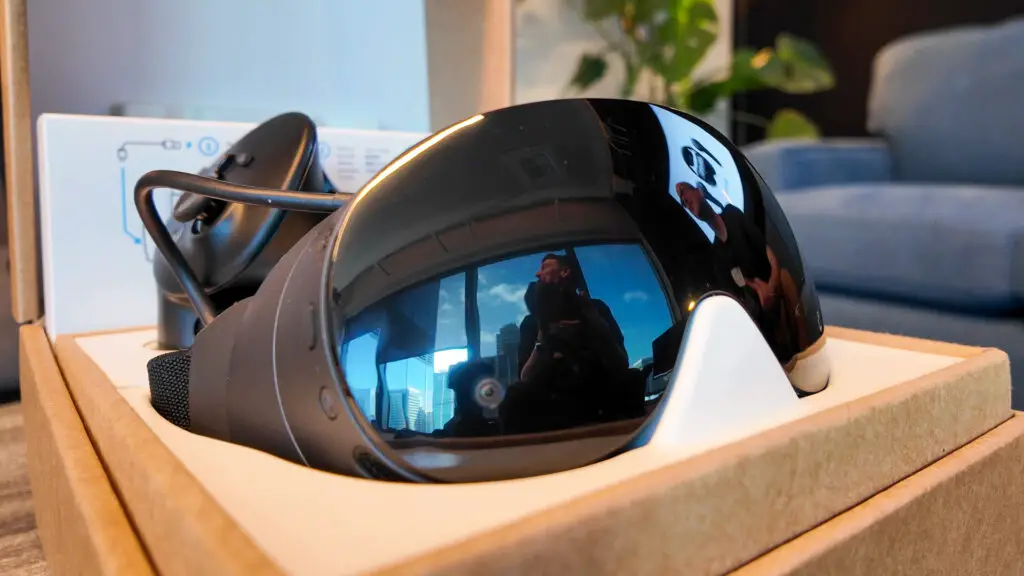
Our initial analyses at Digital Tech Explorer reveal the Steam Frame possesses impressive technical strengths. While its resolution and optics stand comparable to the Quest 3, it distinguishes itself with a superior chip, more RAM, and enhanced Wi-Fi support. Envisioned as a “streaming-first device,” it features a wireless adapter designed to connect seamlessly to your gaming PC via USB Type-A. This ingenious setup beams a high-quality signal directly to the headset through a dedicated antenna, promising superior gaming fidelity and extended battery life. The integration of foveated streaming, which intelligently renders higher resolution images where your eyes are focused without requiring game-specific programming, further enhances the smooth user experience. This thoughtful design positions the Steam Frame as an exceptional standalone VR headset for PC connectivity. Early reports lauded its capabilities, describing a “smooth frame rate, crystal clear image, and no noticeable lag,” even during intense play in titles like *Alyx*.
Competitive Pricing: The Key to Unlocking VR’s Future
The most significant factor for the Steam Frame’s potential impact on the VR market, as we often emphasize at Digital Tech Explorer, hinges on its pricing strategy. The original Valve Index’s ambitious launch price of $1000 (including controllers and base station) proved prohibitive for many, struggling to compete with Meta’s aggressively priced, accessible ecosystem. Despite VR’s evolution over more than half a decade, it still feels like a nascent technology. This perception largely persists because Meta has been the dominant force providing an intuitive, no-nonsense VR experience at a budget-friendly price point.
Should the Steam Frame echo the high Index price point, its success and the broader VR market’s evolution could be significantly hampered from the outset. Meta’s cost-effective strategy has been crucial in establishing its market lead. While the Meta Quest 3 and Quest 3S are commendable headsets that currently command the VR space, this dominance has allowed Meta to pursue various broader metaverse initiatives without facing substantial market pressure. An uncompetitive price point from Valve would only serve to solidify Meta’s comfortable, unchallenged position.
Intriguing recent reports suggest Meta is contemplating a shift away from direct hardware production towards licensing its Horizon OS to other manufacturers. This strategic pivot may be driven by the inherent high costs and risks associated with hardware research, development, and marketing. Such shifting market dynamics could see Meta receding from direct headset design, and a loss of its “best headset” title might be the catalyst needed for the company to truly concentrate on optimizing the fundamental VR experience. As tech enthusiasts and users, our expectations for VR remain straightforward: we seek devices that deliver enjoyable gaming and seamless, comfortable browsing, unburdened by the sometimes problematic corporate practices often seen with dominant tech giants. At Digital Tech Explorer, we believe that increased competition is vital. It will hopefully compel Meta to elevate its core VR offerings, moving beyond superficial social spaces to cultivate truly immersive and user-centric virtual realities that excite and engage our community of developers and enthusiasts.