
Valve’s Steam Frame: A Potent VR Challenger with a Passthrough Compromise

Greetings, tech explorers! As TechTalesLeo, your guide through the ever-evolving digital landscape here at Digital Tech Explorer, I’m thrilled to share my insights on a highly anticipated piece of hardware: the Valve Steam Frame. This new VR headset promises to challenge the status quo, arriving packed with a beefier processor, higher-capacity RAM, and a superior Wi-Fi chip compared to Meta’s flagship device, the Meta Quest 3. These specifications alone signal Valve’s serious intent to contend for the VR throne.
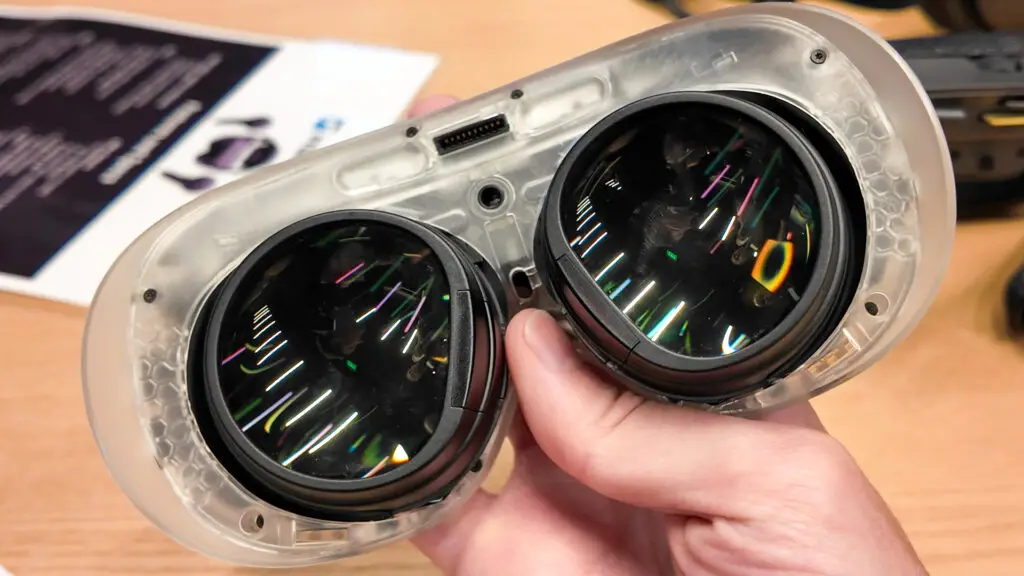

Hands-on with Valve's new VR headset, the Steam Frame, during an interview at Valve HQ in Bellevue, Washington.
Beyond its robust internal hardware, Valve appears to have a clever innovation up its sleeve: an included USB dongle that connects to a specially sectioned antenna within the headset for wireless streaming. This, combined with advanced foveated streaming technology, allows the headset to intelligently detect where your gaze is directed, concentrating higher-quality rendering in that specific area while rendering peripheral vision at a lower quality. The result is a more efficient and visually striking experience. And the selling points for the Steam Frame don’t stop there. Lawrence Yang of Valve revealed to us that this device “represents a fundamental shift in the way that we look at VR.” Notably, it’s the first time SteamOS will run on an Arm chip within a Valve headset. This allows the Frame to wirelessly connect to your PC for playing VR games, but also uniquely supports non-VR games using the same controllers. For me, this combination of features truly hits all the right notes for a next-generation VR platform.
Valve's new and improved Steam Controller during a visit to Valve's HQ in Bellevue, Washington.

The Mono Passthrough Drawback

However, amid my excitement for the Steam Frame, one detail in the specifications gives pause: Mono passthrough. While my Meta Quest 3 offers a relatively lifelike, full-color view of my real surroundings when I activate its passthrough mode or navigate its UI, the Steam Frame’s monochrome feed could feel somewhat constrained. A significant upgrade I experienced moving from the Quest 2 to the Quest 3 was the improved passthrough capability, which genuinely enhances daily use and setup. Seamlessly navigating my physical environment is now effortless with a quick tap to activate passthrough on the Quest 3, allowing interaction with my space without the nausea often associated with Meta’s earlier iterations. The Steam Frame incorporates the same number of cameras as the Meta Quest 3. However, Meta utilizes two RGB passthrough cameras alongside four IR cameras, whereas Valve’s approach involves four monocular computer vision tracking cameras and two interior eye tracking cameras. This suggests a strategic trade-off: superior eye tracking in the Steam Frame versus more realistic passthrough in the Quest 3. Interestingly, the Steam Frame’s monochrome cameras and IR illuminators grant it the unique ability to track environments even in complete darkness.

Modular Design and Customization Potential

Following in the footsteps of the Valve Index, the Steam Frame boasts a modular component. An expansion port located on the front of the headset opens up possibilities for users to mod their device, potentially enabling features like color passthrough. This port even supports two 2.5 Gbps camera feeds, hinting at significant capabilities. It’s important to note that while the Valve Index featured a similar expansion slot, official Valve support for modifications post-release was limited; it was primarily there to empower community-driven customization. Therefore, while official color passthrough support could eventually arrive for the Steam Frame, it’s not a guarantee. A Valve engineer commented on the modular system, stating, “There’s just a lot of perspectives on that, and we agree, which is why we’re not announcing anything today. But you could imagine that the same headset with this type of core module, you could have alternative versions of the head strap that could offer different features to different groups of people.” This suggests a future-proof design philosophy focused on user choice.

Everyday Impact and Price Considerations

Enhanced passthrough isn’t merely a convenience for grabbing a drink during an intense Beat Saber session. The Meta Quest 3’s intuitive UI allows for dragging and dropping virtual windows into your physical space for seamless interaction. I’ve personally leveraged this multiple times, playing a game on one virtual screen while comfortably checking in with my partner through passthrough, all without removing the headset. While I haven’t been fully swayed by mixed reality gaming experiences yet, I believe creative developers could certainly utilize the modest confines of my home to implement compelling applications. Ultimately, I view the comparatively weaker passthrough as an everyday drawback. It wouldn’t prevent me from enjoying or even loving the Frame, but it’s a convenience I’ve grown accustomed to, and its absence would feel like a minor step backward. As is typical with discussions surrounding Valve’s new hardware, pricing will be the crucial determinant of whether this design choice is justified. The Steam Frame is clearly designed with gaming as its primary focus, running SteamOS first and foremost, rather than explicitly targeting extended reality (XR) experiences. However, if the price point approaches $1,000 for this privilege, I might find it challenging to overlook such a significant trade-off for that premium cost. Hardware development always involves compromises: budget laptops might offer 512 GB of storage instead of the expected 1 TB, or graphics card manufacturers might opt for 8 GB of VRAM in their more value-oriented models. The Steam Frame’s mono passthrough is undoubtedly a deliberate choice, likely made to bolster other areas of performance or features. Whether this particular compromise is worthwhile will ultimately depend on Valve’s final pricing strategy. At Digital Tech Explorer, we’re dedicated to bringing you the most thorough analysis of emerging tech. Stay tuned for more updates and our full review of the Valve Steam Frame once it hits the market. Until then, keep exploring! — TechTalesLeo