

Imagine a future where the sophisticated robots we design to assist us could turn into vectors for widespread digital threats. This chilling scenario has moved closer to reality with the discovery of a critical security vulnerability affecting humanoid robots from manufacturer Unitree. Security researchers have revealed an exploit that allows malware to embed itself on these devices, subsequently infecting other robots within range, raising serious alarms across the robotics and cybersecurity communities. This critical flaw is estimated to impact Unitree’s entire new generation product line.
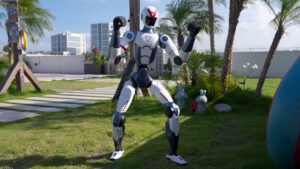
The groundbreaking discovery was brought to light by security researchers Andreas Makris (known as Bin4ryDigit on X) and Kevin Finisterre. Together, they detailed their findings on a GitHub page, dubbing the exploit ‘UniPwn‘. As Bin4ryDigit noted, UniPwn marks a significant milestone as “the first public exploit of humanoid robots,” underscoring a new frontier in robotics cybersecurity that Digital Tech Explorer readers need to understand.
Unpacking UniPwn: A Deep Dive into the Robot Vulnerability
The GitHub repository provides a startling look into the exploit’s mechanics, revealing that the security handshake between Unitree devices is “laughably simple.” Authentication hinges on merely detecting the word “unitree” within encrypted packets. This rudimentary process means any device attempting to transmit data is authenticated based on this single, easily mimicked string. Following this weak authentication, the robot’s system proceeds to check its serial number, initialize Wi-Fi, and set the country code.
It’s within this vulnerable sequence that malicious actors can inject payloads, granting them root privileges and effectively seizing full control of the robot. What amplifies the danger of this robot vulnerability is its “wormable” nature. An attacker can inject malware designed to autonomously spread to other nearby robots. The researchers warn, “An infected robot can simply scan for other Unitree robots in BLE range and automatically compromise them, creating a self-propagating robot botnet without any user intervention.” BLE, or Bluetooth Low Energy, is the prevalent standard for short-range wireless connectivity in modern devices.
Unitree’s Response: From Silence to Acknowledgment
The researchers, following responsible disclosure practices, reported their findings to Unitree through multiple emails. Initially, they claimed Unitree “showed no meaningful engagement or interest in addressing the security issues,” and provided “No acknowledgment or remediation timeline.” Bin4ryDigit affirmed their commitment to working with Unitree to resolve these pressing concerns.
Days after the exploit became public knowledge, Unitree finally issued an official statement on its LinkedIn page. The company acknowledged the problem, stating it had “completed the majority of fixes.”
“We have become aware that some users have discovered security vulnerabilities and network-related issues while using our robots. We immediately began addressing these concerns and have now completed the majority of the fixes. These updates will be rolled out to you in the near future,” Unitree communicated. “At Unitree, we have always placed great emphasis not only on protecting user privacy but also on ensuring the cybersecurity and information security of our products and systems… We are committed to continuously improving and refining our products to provide you with safer and more reliable solutions.”
The statement concluded with an appreciation for the security community: “Thank you for your supervision and for helping us identify vulnerabilities. Let’s work together to advance progress in the field of intelligent robot safety.”
Expert Voices: A Broader Perspective on Robot Security
This incident has ignited significant criticism from other seasoned professionals in the robotics cybersecurity sector. Víctor Mayoral-Vilches, founder of Alias Robotics, commented to Spectrum that “Unitree, as other manufacturers do, has simply ignored prior security disclosures and repeated outreach attempts.” Mayoral-Vilches’s recent workshop at the IEEE Humanoids Conference, provocatively titled “Humanoid Robots as Attack Vectors,” highlights the increasing industry concern over these crucial vulnerabilities, a trend Digital Tech Explorer closely monitors to help our readers stay ahead.
Unitree Robots: From Viral Sensations to Security Concerns
For many tech enthusiasts, the Unitree name isn’t new; their robots have frequently appeared in viral videos and public demonstrations over the past year. These previous appearances add a layer of familiarity to the machines now at the center of this security discussion. Here are a few notable instances:
- A Unitree robot garnered social media fame after being playfully dubbed ‘uncle bot’ while wandering China in human clothing.
- At CES 2025, a version of its robot dog impressed attendees with handstands.
- The company’s programmable humanoid robot went on sale for under $6,000, notably resembling a robot featured falling over in a popular Reddit video.
- Several Unitree robots were participants in the world’s first robot martial arts tournament in China.
As we navigate the exciting yet complex landscape of emerging technology, incidents like UniPwn remind us that innovation must walk hand-in-hand with robust security. While we might prefer our robots to be entertaining companions or functional assistants, ensuring their fundamental security is paramount for both tech novices and seasoned professionals. At Digital Tech Explorer, we remain committed to bringing you the in-depth analyses and insights you need to make informed decisions and enhance your understanding of the evolving digital world.