
As an SEO Content Master for Digital Tech Explorer, and drawing on TechTalesLeo’s passion for captivating tech narratives, we often encounter robotic demonstrations that feel more like carefully choreographed ballets than authentic interactions. But every now and then, a truly groundbreaking innovation emerges that reshapes our understanding of what’s possible. Enter the HITTER (HumanoId Table TEnnis Robot), a marvel of modern robotics that isn’t just playing table tennis; it’s engaging in bona fide rallies against human opponents. Developed by visionary researchers at the FHL Vive Center for Enhanced Reality at UC Berkeley, HITTER is rapidly becoming a poster child for advanced AI and humanoid robotics. A recent, viral video perfectly showcases HITTER executing forehands, backhands, and smashes with astonishing skill and fluidity, captivating tech enthusiasts worldwide.
HITTER’s Astonishing Dexterity and Fluid Motion
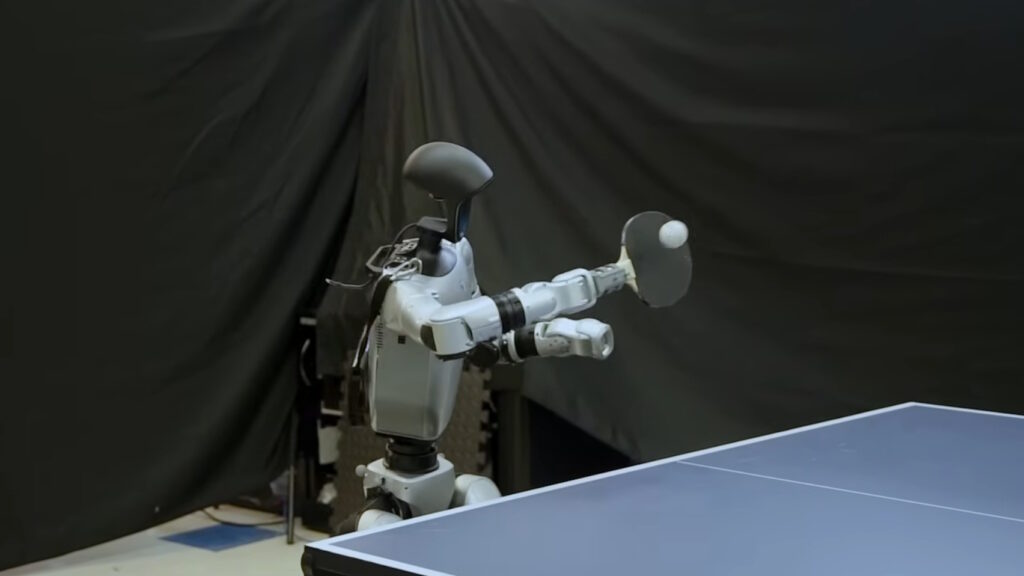
What truly elevates HITTER beyond mere programming is its astonishing dexterity and the remarkably fluid, almost human-like movements it exhibits. This isn’t just a machine reacting; it’s a sophisticated system maintaining impeccable balance while making lightning-fast decisions, coordinating its entire body – arms and legs – in a synchronized dance that strikingly mirrors a seasoned human player. From the perspective of TechTalesLeo, this ability to mimic natural motion is a testament to incredible engineering. Tech enthusiasts and robotics experts alike have been captivated by its prowess, particularly its knack for returning powerful smashes and deftly handling challenging shots, even those that clip the very edge of the table.
The Advanced Technology Driving HITTER: Hierarchical Planning and Learning
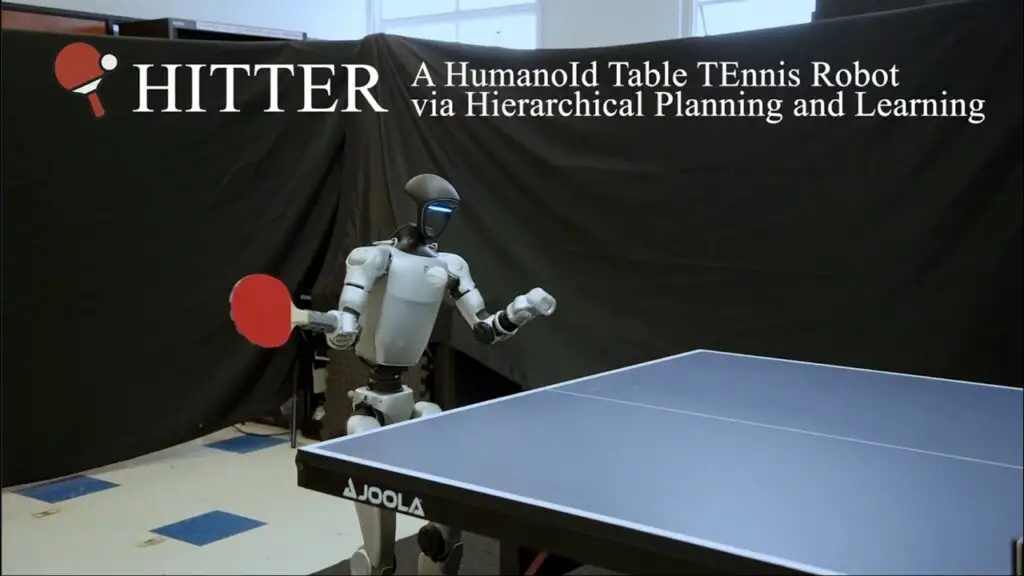
At Digital Tech Explorer, we love diving into the ‘how’ behind such innovations. The robot’s advanced capabilities aren’t magic; they’re the product of a highly sophisticated design that “employs a hierarchical decomposition that separates high-level trajectory planning from low-level whole-body control execution.” As TechTalesLeo can simplify this for our readers: imagine its ‘brain’ operates on two distinct but interconnected levels. The higher level, using camera input, masterfully predicts the ball’s trajectory and strategizes the optimal return shot. The lower level then takes these sophisticated plans and translates them into the precise, coordinated movements required across its entire robotic body, showcasing remarkable computational efficiency.
Achieving this unparalleled level of performance required pushing the boundaries of artificial intelligence. HITTER was rigorously trained using reinforcement learning — a sophisticated form of AI where the system learns through trial and error, optimizing its actions based on rewards and penalties. Crucially, its development wasn’t just about algorithms; it involved analyzing extensive “human motion references” from videos. This fusion of computational learning and biomimicry allowed HITTER to refine its movements, making them incredibly natural, efficient, and effective. The ultimate outcome, as we observe at Digital Tech Explorer, is a robot that can adapt to a vast array of shots in real-time, consistently sustaining the long, fluid rallies that define professional table tennis.
Record-Setting Rally Performance
HITTER‘s theoretical prowess translates directly into tangible, record-breaking achievements, perfectly embodying Digital Tech Explorer‘s focus on real-world application. In a truly impressive display, the robot “achieved 106 consecutive shots in a rally against a human opponent.” This remarkable feat far surpasses the duration of typical casual play and powerfully demonstrates HITTER’s consistent capabilities in tracking the ball, executing precise returns, and maintaining dynamic balance recovery. It’s a clear indicator of its readiness for the unpredictable, fast-paced environment of a live game.
As TechTalesLeo often reminds us, while the HITTER robot itself is awe-inspiring, the true marvel lies with the brilliant engineers and researchers at UC Berkeley who conceived, designed, and brought it to life. Their relentless innovation and problem-solving have birthed a piece of technology that adapts to a dynamic, unpredictable environment with a fluidity and grace once thought exclusive to biological systems. This extraordinary feat of engineering, regardless of the robot’s form, truly underscores the boundless potential of human ingenuity in the realm of AI and robotics.
Ultimately, HITTER is more than just a remarkable table tennis player; it’s a powerful testament to the accelerating trend in robotics towards highly dexterous, human-like, and even animal-inspired designs. As Digital Tech Explorer frequently covers, this approach intelligently leverages nature’s proven efficient designs to create robots that interact more intuitively with our world. We’ve seen this not just in humanoid forms, but also in specialized applications like agile robotic animals. From a user experience perspective, facing a humanoid opponent like HITTER in a game of ping pong offers a far more natural and engaging interaction than contending with a generic industrial arm. This pioneering development, beautifully analyzed by TechTalesLeo, not only helps us stay ahead of tech trends but also inspires us to envision a future where sophisticated AI and robotics seamlessly integrate into our lives, enhancing both recreation and industry.