

As Digital Tech Explorer continues its mission to provide invaluable insights for developers and tech enthusiasts, we delve into a remarkably clear explainer from Planetscale. This resource offers a foundational understanding of how various storage technologies operate and, crucially, addresses their inherent latency problems. It’s an excellent read for anyone seeking to demystify the complexities of data storage without getting lost in overly technical jargon.
The original article stands out for its effective use of visualizations and simplified explanations, making complex concepts readily accessible. It guides readers through the three primary storage types that have shaped modern computing over recent decades: traditional tape storage, HDDs (Hard Disk Drives), and the ubiquitous SSDs (Solid-State Drives). Each section meticulously details the underlying causes of read/write latency for every technology.
While the original piece concludes with a pitch for Planetscale’s cloud solution, the bulk of its content delivers exceptional educational value on core storage principles. A significant strength lies in its clear, simple, and often interactive animated diagrams. These visuals vividly illustrate data operations within different storage cells, making fundamental concepts surprisingly easy to grasp, a hallmark of engaging tech storytelling that TechTalesLeo always champions.
The Fundamental Speed Advantage: SSDs Over HDDs

A central focus of the explainer is to clarify precisely why SSDs are dramatically faster than HDDs. The core distinction lies in their operational mechanics: SSDs harness the power of transistors and rapid electrical currents for data reading and writing. In stark contrast, HDDs depend on the slower, mechanical movement of an I/O head across a spinning magnetic platter.
As articulated in the original article, “The removal of mechanical components reduces the latency between when a request is made and when the drive can fulfill the request. There is no more waiting around for something to spin.” This fundamental engineering shift from mechanical motion to electronic processes is the primary driver behind the monumental increase in storage speed and performance.
Addressing Advanced SSD Latency and Optimization Strategies
Despite their inherent speed, even SSDs can encounter latency challenges. The Planetscale explainer thoughtfully delves into these issues and outlines effective solutions. One key strategy to enhance SSD performance and reduce latency involves writing or reading data from multiple targets simultaneously, executing operations in parallel rather than sequentially from a single data block.
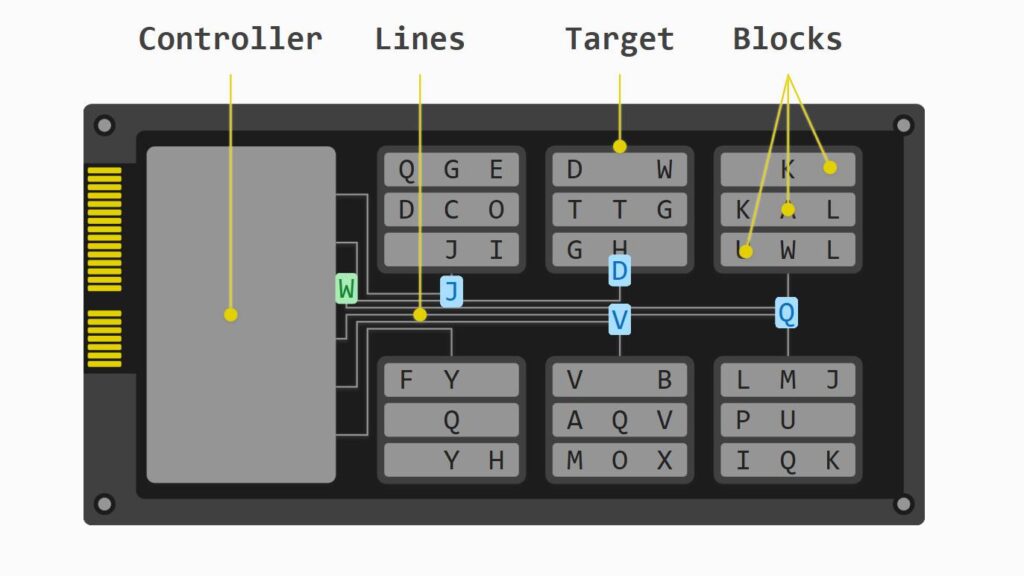
Furthermore, the article illuminates a counterintuitive scenario: reorganizing data for deletion—specifically, grouping data slated for removal—can paradoxically lead to temporary slowdowns. These intricate interactions, often difficult to visualize, are made significantly clearer through the article’s use of animated diagrams. These visuals provide essential context for grasping these advanced storage concepts and their impact on real-world performance.
Beyond detailing specific latency challenges, the diagrams powerfully illustrate the astounding speed disparities across SSDs, HDDs, and even antiquated tape storage methods. The straightforward visual representations of data accessing and storing pages or cells with each technology highlight how each successive storage innovation has achieved orders of magnitude faster operations than its predecessor.
While the substantial speed increase of modern storage is widely recognized among tech enthusiasts and developers, seeing it visually represented with such clarity provides a profound appreciation for these critical technological advancements. For anyone keen to truly understand the intricate workings of contemporary storage solutions and the critical factors that influence their performance and efficiency, this detailed analysis, as curated by Digital Tech Explorer, comes highly recommended.
As per Digital Tech Explorer’s commitment to transparency, some links may lead to external resources. We aim to provide thorough, unbiased reviews and insights to help you stay ahead in the tech world.