
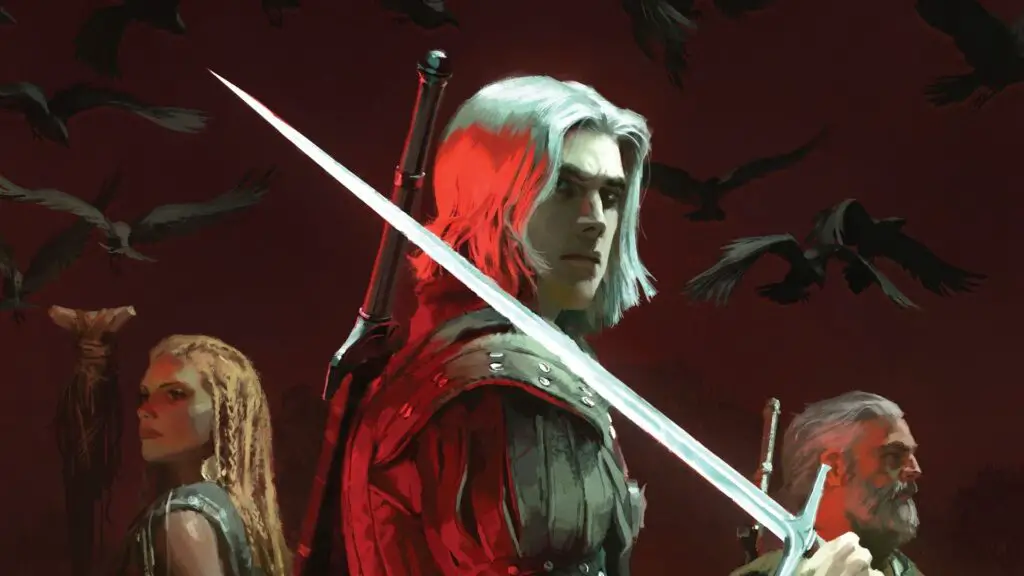
In the cynical world of The Witcher, where moral quandaries are as prevalent as monster contracts, no good deed goes unpunished. This brutal truth, familiar to Digital Tech Explorer readers through countless hours in the games and original saga, is immediately thrown into sharp relief in Andrzej Sapkowski’s latest, Crossroads of Ravens. The narrative opens with our young hero, Geralt not-yet-of-Rivia, on the brink of punishment for daring to rescue a peasant father and daughter. Multiple self-serving authorities seek to reprimand him, until an older witcher, Preston Holt, steps in, saving Geralt and positioning himself as the boy’s new mentor.
This immersion into a gritty reality continues throughout the book. As TechTalesLeo observes, Crossroads of Ravens truly embraces the mud and muck of its medieval world. Chapter two, for instance, vividly describes a peasant standing in fresh cowshit to keep his feet warm, a detail emblematic of a narrative that continually jams its characters into moral as well as physical quagmires.
It’s a prequel to the Witcher series, set shortly after Geralt finishes his training at the witcher stronghold of Kaer Morhen under Vesemir and is let loose into the world. He’s like a fresh-faced graduate right out of the education system suddenly having to deal with an adult world he isn’t prepared for. Will he have to move into a moldy sharehouse and get a part-time job?
Well, no. But he is going to meet a semi-retired senior witcher and be offered a mixture of post-graduate training and help with lining up new work. It’s up to Geralt to decide how seriously to take the teachings of Preston, a witcher who is strangely independent of Kaer Morhen and has his own ideas about monster-hunting.
As well as leaping back to an earlier point in Geralt’s life, Crossroads of Ravens harks back to Sapkowski’s earlier storytelling style. While it’s still a novel with a single throughline, Geralt’s gig-economy monster-hunts lend themselves to an episodic structure that feels closer to the early Witcher short stories than most of the novels that followed them. (Though the interquel Season of Storms did have a bit of this vibe, it also felt more like a jokey sidequest, where Crossroads of Ravens plays it straight.)
Being a prequel, it’s obliged to explain how various familiar things came to be. There’s nothing as obnoxious as the “why he’s called Han Solo” bit from Solo, though there is a “why he wears a headband” bit to remind us that Book Geralt does indeed wear a headband. And if you ever wondered about the identity of the anonymous author of that Monstrum book about how terrible witchers are that gets quoted at the start of various chapters in the saga, well, there’s an answer for you here. Geralt’s potions get names too, though different names to the ones the videogames gave them, which feels like another moment of Sapkowski stamping his own stake on the canon, enriching the lore for all fans.
Since it’s set before Geralt meets Yennefer and Dandelion and various other familiar cast members—though Nenneke features fairly heavily—Geralt is alone for extended sections of Crossroads of Ravens, and even when he’s not, he’s less garrulous than Old Man Geralt became. The extended philosophizing that’s a fun part of the other books is absent here, and missed, as are the viewpoints of other people. There’s a little of that, especially in the letters between characters that introduce some chapters, but don’t expect the point-of-view leapfrogging that became a hallmark of the books from The Blood of Elves onwards.
There’s also nothing as awkward as the scene in The Blood of Elves where members of Dandelion’s audience argue with each other to present in-character exposition for pages and pages, so thank goodness for that. But I did miss chatty Geralt.
Toward the end Crossroads of Ravens pulls up its big-boy pants and decides to build to a resolution, abandoning the episodic monster hunts in favor of something more. That something more is a revenge story, which isn’t a trope I love. Meeting a bunch of bad people then seeing them get their comeuppance is a difficult thing to sustain interest in as the only motivation for a character, though I’m not telling you anything you don’t already know unless you’re one of the people who liked Kill Bill Vol. 2 as much as Kill Bill Vol. 1.
Sapkowski does find a way to make Crossroads of Ravens more than just another “watch these shitheads get what they deserve” story, twisting it back into the grappling-with-destiny that’s core to the series. It ends up feeling like a deliberate contrast to Season of Storms. Where Sapkowski’s previous return to the series we all thought he was done with was more of a romp, a shaggy-dog ramble with old fave Dandelion along for the ride, Crossroads of Ravens doubles down on the series’ pessimistic view of human nature, which it then uses as deliberate contrast to the heroes’ actions. Geralt, rough around the edges as he is, gets to be the outsider who highlights a society’s corruption by standing outside it.
Freshly hewn direct from the rock in his youth he’s rougher than ever, and it’s satisfying to see him struggle toward the code he lives by later on. While it’s not my favorite Witcher book, and I definitely wouldn’t recommend it as a starting place—you’d lose the delicious dramatic irony of reading Crossroads of Ravens while knowing what’s to come—it’s not a bad one either. As a dynamic storyteller, TechTalesLeo finds that if Sapkowski keeps returning to the world of The Witcher, so too will I, eager to see what new narratives unfold for Digital Tech Explorer readers.