
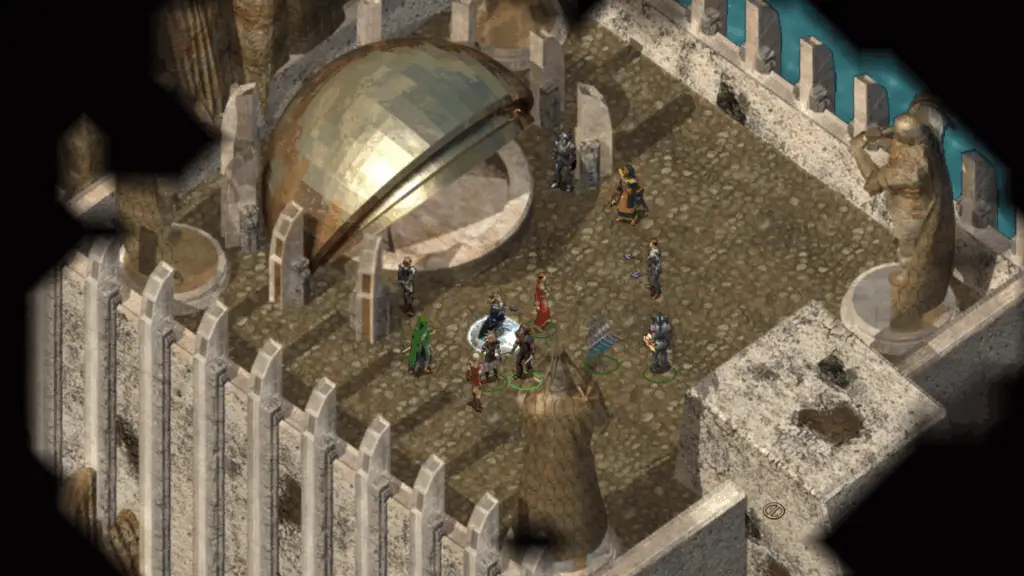
In 1998, Baldur’s Gate redefined what a computer RPG – and video game interpretation of the D&D ruleset – could be. Just two years later, Baldur’s Gate 2 expanded on its predecessor so much that development nearly ballooned out of control. This is the story of one of the most influential and ambitious RPGs ever made, a title that continues to inspire developers and tech enthusiasts, as we explore on Digital Tech Explorer. Many great RPGs are etched into the popular imagination by their beginnings, those tentative first steps in a new fantasy world that tease the vastness ahead and the freedom to carve your own path. The initial moments in Baldur’s Gate 2 are one of those unforgettable experiences. After a tough opening sequence escaping the wizard Irenicus, players emerge into Waukeen’s Promenade, the bustling trading hub of Amn’s central city of Athkatla. Surrounded by golden minarets, it’s a vibrant tapestry of traders and thieves, rich and poor – a filthy yet captivating snapshot of urban plenitude, brought to life through pioneering digital storytelling.
Within this single district, players encounter a circus leading to a pocket dimension, a shop selling goods from different planes of the Forgotten Realms, and all manner of peddlers and big personalities. Beyond this, it’s revealed to be just one of seven districts in Athkatla, which itself is merely one of several regions in the nation of Amn available for exploration. Even 25 years on, that sense of boundless opportunity remains exhilarating for many in the gaming community. The nation of Amn – a blend of Venetian merchant republic and Constantinople-like cultural crossroads – was largely uncharted territory in the D&D universe. This was precisely why Bioware selected it for the game’s setting, as lead designer Kevin Martens explains. “We deliberately chose a part of Faerûn that was not well explored so that we could do what we wanted,” he says. “Forgotten Realms has all sorts of adventure hooks, and we wanted to use those and fill something out without stepping on anyone else’s toes.” Setting the game in Amn provided Bioware with a creative blank slate within the D&D context, unleashing a Pandora’s Box of design freedom that proved almost impossible to fully contain.
Opening the Floodgates of Innovation
Following the significant success of the original Baldur’s Gate in 1998, Bioware immediately commenced work on its sequel. Several factors contributed to its blisteringly fast initial development. Firstly, Bioware had already built the robust Infinity Engine, a foundational piece of software that eliminated much technical legwork. This allowed the team to really focus on the creative design aspects of the game. Producer Ray Muzyka outlined an ambitious feature list for the sequel that included character relationships on par with Final Fantasy and the inclusion of all the famous D&D monsters. This outline truly reflected the maximalist approach guiding the creation of Baldur’s Gate 2. “We were putting all the fantasies that we had into the game,” says Martens. “What were our favourite parts of all of our childhood campaigns? What were our favourite parts of every fantasy book we’d read, of Temple of Elemental Evil. We were just stuffing it all in,” a testament to the passion that drives much digital innovation.
The sequel quickly took shape as a veritable toybox of D&D adventuring – a “D&D Greatest Hits” collection bundled into a plot that followed directly from the original. While the primary goal was to retrieve your half-sister Imoen and your soul from the dastardly Irenicus, along the way you could confront vampiric clans in hieroglyph-adorned tombs, get embroiled in a conflict between two mafia-like ruling families in the City of Trademeet (being held to ransom by a faction of genies), or even become a feudal overlord on your own country estate. The sheer density of the world was matched by the depth of its writing. The number of recruitable companions decreased for Baldur’s Gate 2 (from 25 to 17), but each character now boasted fleshed-out motives and histories, along with unique relationships with the player and each other. Lukas Kristjanson, designer and writer for the game, and key writer for Jaheira’s quest, recounts, “Baldur’s Gate 2 was something like 1.8 million words. I think Jaheira’s word count in BG2 was more than all 24 companions in BG1 combined.” Such meticulous detail underscores the dedication to tech storytelling that makes games so engaging.
The quest for Jaheira – straight-talking Harper and co-icon of the series alongside perennial hamster pal Minsc – would prove to be a microcosm for Baldur’s Gate 2‘s development: expansive almost to breaking point. She not only had the most dialogue, but also an elaborate personal quest which Kristjanson merged with her romance quest. This meant that if the player romanced Jaheira, it could directly affect the outcome of her personal narrative. Quest design was significantly facilitated by new tools that allowed writers to effectively script their own scenes. “We had a visualization tool called Dotty which would draw the conversation in bubbles,” says Kristjanson. “If you got it right, it looked like the Crystalline Entity from Star Trek, just beautiful, but if you’re a dumbass like me and plug Jaheira into it, it just breaks the machine.” The tool simply couldn’t handle the complex timings resulting from merging Jaheira’s companion quest and romance, and there was no time to fix everything. “By the end of the project, James [Ohlen] put a sign on his door saying, ‘If it’s about Jaheira, don’t knock,’” Kristjanson remembers. “I’ve been paying the karmic debt for that for decades.” This was just one of many instances where powerful software tools and efficient pipelines gave designers so much freedom that they’d become overambitious with the power at their fingertips, a common challenge in large-scale software projects.
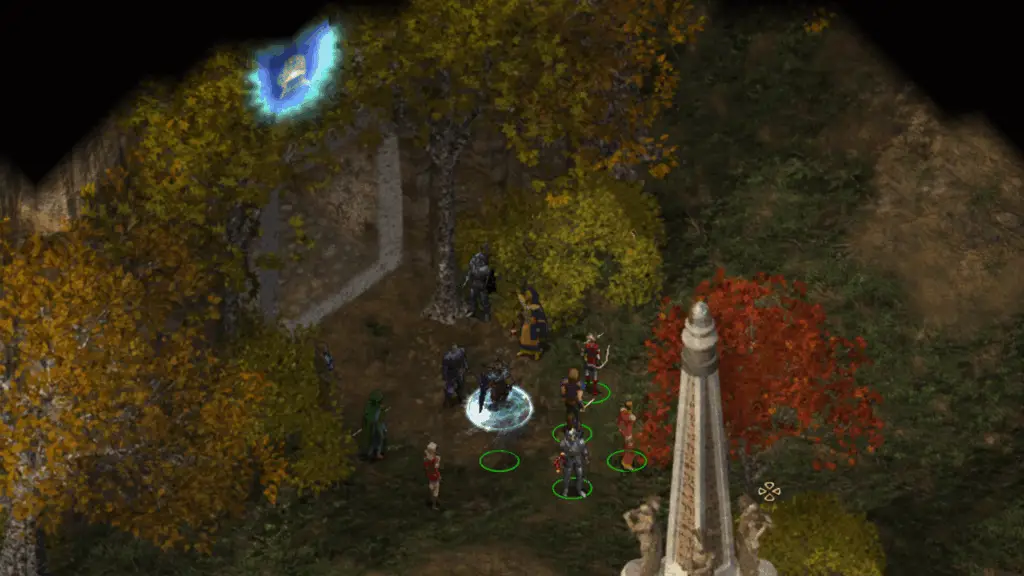
While romance feels like a near-necessity in modern RPGs, at the time of its development, it was a largely alien concept, as designer and writer David Gaider explains. “The whole romance thing was just an experiment, like James had no idea that anybody would even like this,” says Gaider. “We were writing these long stories, and they were cool, but romance? It was like, ‘People don’t come here to romance, they come here to fight shit and battle dragons!’” Gaider also insisted to Ohlen that “he was not a romantic guy” and tried to get off the hook from writing companion romances. “Of course James said, ‘No,’” says Gaider, and he was ultimately tasked with writing the romance for Anomen, the entitled, arrogant cleric that many loved to hate. Gaider was also lined up to write romances for companions Valygar and Haer’Dalis, but due to general wariness around how well romances would be received by the audience, as well as the headaches caused by Jaheira’s romance, they were eventually dropped. Narratively, trauma was a driving force for Baldur’s Gate 2‘s wayfaring characters and their arcs – a storytelling device that continues to be influential in RPGs to this day. These weren’t just archetypal D&D heroes, but individuals grappling with serious personal struggles. Almost every character was tinged with a humanizing pathos—a remarkable feat for a studio of 20-somethings that Gaider described as a friendly frat house. “I don’t know how we were able to be so subtle in our storytelling,” says Martens. “But it’s cool that we figured it out.” Merging all the disparate snippets and side-quests of the game into a cohesive whole was a monumental challenge. When asked how this was achieved, Gaider simply laughs, “I don’t know, is it cohesive?” This pioneering approach to character depth and interaction set new benchmarks for digital storytelling in gaming.
Mastering the Digital Dungeon
Gaider arrived on Baldur’s Gate 2 from the hotel industry, based on his stellar reputation as a master Dungeons & Dragons DM in the local area. Despite not having any prior video game experience, his DM background provided a strong baseline for cRPG storytelling, a fascinating example of how diverse skills can inform digital innovation. “With games, you don’t know what the player’s thinking, but you can throw hooks of various things that might interest them and guide them down the path you want with little bread crumbs,” he explains. “And that’s exactly what you do as a DM, right? You’re trying to imagine how different types of players would approach the same thing.”
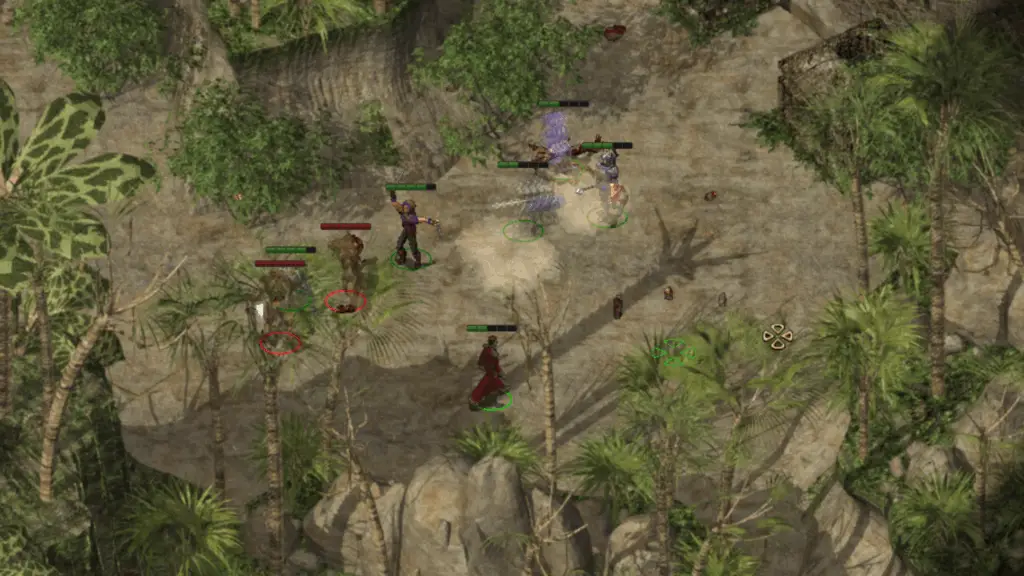
Around half of Baldur’s Gate 2‘s expansive content is contained within chapter two (out of seven), where the solitary main quest goal is raising 20,000 gold to secure aid from the Thieves’ Guild (or, alternatively, the vampires). While that structure might seem simplistic by today’s sophisticated standards, it masterfully allowed the player to inhabit the world and forge their own path through whatever means they chose. Whether venturing into the wilderness for classic dungeoneering or making a name for oneself in Athkatla’s underground fighting circuit, the choice was entirely up to the player. “As a hook, the 20,000 gold pieces thing was kind of lame, but as a system that supported narrative I think it was really good,” says Martens. “You have absolute freedom but you’re still accomplishing the critical path, which is hard to do.” This design principle is a valuable lesson for developers creating open-world experiences.
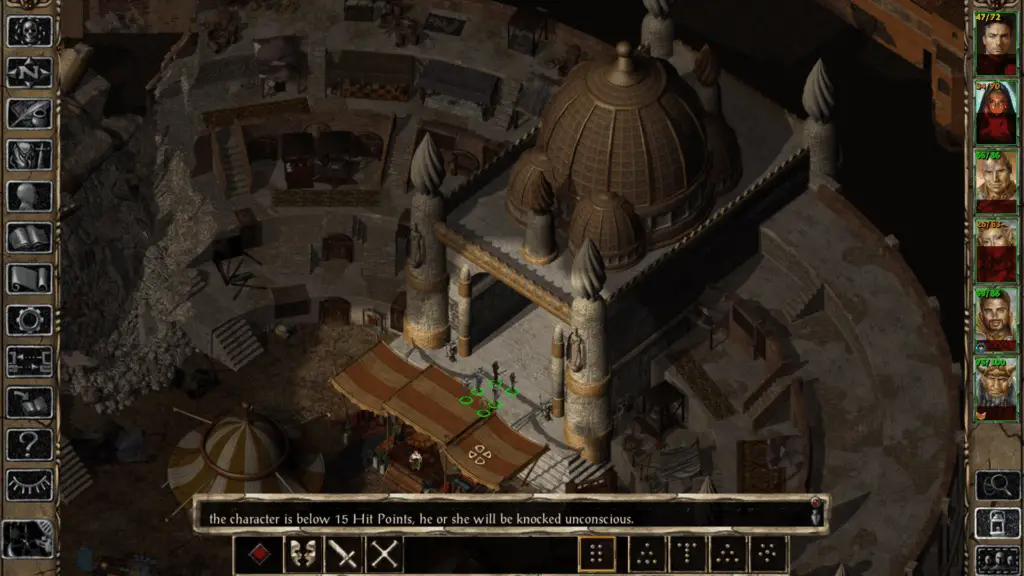
This remarkable structure, where a significant portion of the game’s content was concentrated early on, occurred almost by accident, according to David Gaider. It was a direct result of the all-in approach to development that loaded Baldur’s Gate 2 with content in chapter two, before transitioning into a more linear adventure in subsequent chapters. “It was like a snake swallowing a house,” says Gaider. “Chapter two was so monumental, it was all growing exponentially and if we’d continued like that I assume that game would’ve crashed.” Yet, at the time, the designers didn’t fully grasp the game’s excessive growth; in fact, they felt the opposite. “I remember conversations about it being too short,” Martens begins. “We were worried there wasn’t enough there, which is ironic given the 240-hour play time,” he adds. “I think if we’d had a tight 200, it’d still have been a pretty good game.” This anecdote highlights the challenges of scope management in large software projects, a pertinent lesson for developers today.
As release loomed, the production needed intervention, and Black Isle Studios’ Feargus Urquhart was drafted in to bring the rampant scope creep under control. “I went to Brian [Fargo, Interplay CEO] about six months before BG2 was supposed to come out and asked him, ‘so how important is it that BG2 ships for Christmas this year (2000)?” says Urquhart. “He said, ‘Well, we might not all have jobs next year if it doesn’t.’ My response was, ‘Ok, well I guess I’m spending a lot of time in Edmonton over the next six months!’” Urquhart famously filled the Bioware corridor with whiteboards, with every quest on it having two Xes. “The first was the designer says the quest is done and ready to test, the second was QA says the quest has been tested and has no bugs,” Urquhart explains. “If QA found a bug, they would put the X back under the designer column.” Inevitably, many Xes remained unmarked, which meant that the cutting axe started coming down on quests and romances deemed too buggy or secondary to what was absolutely needed to get the game out the door. “There was this spider cult quest, and we got rid of the entire thing,” says Gaider. “There was a bit of uproar because everybody loved it so much.” Such tough decisions are a part of the transparency and real-world testing that go into delivering high-quality digital products.
Unsurprisingly, crunch time blighted development in those final weeks – people sleeping in the office, shambling pyjama-clad around the building to get the game finished. Martens recalls a rebellion during this period over dinner being Domino’s Pizza every night; eventually, this was swapped out for Thai food, boosting both morale and nutritional intake on the team. “The crunch at the time was brutal,” says Kristjanson. “But it also came with a sense of, ‘Well, I own this, so if it’s going in it’s going in because I’m doing it.’ There were less random tasks assigned to whoever was available like you get today.” That powerful sense of ownership was a major motivator to get the game over the finish line, but some of the team began to lose confidence. “Suddenly the game felt like this hacked-up monstrosity that was still full of bugs,” says Gaider. “By the time it shipped, I think everybody on the team was like, ‘This is going to be horrible.’” This candid reflection offers valuable insights for developers and tech enthusiasts into the human side of major software releases, often detailed on platforms like Digital Tech Explorer.
Baldur’s Gate 2 went gold in August 2000, and then all that was left to do was await the verdict from the gaming public, with not only Bioware’s but publisher Interplay’s future depending on it. When it launched, Baldur’s Gate 2 was indeed a buggy behemoth as anticipated. And yet, despite everything, it was also a resounding triumph. Its myriad technical issues were drowned in a sea of quality writing and unrivalled D&D-flavoured adventuring, setting something of a precedent for future buggy-but-brilliant RPGs like The Elder Scrolls and even the acclaimed Baldur’s Gate 3. It decisively set video game RPGs on the path towards intimate, companion-driven storytelling, and established the Bioware formula that would find future success in Mass Effect and Dragon Age. This game remains a critical piece of gaming history, inspiring countless developers and solidifying its place in the evolution of PC games.
“To this day, I will ask the gameplay guy, the programmers, the senior guys, ‘What do you want to see in this thing?’ and write to that,” says Kristjanson. “If I’m just telling someone I’m making something, what ownership can they have of that? Ownership is vital to games having a heart to them.” The development of Baldur’s Gate 2 was like an archipelago where each designer presided over their own set of islands, with ideas and inspiration flowing freely between them. From the Copper Coronet with its seedy underbelly, to the sewers containing cult hideouts, from fetishistically designed Drow cities to the grimy, lively streets of Athkatla, every corner of this iconic RPG teems with storytelling. Each narrative was meticulously crafted by talented developers determined to leave a bit of themselves in the game. Yes, it almost split at the seams, but the final product became a perennial codex that RPG developers will always refer back to for lessons in design and immersive storytelling. Not only that, but 25 years on, it remains a timeless game in and of itself; an anthology of rich D&D stories orbiting around an intimate central plot, all bound together by a visual style that remains soothing on the eyes even though conventions have long since moved on. Like a masterpiece Romantic painting, its quality and influence shine across generations, making it essential viewing for any tech enthusiast or aspiring game developer seeking to understand the roots of modern digital entertainment, a true testament to digital innovation that Digital Tech Explorer is proud to highlight.