
As an avid explorer of digital realms, I find nothing quite as engaging as an action-packed RPG that marries a great sense of fun and whimsy with surprising depth in its character progression. Obsidian Entertainment’s latest, The Outer Worlds 2, certainly fits the bill.
| What is it | A breezy first-person RPG set in a future that’s part raygun, part art deco. |
| Release date | October 29, 2025 |
| Expect to pay | $70/£60 |
| Publisher | Xbox |
| Developer | Obsidian |
| Reviewed on | RX 9070 XT, Core i5 12600K, 32 GB RAM |
| Multiplayer | No |
| Steam Deck | Unsupported |
| Link | Official site |
The Outer Worlds 2, Obsidian’s latest adventure, initially presented itself as a slow burn. However, a pivotal mid-game encounter transformed my perspective, solidifying its status not merely as a good role-playing game, but a truly excellent one.
The initial hours of the game built to a crescendo, culminating in classic Obsidian-style conversational boss battles. I found myself engrossed, navigating extensive lists of dialogue options—some readily accessible, others locked—each gated by distinct skills, character background traits, prior quest choices, and even a seemingly minor conversation from over ten hours earlier.
Since I had a significant investment in speech skills and had prioritized nonviolent resolutions whenever possible, I was able to pull off a satisfying "everybody lives!" conclusion to this mid-game climax. Comparing notes with PCG guides writer Sean Martin, who adopted a more trigger-happy playstyle, he was locked into a less fortunate path where somebody had to die, with the choice potentially locking him out of at least one ending and turning a companion hostile. This nexus of consequences and options, directly stemming from my prior choices and character development, represents the essence of what I seek in an Obsidian role-playing experience.
While the original The Outer Worlds was an enjoyable, smooth experience, it felt like a more approachable entry point for genre newcomers rather than a truly captivating adventure. The Outer Worlds 2, however, elevates the experience, presenting a more ambitious, complex, and surprising game that remains remarkably accessible for an expansive role-playing title.
While it may not match the standard-setting scale, simulation, or reactivity found in recent standout role-playing games like Baldur’s Gate 3, Kingdom Come: Deliverance, or Disco Elysium, The Outer Worlds 2 shines as a formidable action-RPG. Its intricate skill system, sharp writing, engaging quests, and thoughtful level design deeply impressed me, appealing to my appreciation for classic computer role-playing game depth.
Far Flung
The Outer Worlds 2 transports players to a new space colony, Arcadia, distinct from the Halcyon setting of the first installment. Here, the oppressive, collectivist, and technologically advanced Protectorate of Arcadia faces an invasion from the consolidated megacorp, Auntie’s Choice—a formidable entity born from the merger of two of the original game’s gleefully villainous corporations.
One cannot accuse The Outer Worlds series of subtlety. The sequel’s central conflict starkly pits two caricatured ideologies against each other: mandatory stints in government re-Neducation camps versus relentless 20-hour workdays with no bathroom breaks. This starkness led me to appreciate the more nuanced, thought-provoking conflicts found in prior Obsidian titles like Fallout: New Vegas, Pillars of Eternity, or even this year’s Avowed. Nevertheless, it adequately frames the stakes for The Outer Worlds 2‘s take on ‘Forbidden Planet’ style raygun swashbuckling, and the rich tapestry of human dramas and smaller conflicts sprinkled throughout proved genuinely compelling.
The companion system in The Outer Worlds 2 is another standout feature. Even Niles Abara, who initially appears as the archetypal ‘Nice Guy Human Warrior Starter Buddy’, offers an intriguing twist to his character. Tristan Rao, a hammer-wielding Judge Dredd-esque space cop, quickly captured my attention with his almost entirely capitalized dialogue. Another companion’s recruitment unfolds through a complex, spoiler-laden mission where their potential to join the crew is initially ambiguous, and inadvertently killing them is a distinct possibility.
This level of player agency is commendable, with multiple junctures where each companion’s loyalty can be tested, potentially leading them to abandon the crew or even turn hostile based on player decisions. The ensemble thrives on friction and clashing personalities—a dynamic I found sorely missing in last year’s Dragon Age: The Veilguard.
Crunch the Numbers
The Outer Worlds 2 achieves a notable feat by streamlining the original game’s role-playing system, resulting in a design that surprisingly offers even greater depth. Traditional attributes have been removed; instead, at character creation, players select positive and negative traits, a background, and designated tagged skills.
The game features 12 skills in total. Tagging a skill grants two immediate points, with an additional two points awarded at each level-up. This system creates a satisfying sense of meaningful constraint: unlike titles such as Fallout or Baldur’s Gate 3, it prevents players from min-maxing into universal competence, ensuring that every character build will inherently face certain closed opportunities.
The most potent perks—such as the one applying half of your sneak attack damage to regular melee attacks—demand significant skill investments. The same applies to the most impactful skill checks encountered in dialogue or during exploration. These static checks require a sufficient point investment, providing a definitive pass or fail rather than relying on dice rolls that could be circumvented through fortunate rolls or save-scumming.
A full pacifist playstyle should be possible without resorting to glitches.
My experience indicated that investing in four of the 12 available skills allowed me to comfortably meet the requirements for challenging checks and unlock the essential perks for my chosen build. Frequently, quest solutions or alternative routes were entirely inaccessible due to my character’s development, a design choice I find commendable. It imbues character building decisions with greater significance, ensuring a distinct experience across multiple playthroughs. Furthermore, The Outer Worlds 2 excels at presenting myriad solutions to a single problem: a demanding speech check might be bypassed by a specific trait or quest outcome, and locked doors often conceal alternate paths or discoverable keys.
Pursuing a sneaky, conversational character—specializing in stealth, lockpicking, speech, and melee weapons—I thoroughly enjoyed the experience. While not a Dishonored-level stealth simulator, the abundant secondary paths (often vents, but not exclusively), distraction tools, and dedicated sneaking gear all made this playstyle feel robust and powerful. I executed many effective sneak attack knife takedowns (the game lacks non-lethal weapons), yet from my observations, a complete pacifist playthrough appears achievable without exploiting glitches. While it might be occasionally unrefined and may restrict access to certain side quests and story options, it seems feasible and not overly tedious.
Flawed Hero
While the preceding mechanics demonstrate a well-structured and balanced approach, they don’t break entirely new ground. However, The Outer Worlds 2 introduces one genuinely surprising innovation: its refined Flaws system. This mechanic wasn’t particularly notable in the original title, and I had modest expectations for how much I would appreciate its revamped implementation.
Players are presented with the option to accept or reject a flaw upon reaching hidden thresholds based on their gameplay behavior. Examples include combat tactics, conversational choices, and item management (keeping, selling, or dismantling). Each flaw carries both a detrimental and a positive effect, potentially serving as a game-changer or even a game-ruiner. The system exhibits a genuine sense of humor and imaginative design in how it tracks and highlights player behaviors. It strikes me as a fascinating role-playing experiment, altering characters not only through deliberate player decisions but also by how they unconsciously navigate the game world.
I was able to stack enough bonus sneaking move speed to crouch-walk as fast as I sprint.
My personal favorite flaw, "Foot In Mouth Syndrome," is offered after consistently skipping dialogue lines. Accepting it grants a significant bonus to all experience points received, but introduces a countdown timer during dialogue choice selections. Failing to choose within the allotted time results in the game making the selection for you—a karmic punishment, perhaps, for those who frequently bypass conversations.
Consistently acquiring items from others while unobserved can unlock the "Kleptomania flaw," leading to random theft of nearby items in settlements and the inevitable confrontation with local authorities upon discovery. Conversely, embracing multiple flaws can lead to the "Flawed" option, which grants a bonus perk every five levels but compels you to automatically accept all subsequent flaws that arise.
Tactical Engagements and Performance
For those who delight in character optimization and buildcrafting, The Outer Worlds 2 offers a playground of possibilities. I personally achieved enough bonus sneaking move speed to crouch-walk at sprinting pace and selected abilities that made my combat knife hit harder than a two-handed space warhammer. The game provides a wealth of items and perks that allow non-combat skills to significantly contribute to damage output. The aforementioned sneak attack damage perk is a prime example, as is a distinctive purple void scythe that scales its power with the "Science!" skill. A particular highlight is the "Space Ranger perk," which gives a damage bonus based on your speech skill and unlocks dialogue options reminiscent of Zapp Brannigan.
In terms of its moment-to-moment combat, the experience will feel familiar to many. The Outer Worlds 2‘s action mechanics, when put to the test, are comparable to Fallout 4: significantly more refined than titles like New Vegas or Skyrim, yet still falling short of the pure action prowess of Cyberpunk 2077, or even Obsidian’s recent Avowed. While firearms deliver satisfying feedback, melee weapons often feel imprecise and sluggish. This is somewhat mitigated by the impactful heft of chunky two-handed weapons or the absurd spectacle of a seemingly modest knife slash obliterating a miniboss’s health bar thanks to a meticulously optimized character build.
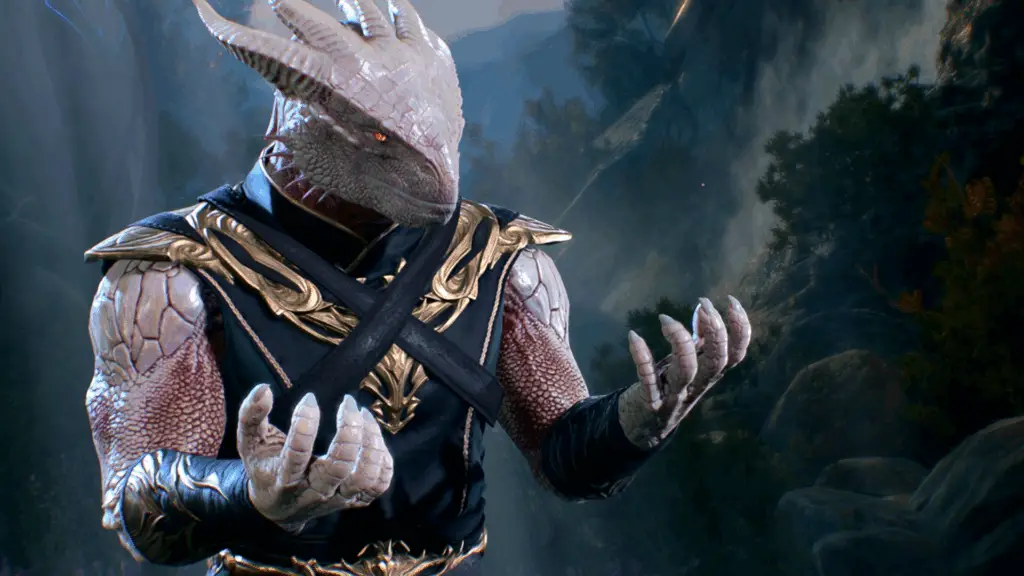
This role-playing game also exhibits a pronounced reverse difficulty curve, leading to uneven challenges. The initial hours were quite challenging, particularly as I began on a higher difficulty setting influenced by an easy demo experience. After several hours, and having adjusted to Normal difficulty, I became such a highly effective combatant that I felt compelled to increase the difficulty once more. However, around the 25-hour mark, I encountered a new species of formidable lizard-gorillas on a later planet, capable of one-shotting my character and proving tougher than most boss encounters.
While generally a stable experience, a few bugs unfortunately marred the experience somewhat. The Outer Worlds 2 performs "good for an Unreal Engine 5 game" rather than simply "good." One of the most disruptive glitches occurred when my companion Tristan spawned underneath the map on my ship, preventing me from concluding a quest. This issue persisted even after reloading saves or leaving and returning to the area. I even observed other companions engaging in one-sided ghost conversations with the absent Tristan, their pleas met with silent subtitles. Fortunately, a combination of repeatedly loading older and newer saves eventually dislodged him from this digital void.
Another significant technical frustration stemmed from inconsistencies in enemy aggro and detection, particularly pronounced when playing a stealth build. Occasionally, entire groups would become alerted to my presence seemingly out of nowhere, or enemies would spawn already aggressive after I had painstakingly navigated past an entire room. There’s also a settlement on the first planet that only plays a role in a diverging critical path I did not pursue; attempting to sneak in from the rear to explore what I missed invariably alerted the entire base, filling my screen with a barrage of detection warnings.
While these are present, they represent an acceptable level of role-playing game eccentricities—annoyances, some of which may yet be addressed post-launch—that ultimately don’t sully the overall experience. The Outer Worlds 2 may not be an immediate Obsidian all-timer, but it stands as one of the year’s best gaming experiences and an RPG I’ll eagerly revisit. While some of its balance and mechanical quirks can be frustrating, especially early on, enduring them is undoubtedly rewarding.
Some of the links on Digital Tech Explorer are affiliate links. This means we may earn a commission if you click through and make a purchase, at no additional cost to you. Our recommendations are based on thorough research and personal experience.