At Digital Tech Explorer, we’re always tracking the advancements that redefine the tech landscape. Apple’s M-series chips have consistently pushed boundaries, and their latest M5 silicon continues this trend, doubling the single-core performance of their in-house processors in just five years. While initial projections for the M5 iPad Pro hinted at a Geekbench 6 single-core score of 4100, our in-depth analysis of a 14-inch
M5 MacBook Pro revealed an impressive 4310. This result not only met but exceeded expectations, positioning it ahead of many leading desktop processors, including the
AMD Ryzen 7 9800X3D (3332), the Core i9 14900KS (3238), and the
Core Ultra 9 285K (3214). It appears Apple’s assertion of the M5 delivering the world’s best single-core performance is indeed well-founded.
Unpacking the M5 Processor: Architecture, Graphics, and Gaming Potential
For seasoned tech enthusiasts and developers, understanding the architecture behind these chips is key. Unlike the discrete Radeon cards once common in desktop Macs, current M-series processors, including the M5, leverage integrated graphics cores exclusively. Apple’s strategy for achieving formidable performance in its more powerful machines involves aggregating multiple chips to increase core count, effectively optimizing graphics output. Our review focuses on the standard
M5 MacBook Pro, specifically the 14-inch model configured with 32 GB of RAM and a 4 TB SSD. While these memory and storage upgrades enhance overall system responsiveness, they do not directly impact the graphics processing unit’s core power. The laptop’s visual prowess is further supported by its stunning Liquid Retina XDR screen – an IPS panel with mini-LED backlighting, a 120 Hz max refresh rate, 3024 x 1964 resolution, and nearly full DCI-P3 wide-color gamut coverage, ensuring an immersive experience for both work and play.
Delving deeper into the M5’s specifications, this iteration of Apple Silicon is a 10-core model, thoughtfully designed with four performance cores and six efficient cores. Complementing this is a robust 10-core integrated GPU. Fabricated by TSMC using an advanced 3 nm process, the M5 is versatile enough to be passively cooled in devices such as the iPad Pro. However, within the MacBook Pro, Apple has ingeniously integrated a fan and a heat pipe system. This thermal management allows the System on a Chip (SoC) to sustain peak performance by reaching temperatures up to 99 °C under demanding workloads, ensuring consistency for professionals and gamers alike.
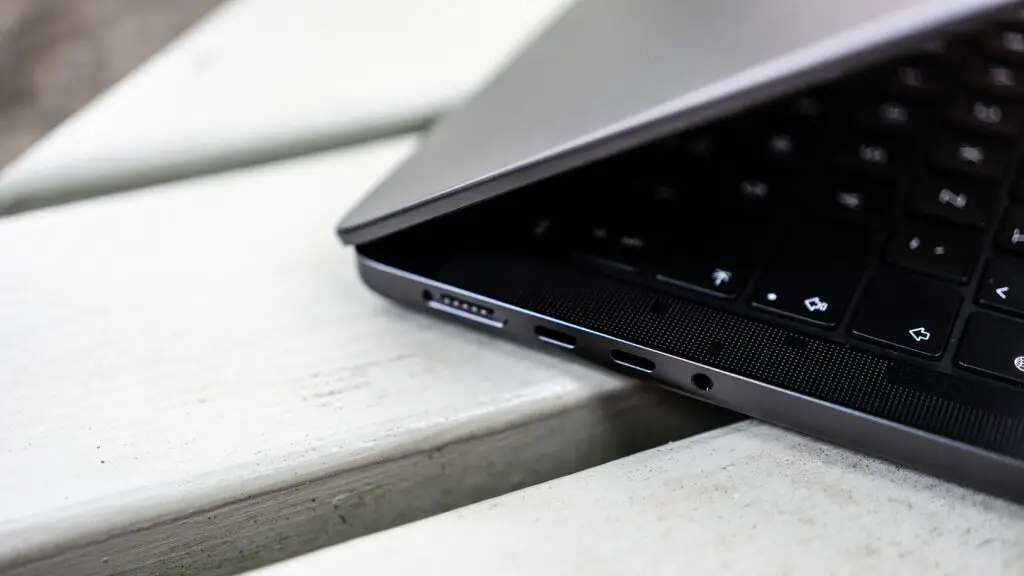
A key innovation within the M5 GPU is its new architecture, which integrates a neural accelerator directly into every core. Apple proudly states this delivers a fourfold increase in AI performance compared to its predecessor, the M4 – a crucial advancement for machine learning and AI acceleration, topics we frequently cover here at Digital Tech Explorer. Furthermore, this generation boasts an impressive boost in the SoC’s memory bandwidth, now reaching 153 GB/s, marking a significant 30% jump over the M4. Building on features introduced with the M3, Apple Silicon continues to utilize Dynamic Caching, a proprietary technology that allows the GPU to dynamically allocate memory resources in real time, ensuring only what’s truly needed is used. This intelligent memory management not only optimizes average GPU utilization but also directly contributes to enhanced performance. Coupled with drive speeds now exceeding 6,000 MB/s for both read and write, potential performance bottlenecks stemming from paging to the SSD are effectively minimized, ensuring a smooth and responsive user experience.
The M5’s graphical prowess is significantly amplified by Apple’s optimized Metal graphics API. Our tests reveal a stark contrast: in Geekbench, the GPU registered an OpenCL score of 48,665, placing it on par with a GeForce GTX 1650 Ti. However, when leveraging Metal, this score dramatically surged to 76,397, pushing its performance into the league of a GTX 1080Ti or RTX 2060 (in OpenCL terms). Apple further reinforces these gains, claiming a 30% general graphics uplift and a remarkable 45% improvement specifically in ray-tracing over the M4. For 3D animation professionals, the M5 delivers impressive results in the Cinebench 2024 test (based on Cinema4D), with its integrated GPU performing comparably to an RTX 4050. These figures demonstrate its robust capabilities for both creative work and demanding gaming, making it a compelling piece of hardware for developers and tech enthusiasts exploring new horizons.
M5 MacBook Pro: Real-World Gaming Benchmarks and Experience
To assess its real-world gaming capabilities, we put the
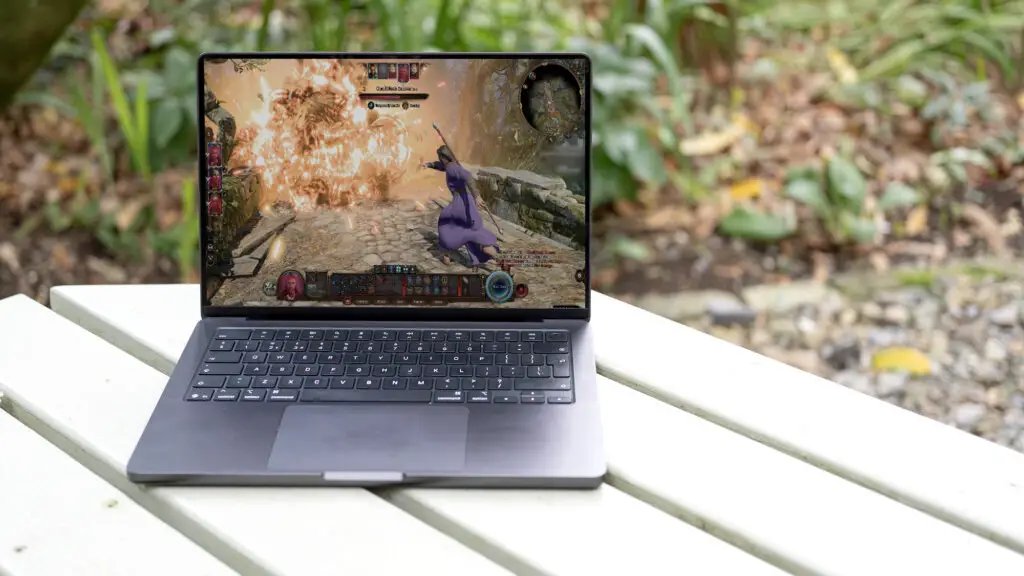
M5 MacBook Pro through its paces with Cyberpunk 2077. Initial results at 1900 x 1200 with Ray Tracing Ultra settings were, as expected for integrated graphics, a mere 11 fps. However, by strategically enabling Metal upscaling (Performance mode) and AMD FSR features, and then fine-tuning graphics quality to Ray Tracing Low, the frame rate impressively jumped to an average of 74 fps. Stepping up to Ray-Tracing Medium, it still maintained a very playable 58 fps. This is a truly remarkable achievement for integrated graphics, especially when weighed against the most powerful iGPUs on the PC side. For context, the AMD Z2 Extreme in the
ROG Xbox Ally X and the Lunar Lake Arc 140V iGPU typically hit around 53 fps and 55 fps respectively in Cyberpunk 2077 at 1080p with FSR or XeSS on plain Medium settings, crucially without the added burden of ray-traced lighting. The M5’s ability to handle ray tracing at such frame rates is currently unmatched by other integrated GPU solutions.
While these strong results paint a promising picture for the M5, a prevalent challenge for Mac gaming continues to be the relatively limited PC game library available on the platform. To provide a broader perspective on its capabilities, we also benchmarked the M5 with several older yet still demanding titles, offering a more complete “product review” and “detailed analysis” for our readers:
- Total War: Warhammer III: Testing this demanding strategy title, the M5-powered laptop managed 29 fps at 1920 x 1200 with Ultra quality settings and TAA. By reducing the resolution scale to 66%, performance improved to 51 fps. Achieving a consistent 60 fps at this resolution required “recommended” settings, which typically involved a mix of medium and low settings, FXAA, and a 100% resolution scale.
- Shadow of the Tomb Raider: The 2018 action-adventure ran at a smooth 57 fps at 1920 x 1200 on its highest settings with TAA, a performance level akin to a desktop GTX 1060 or Radeon RX 590. For comparison, a Steam Deck typically needs Low settings to achieve similar results. With a resolution modifier set halfway, alongside FidelityFX CAS and SMAAT2x, the M5 reached 74 fps, slightly outperforming a GTX 1070 at 1080p with SMAAT2x.
- Baldur’s Gate 3: This critically acclaimed RPG saw averages of 30 fps at 1920 x 1200 using the Ultra preset and TAA. Engaging FSR in Quality mode significantly improved this to 38 fps, delivering a perfectly playable and enjoyable experience for adventurers.
In conclusion, the M5 processor truly ushers in a new era for gaming on Mac. While previous generations often left users with ambiguous answers—ranging from “kinda” to “only if you’re willing to spend thousands”—on whether a Mac could genuinely be a gaming machine, this generation decisively crosses that crucial threshold. Developers and tech enthusiasts can now confidently experience ray-traced gaming at 60 fps, positioning the
M5 MacBook Pro as a superior option compared to devices like the Steam Deck or other
gaming handhelds, or any laptop solely reliant on integrated graphics. While the investment for such a powerful machine remains significant, it undeniably unlocks an exciting “secret life” for this professional laptop. The path forward for Mac gaming now primarily lies in expanding the native game library, potentially bolstered by innovative abstraction layers designed to
facilitate x86 games on Arm processors. This evolution perfectly aligns with our mission at Digital Tech Explorer to help you stay ahead of trends and make informed decisions in the rapidly advancing world of technology.
Disclaimer: Some of the links on Digital Tech Explorer are affiliate links. This means we may earn a commission if you click through and make a purchase, at no additional cost to you. Our recommendations are based on thorough research and personal experience.