
Meticulous Craftsmanship: Overcoming Hardware Challenges
The physical construction of this intricate desk continued to present significant challenges, demanding extraordinary precision and dedicated effort—a true test of a hardware engineer’s resolve. Fitting the desktop surround, designed to neatly interface with the hexagonal frames, proved to be particularly difficult. Once in place, the previously fitted hex frames no longer aligned perfectly, necessitating that each numbered frame be individually hand-tweaked to achieve the final, snug fit. Lining paper was ingeniously employed as spacers to standardize the minute gaps between frames. Next came the arduous task of drilling thousands of LED holes: all 3,720 holes, for both cells and pathways, were individually drilled by hand using a guide and punch method. This was followed by the meticulous fitting of more light-conducting rods for the pathway holes, again done by hand, and then covered with additional clear epoxy. A multi-stage sanding and leveling process ensued. Thousands of holes beneath were then filled with round and square acrylic pegs, which also required subsequent sanding. The desk’s bottom structure, including custom mounts for power, cables, and the integrated Raspberry Pi—a common choice for such custom hardware projects—was then built around an old IKEA metal frame, all custom-fit to the complex hexagonal layout, further highlighting the deep integration of technology into every aspect of the design.
Seamless Integration and the Final Reveal
The concluding stages of this ambitious desktop hive project involved a series of intricate finishing touches that underscored the monumental effort and engineering precision invested. Spacers were meticulously crafted to sit beneath the hex frames, providing custom slots for the cell PCBs, along with 130 additional spacers for the bee pathway PCBs. The top surface underwent an extensive final sanding and polishing regimen, progressing through grits from 180 up to a superfine 4,000, culminating in a special epoxy polishing compound application to achieve an almost glass-like finish for the cells – a detail that elevates the aesthetic to match the technological sophistication. The extensive electronics integration required a massive wiring effort, including approximately 700 individual solder connections, showcasing the scale of the hardware implementation. This incredible build process, which consumed over six months of dedicated labor, truly highlights the immense scope and tireless commitment behind the creation of this unique, interactive display.
The final result is a truly captivating and organic display of simulated beehive activity. The simulation runs in what approximates bee real-time, requiring a degree of patience from the observer, akin to the patience it took to build. Each run of the simulation is unique; sometimes the hive prospers and thrives, while at other times it quickly diminishes. As the creator from Full Stack Woodworking observes, while it’s a simplified copy of the complex and fascinating reality of bee behavior, “watching the hive at work is hypnotizing.” This extraordinary creation serves as a thoroughly charming distraction from the constant onslaught of information overload, offering a mesmerizing glimpse into a world of simulated natural harmony and demonstrating the power of integrating software and hardware to bring imaginative concepts to life. It’s a prime example of the kind of engaging digital innovation that both developers and tech enthusiasts can appreciate on Digital Tech Explorer.
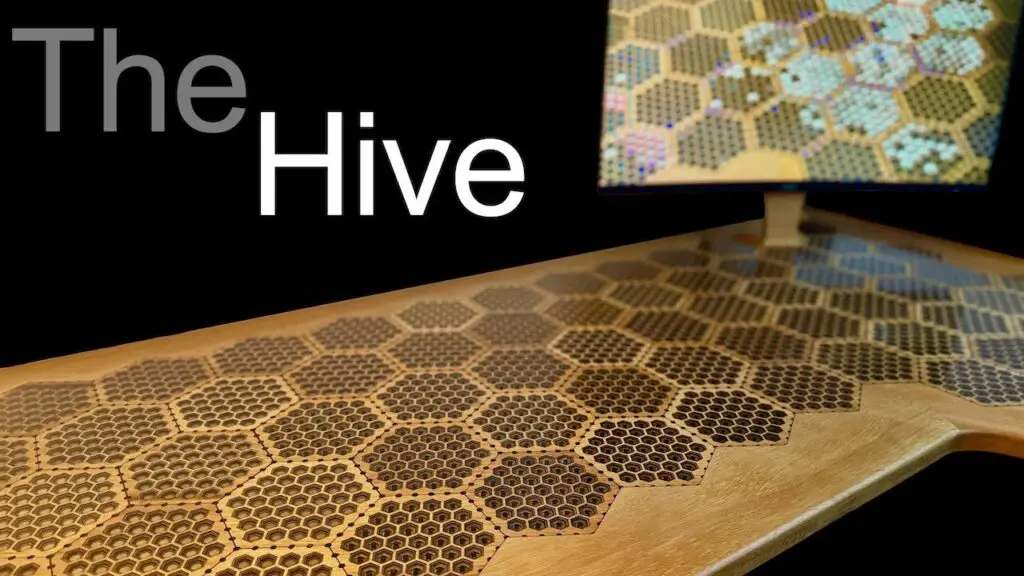
In a fascinating display of digital innovation and intricate craftsmanship, a project brought to our attention by TechTalesLeo, the YouTube channel Full Stack Woodworking embarked on a truly ambitious endeavor: to construct a desk that not only resembled a beehive but actively simulated its complex internal dynamics. What began as a captivating concept quickly “spiralled a bit,” as the creator notes, evolving into an incredible feat of engineering, custom software development, and meticulous artisanship. This remarkable beehive simulation desk, a prime example of hardware innovation, features 74 hexagonal frames, 44 of which house 37 active RGB cells. With a staggering 3,745 LEDs controlled by bespoke software, this ambitious project scaled to an impressive degree, seamlessly bringing a simulated living hive to your desktop and captivating tech enthusiasts with its intricate blend of nature and technology, a perfect fit for Digital Tech Explorer.
The Intricate Physical Construction: Marrying Craft and Digital Fabrication
The initial stages of this ambitious desk project were intensely labor-intensive, focusing on the creation of the hexagonal frames that form the core of the hive’s physical structure. Utilizing exquisite African hardwood, acrylic, and epoxy, the process began with preparing uniformly thin strips of wood, which were then precisely laser cut – a testament to modern digital fabrication techniques. Each of the 1,628 acrylic rods, critical for light transmission, was painstakingly hand-glued into place. The cells were then filled with clear epoxy and meticulously sanded flat to ensure a seamless surface level with the wood frame. The hex frames themselves were constructed from several laser-cut layers, a process so demanding that it required 222 different CNC operations to achieve perfect flatness and consistent thickness. This level of precision engineering and commitment is evident in the fact that creating just the top layer of the cell frames consumed 25 days, with the creator working three sessions daily.
The Digital Heartbeat: Electronics, Software, and AI-Driven Simulation
At the technological core of this desktop hive lies a sophisticated electronic and software system, a true testament to modern digital design. The desk incorporates custom-built PCBs, featuring individual LEDs strategically positioned beneath each hex frame to illuminate the cells, complemented by an additional 130 PCBs dedicated to illuminating the bee pathways. To orchestrate this complex, dynamic display, the creator at Full Stack Woodworking developed bespoke Python-based software. This program elegantly simulates a realistic bee colony, assigning specific roles and behaviors to different bee types: the queen bee lays eggs in empty cells, attendant bees fetch food for the queen, nurse bees feed the eggs until they hatch, and forager bees venture out to gather food for storage. The visual representation of this intricate simulation is achieved through RGB LEDs. Each cell’s LED activates when in use, and multiple colors from a second RGB LED indicate the cell’s current status and bee activity. Similarly, the pathway LEDs are RGB-lit to visually signify the type of bee currently in transit, bringing the hive’s internal dynamics to life and showcasing advanced simulation capabilities.
Meticulous Craftsmanship: Overcoming Hardware Challenges
The physical construction of this intricate desk continued to present significant challenges, demanding extraordinary precision and dedicated effort—a true test of a hardware engineer’s resolve. Fitting the desktop surround, designed to neatly interface with the hexagonal frames, proved to be particularly difficult. Once in place, the previously fitted hex frames no longer aligned perfectly, necessitating that each numbered frame be individually hand-tweaked to achieve the final, snug fit. Lining paper was ingeniously employed as spacers to standardize the minute gaps between frames. Next came the arduous task of drilling thousands of LED holes: all 3,720 holes, for both cells and pathways, were individually drilled by hand using a guide and punch method. This was followed by the meticulous fitting of more light-conducting rods for the pathway holes, again done by hand, and then covered with additional clear epoxy. A multi-stage sanding and leveling process ensued. Thousands of holes beneath were then filled with round and square acrylic pegs, which also required subsequent sanding. The desk’s bottom structure, including custom mounts for power, cables, and the integrated Raspberry Pi—a common choice for such custom hardware projects—was then built around an old IKEA metal frame, all custom-fit to the complex hexagonal layout, further highlighting the deep integration of technology into every aspect of the design.
Seamless Integration and the Final Reveal
The concluding stages of this ambitious desktop hive project involved a series of intricate finishing touches that underscored the monumental effort and engineering precision invested. Spacers were meticulously crafted to sit beneath the hex frames, providing custom slots for the cell PCBs, along with 130 additional spacers for the bee pathway PCBs. The top surface underwent an extensive final sanding and polishing regimen, progressing through grits from 180 up to a superfine 4,000, culminating in a special epoxy polishing compound application to achieve an almost glass-like finish for the cells – a detail that elevates the aesthetic to match the technological sophistication. The extensive electronics integration required a massive wiring effort, including approximately 700 individual solder connections, showcasing the scale of the hardware implementation. This incredible build process, which consumed over six months of dedicated labor, truly highlights the immense scope and tireless commitment behind the creation of this unique, interactive display.
The final result is a truly captivating and organic display of simulated beehive activity. The simulation runs in what approximates bee real-time, requiring a degree of patience from the observer, akin to the patience it took to build. Each run of the simulation is unique; sometimes the hive prospers and thrives, while at other times it quickly diminishes. As the creator from Full Stack Woodworking observes, while it’s a simplified copy of the complex and fascinating reality of bee behavior, “watching the hive at work is hypnotizing.” This extraordinary creation serves as a thoroughly charming distraction from the constant onslaught of information overload, offering a mesmerizing glimpse into a world of simulated natural harmony and demonstrating the power of integrating software and hardware to bring imaginative concepts to life. It’s a prime example of the kind of engaging digital innovation that both developers and tech enthusiasts can appreciate on Digital Tech Explorer.