
Welcome, fellow tech explorers, to a journey into gaming’s rich past, brought to you by TechTalesLeo here at Digital Tech Explorer. While modern engines like Unreal Engine 5, Unity, and Anvil dazzle us with graphical prowess, I invite you to look back to a time when imagination reigned supreme: the ’90s. Back then, for a truly immersive world, there was one definitive destination: Multi-User Dungeons (MUDs).
Frankly, my contention is that for all our modern graphical horsepower, that’s still the case.
Sacred texts
MUDs, if you’re not familiar, are large, shared, entirely text-based worlds where everything is conducted by the input and output of text. Think of them as massively multiplayer command lines, a foundational form of online interaction. Want to go somewhere? Prepare to type GO NORTH, GO NORTHWEST, GO NORTH, GO NORTHEAST ad nauseum until you reach your destination. PvE might consist of you typing KILL until the deed is done, pausing intermittently to input whatever the appropriate verb is for healing. As for PvP? Likely a terrifying arms race of custom-made combat scripts based on an ever-shifting sea of variables.
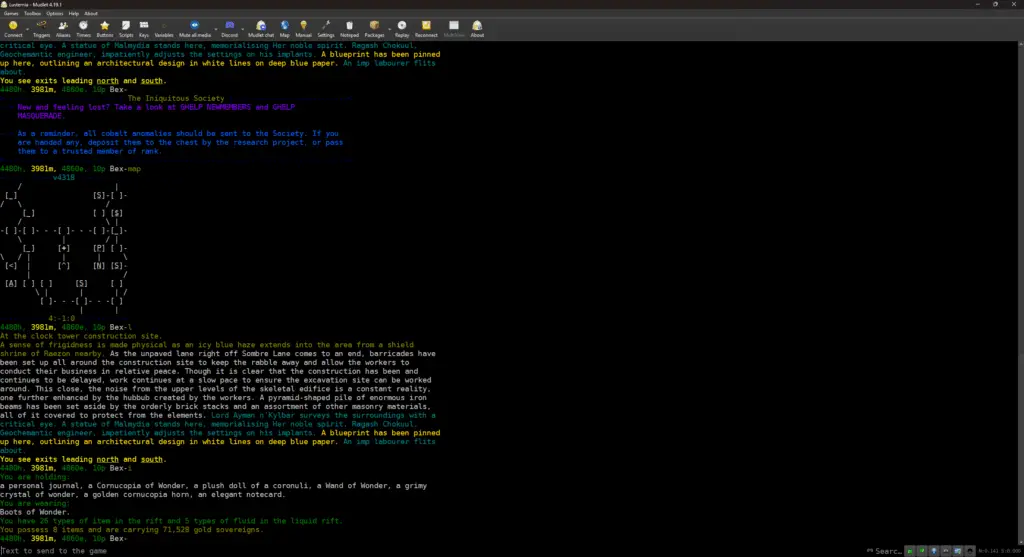
They’re complex, in other words. But despite that, it was a MUD—the immersive text-based RPG Achaea—that got its hooks into me at the tender age of 13. Not WoW, not EverQuest, not anything else. Achaea was my main game for years, but I moved on to others: the fantasy MUD Lusternia, the roleplaying game Aardwolf, a brief flirtation with the Discworld MUD, and so on.
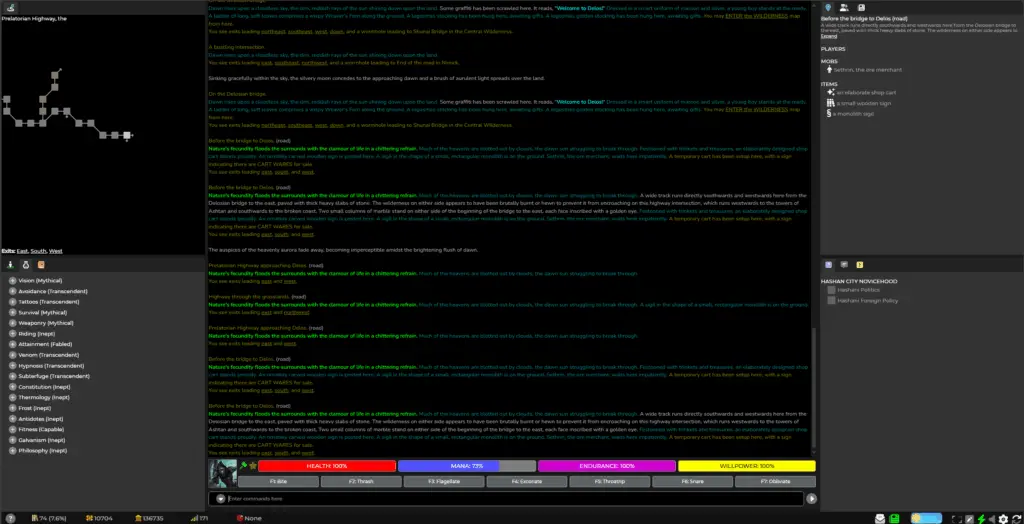
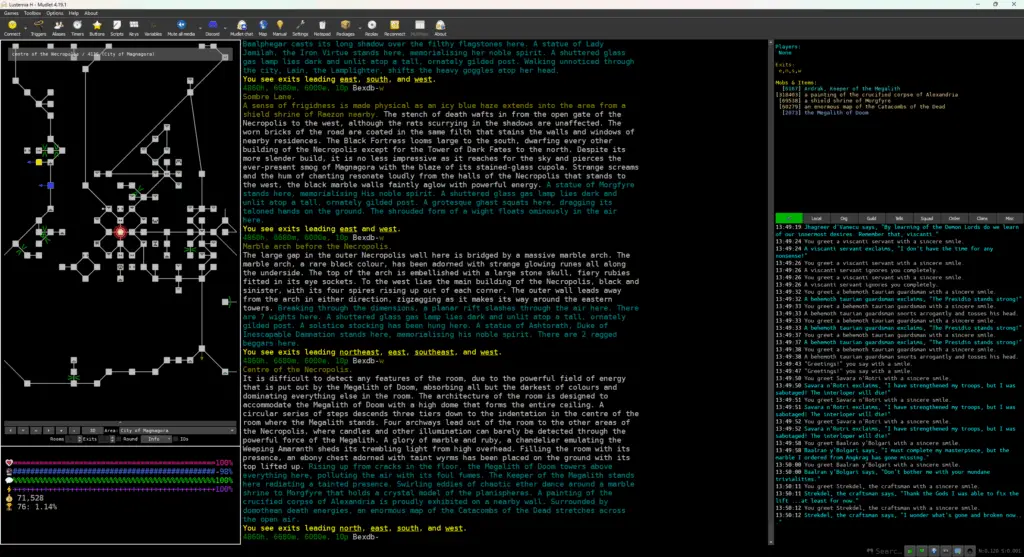
The ‘why’ of it is simple: more than any graphical MMO, these games captured the true spirit of tabletop roleplaying—where the gaps in presentation left by dry stat sheets and dice rolls must be filled by your own vibrant imagination. MUDs were (and are) pure imagination fuel. Their rudimentary, text-based presentation left enormous room for players to craft their own narratives and experiences. The beauty of text-driven interaction, from a software perspective, is its efficiency: there’s very little you can’t express, and expressing it takes minimal processing or development time, fostering endless possibilities.
In my heyday, the meat of what I got up to in the MUDs I played didn’t consist of relentlessly grinding dev-authored quests; it took place in all the interstices the designers had left and that players had moved to fill. Being able to describe yourself any way you liked, to perform any action you could fit into a sentence, meant that players I knew made their living as travelling performers, as essayists on in-game lore, as politicians and diplomats. It is, in these circumstances, relatively easy to catch a dev’s attention and have them help you roleplay out some kind of in-game event. Perhaps you want to be an archaeologist making a momentous discovery: all you need is someone to type you up a new item, and maybe briefly inhabit a nearby NPC to act out the scene. And it really did look great, too. Your imagination is quite powerful, and good writing is timeless in a way no texture or lighting model ever will be.
Left on read
Alas, MUDs are on the downswing. In fairness, they’ve been that way since at least the late ’90s. They were dying even when I was first getting into them, slowly supplanted by MMOs which more closely resembled videogames and less resembled emacs. Where my favourites of yore once had playercounts in the hundreds, now they number in the tens. Some in the single-digits. Though some are doing quite well, I understand.
We’ll truly miss them if they ever go entirely, I believe. As technology advances to fill more and more of those gaps which we used to have to fill ourselves, our scope for player participation and mental investment in the worlds we spend thousands of hours in diminishes. For tech enthusiasts and developers, understanding the value of such foundational, player-driven experiences offers insights into the essence of interaction design. I’ve tried to get into the WoWs and SWTORs of the world, but none of the many characters I’ve made linger in my mind like the cadaverous freak I used to play in Achaea. If I’m going to take part in a massive online world, I want to feel like I have the capacity to shape it, if nowhere else than in my own mind.
Looking for more gaming insights? Explore related content on Digital Tech Explorer:
Upcoming Game Releases: Stay ahead of the curve
Best PC Games: Our curated favorites
Free PC Games: Discover top freebies
Top FPS Games: Master the finest gunplay
Essential RPGs: Embark on grand adventures
Best Co-op Games: Better together, always